23 Kitchen Window Ideas to Brighten and Upgrade Your Home
Your kitchen window does more work than any other window in your home. It controls how much natural light hits your prep space, how the room smells after you cook fish on a Tuesday night, and whether your kitchen feels like a bright, functional room or a dark box with appliances in it. Most homeowners ignore it completely until it breaks or looks embarrassing.
That stops today. These 23 kitchen window ideas give you specific window types, real product recommendations, honest price ranges, and the exact reasons each one works in a real kitchen. No vague Pinterest inspiration. No architect-level fantasy. Practical window ideas for real homes, real budgets, and real cooking lives.
1. A Classic Double-Hung Window Above the Sink
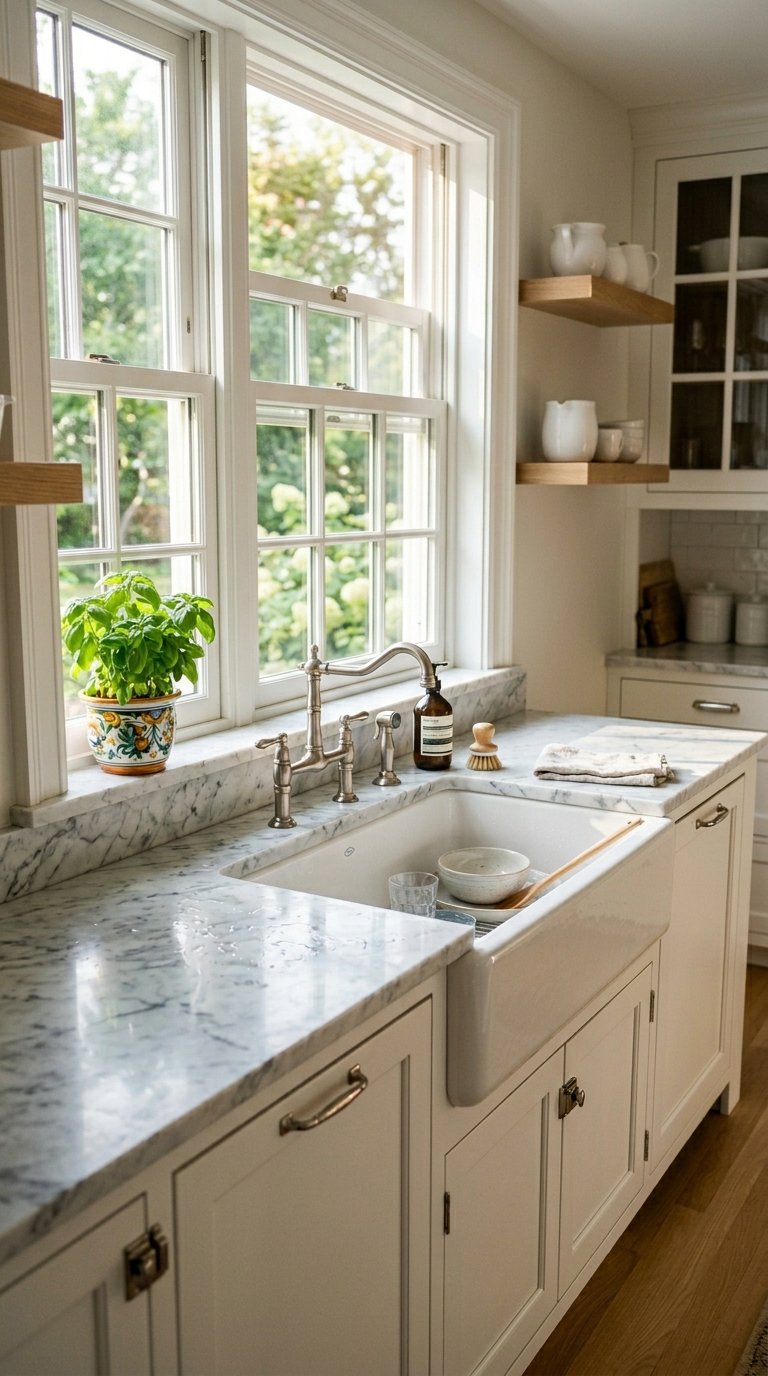
A double-hung window above the kitchen sink is the most functional placement in the room because it puts natural light directly over your primary work surface and gives you ventilation exactly where cooking odors and steam accumulate. The upper and lower sash both open independently, which lets you control airflow without letting rain in from the top.
Andersen’s 400 Series double-hung window in a standard 36×48-inch size costs $400 to $600 per unit before installation. The fiberglass-reinforced composite frame handles kitchen humidity without warping or swelling the way wood frames do over time. If you want the wood look without the maintenance, Andersen’s TruScene insect screen on the 400 Series is nearly invisible from inside, which keeps your garden view clear while the window sits open.
For a budget option, JELD-WEN’s V-2500 series double-hung vinyl window in the same size range costs $150 to $250 per unit at Home Depot. The performance gap between Andersen and JELD-WEN at this size is real but manageable for kitchens in mild climates. In high-humidity or extreme-temperature regions, spend the extra $200 and get the Andersen.
2. A Casement Window for Maximum Ventilation
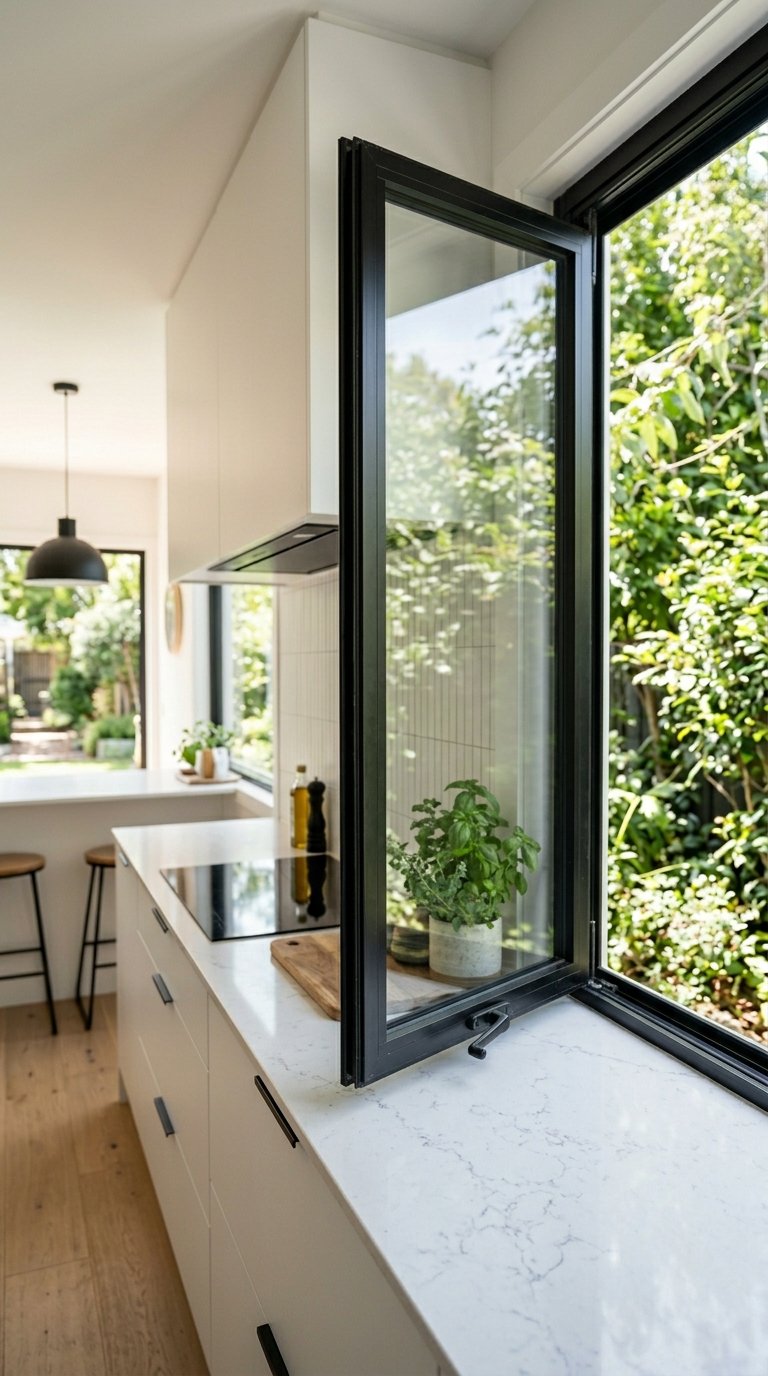
A casement window opens outward on a side hinge like a door, and that single design feature makes it the most ventilating window type available for a kitchen. It catches cross breezes and directs them into the room rather than letting air slide past a partially open sash the way double-hung windows do.
Pella’s 250 Series casement window in a 24×36-inch size costs $300 to $500 per unit. The between-the-glass blinds option on the Pella 250 Series puts the shade inside the insulated glass unit, which eliminates the cleaning problem that fabric blinds create in a cooking environment. No grease on the fabric. No dusting the slats. FYI, this is the single most practical window feature in a kitchen and most homeowners do not know it exists.
Casement windows require clear space outside the window for the sash to swing open, which rules them out above kitchen counters where a patio or pathway runs close to the exterior wall. Check your clearance before you order. A casement window that opens into a bush or a fence post stays closed permanently and you lose every ventilation benefit it offers.
3. A Picture Window for an Unobstructed Garden View
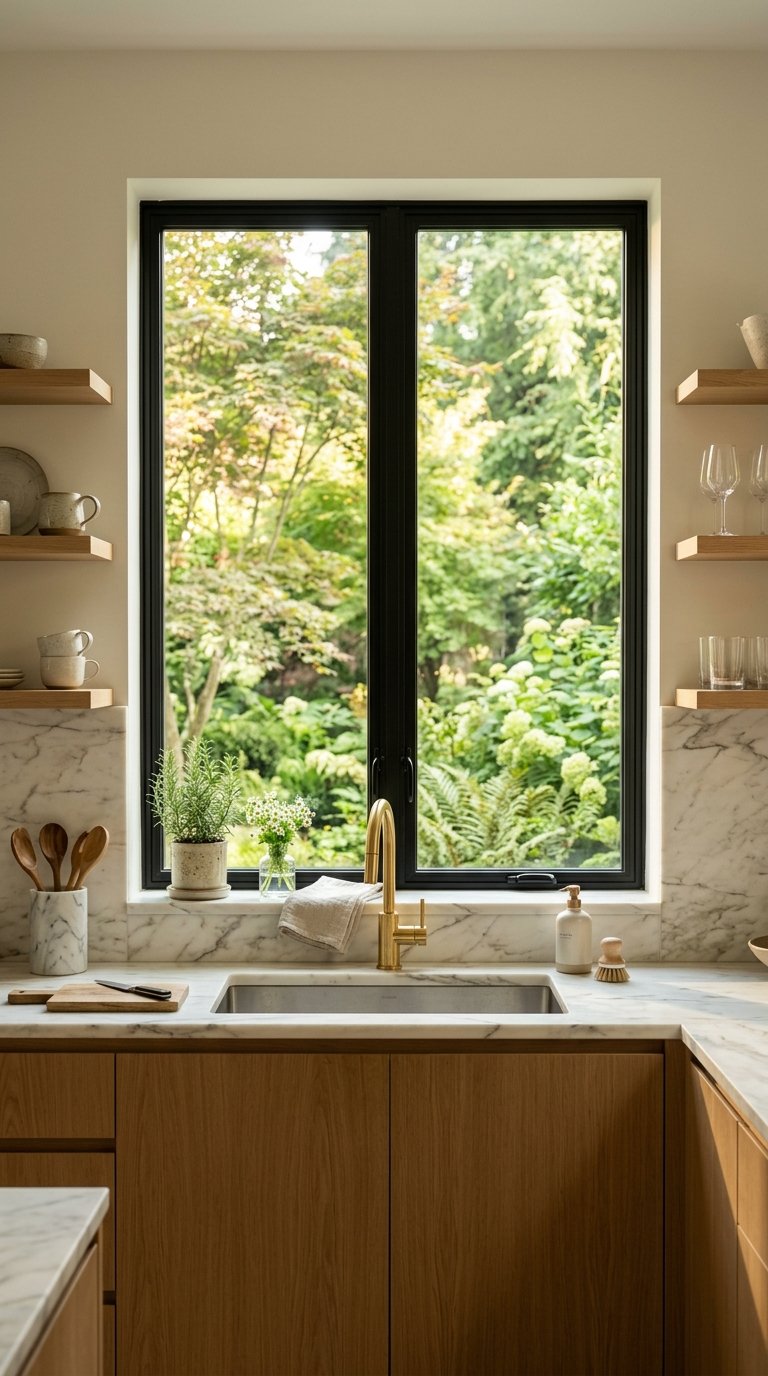
A picture window is a fixed, non-opening window that prioritizes the view and the light over ventilation. In a kitchen that faces a garden, a backyard, or a tree line, a large picture window transforms the room from a functional space into a room with a reason to stand at the sink.
Marvin’s Elevate picture window in a 48×60-inch size costs $800 to $1,400 per unit before installation. The Ultrex fiberglass frame on the Marvin Elevate line is eight times stronger than vinyl, which allows for larger glass areas with thinner frame profiles. Thinner frames mean more glass, which means more light and more view for the same rough opening size.
Pair a picture window with a smaller operable casement or awning window on an adjacent wall to maintain ventilation in the kitchen. A picture window alone leaves the room with no airflow option, which matters in a room where you cook every day. The combination of a large fixed picture window for the view and a smaller operable window for the breeze covers both functional needs without compromise.
4. An Awning Window Above the Counter
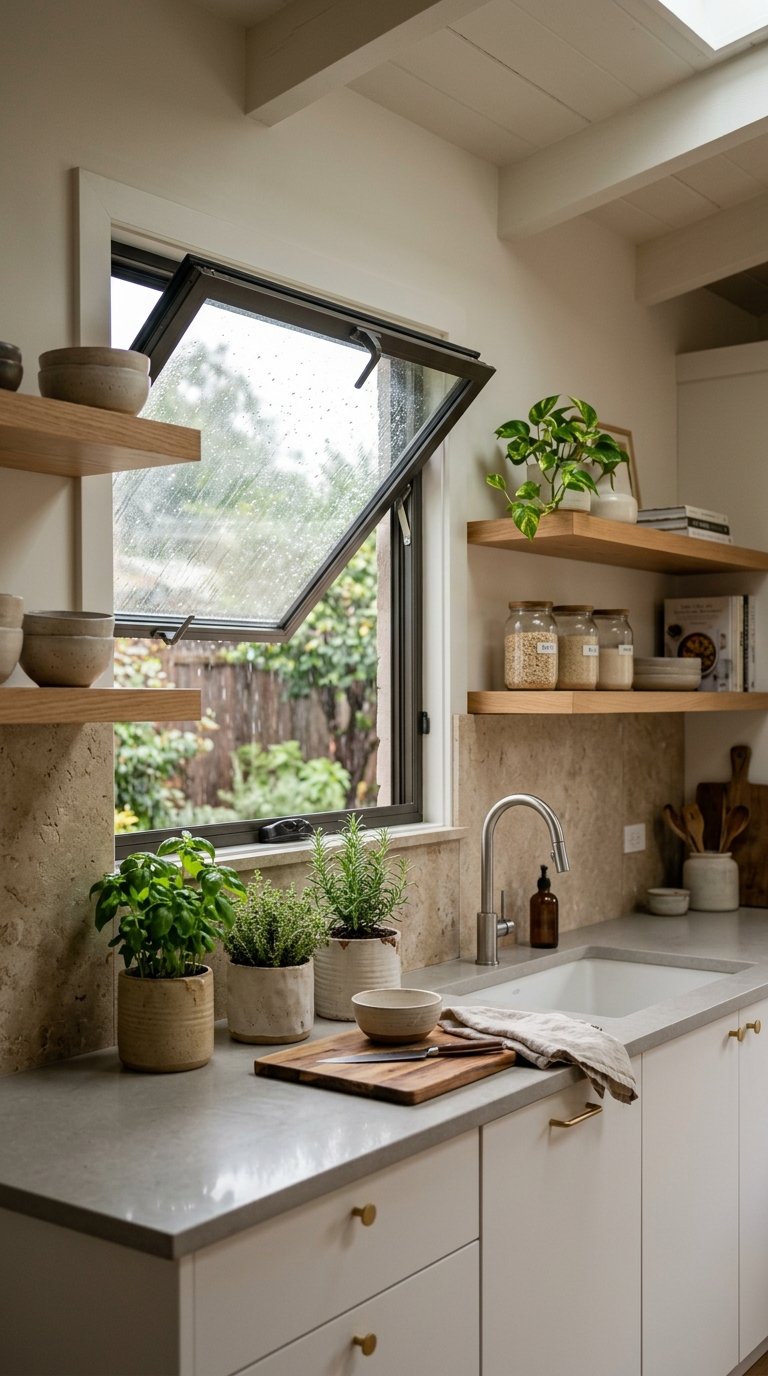
An awning window hinges at the top and opens outward from the bottom, which means you leave it open during light rain without water pouring into the kitchen. That specific feature makes it more useful in a kitchen than almost any other window type for homeowners in rainy climates.
Andersen’s A-Series awning window in a 30×20-inch size costs $350 to $550 per unit. The low-profile size fits above a backsplash or a cabinet run without requiring a structural header modification in most residential wall configurations. Install it high on the wall above upper cabinets if you want ventilation without losing wall space for cabinet storage.
The awning window’s bottom-opening design also limits how wide it can open, which reduces the total airflow compared to a full casement window of the same size. In very hot kitchens with high cooking volume, pair an awning window with a range hood that vents externally rather than relying on window ventilation alone. Broan’s Elite E64000 range hood at $500 to $700 handles the heat load that a single awning window leaves unaddressed.
5. A Garden Window That Extends Beyond the Wall
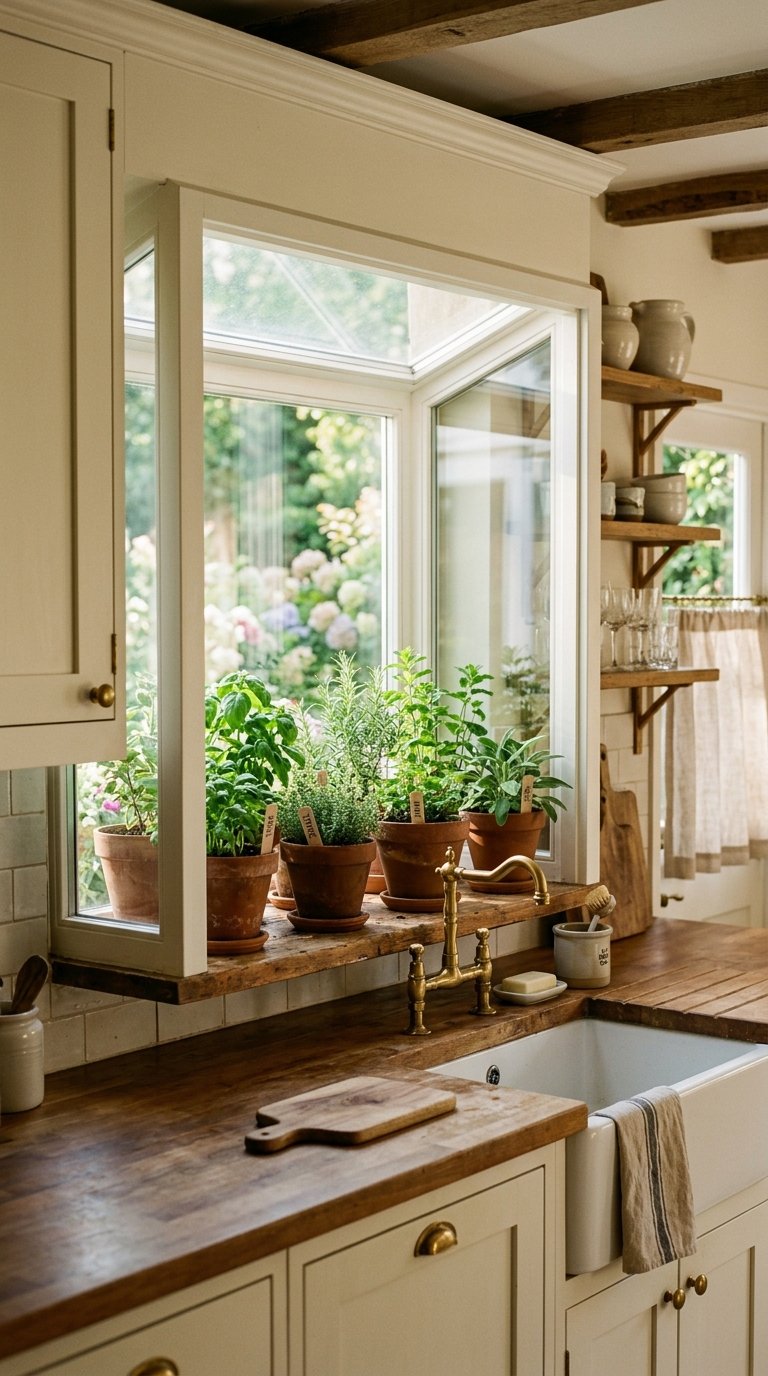
A garden window projects outward from the kitchen wall in a box shape with glass on three sides and a sloped glass roof. It creates a small greenhouse shelf inside the kitchen, giving you a place to grow fresh herbs within arm’s reach of the stove while adding light from three directions instead of one.
Simonton’s garden window in a 36×36-inch size costs $400 to $800 per unit before installation. The unit includes side vents that open independently, which provides ventilation alongside the light and growing space. The shelf depth of approximately 14 inches holds four to six standard herb pots in a single row, which puts fresh basil, rosemary, and thyme within reach during cooking without a separate countertop garden setup.
The installation of a garden window requires structural support because the projecting box adds weight and load to the wall framing. Budget $300 to $600 for installation in addition to the unit cost, and hire a contractor who has installed garden windows specifically. Standard window installers occasionally underestimate the framing requirement and the window settles forward over time, creating seal failures and water infiltration.
6. A Bay Window to Expand a Tight Kitchen
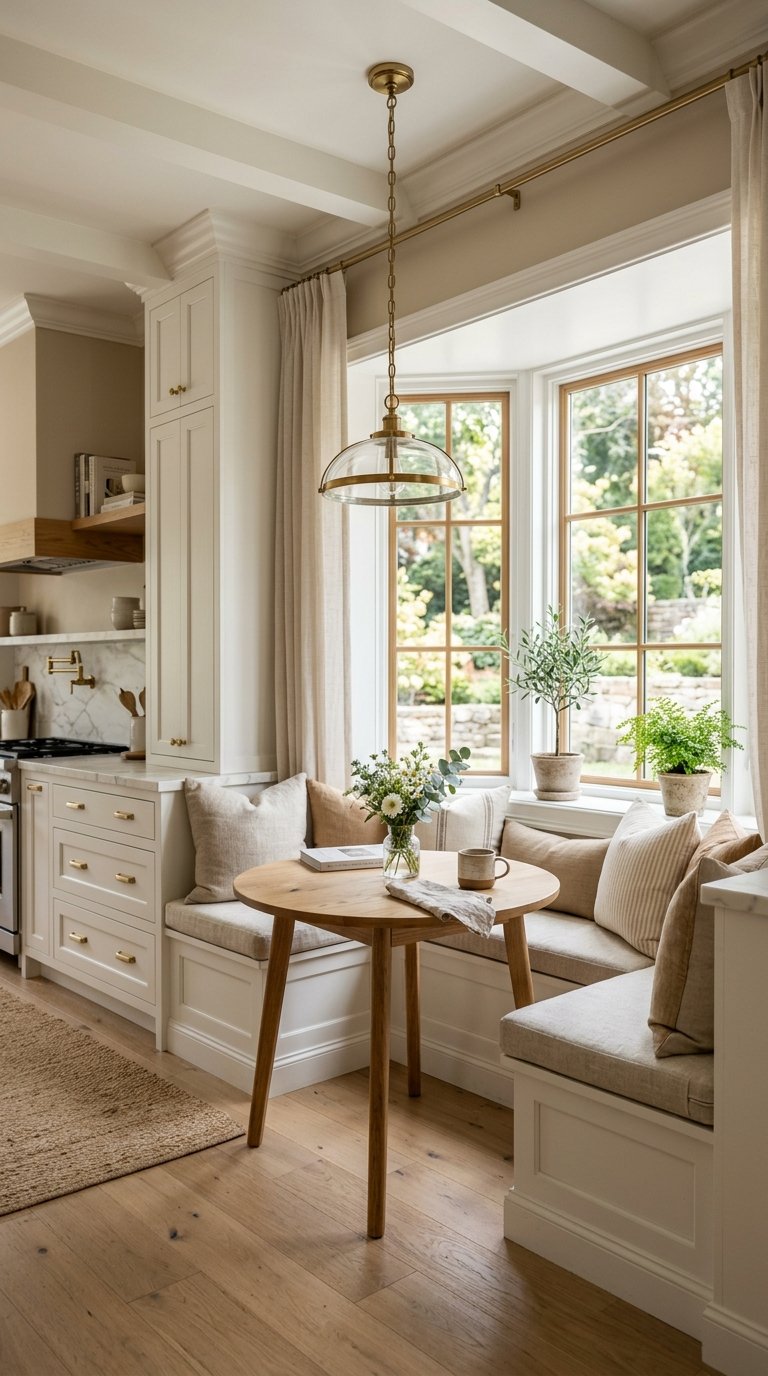
A bay window projects outward from the exterior wall in a three-panel angled configuration that adds physical square footage to the kitchen interior. The projection typically runs 12 to 18 inches deep and 4 to 6 feet wide, which turns a flat wall into a windowed alcove that fits a small dining bench, a window seat with storage, or an extended countertop run.
Andersen’s 400 Series bay window in a 72-inch wide configuration costs $1,500 to $3,000 per unit before installation. The installation requires a structural header above the rough opening and a knee wall or cantilever support below the projecting floor, which adds $1,000 to $2,500 in framing and finish work on top of the window cost. The total investment sits in the $2,500 to $5,500 range for most residential bay window kitchen installations.
The payoff is significant. A bay window alcove in a tight kitchen adds natural light from three angles simultaneously, creates a visual sense of expansion that paint and mirrors approximate but never fully achieve, and adds measurable square footage to the room. Real estate appraisers count bay window alcoves in usable floor area calculations, which means the investment contributes to the appraised value of the home.
7. A Clerestory Window for Light Without Losing Wall Space
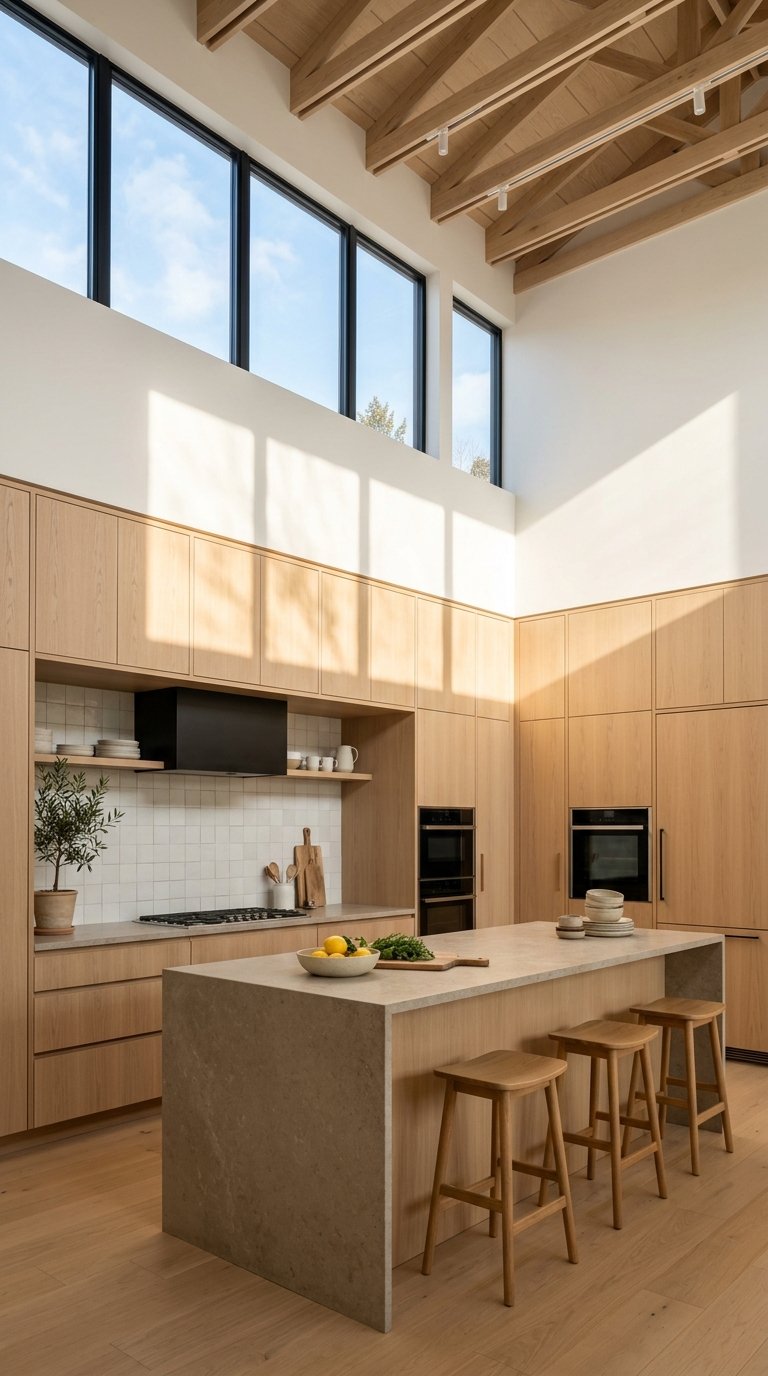
A clerestory window sits high on the kitchen wall near the ceiling line, above the standard cabinet height. It delivers natural light into the room from above without occupying any wall space below the ceiling where cabinets, appliances, or artwork would otherwise sit.
VELUX’s fixed clerestory window in a 46×22-inch horizontal format costs $300 to $500 per unit. Install it on the south or east wall to capture morning and midday light in the kitchen, which is the most useful light direction for a cooking space. A south-facing clerestory in a northern hemisphere kitchen delivers direct sunlight across the ceiling and upper walls for most of the day, brightening a room that standard wall windows alone leave dim.
Clerestory windows work best in kitchens with 10-foot or higher ceilings where the standard 8-foot cabinet run leaves a visible wall section above. In standard 8-foot ceiling kitchens, the clerestory window competes with upper cabinet installation and the trade-off between light and storage rarely favors the window. Measure your wall height before you commit.
8. Frosted Glass for Privacy Without Losing Light
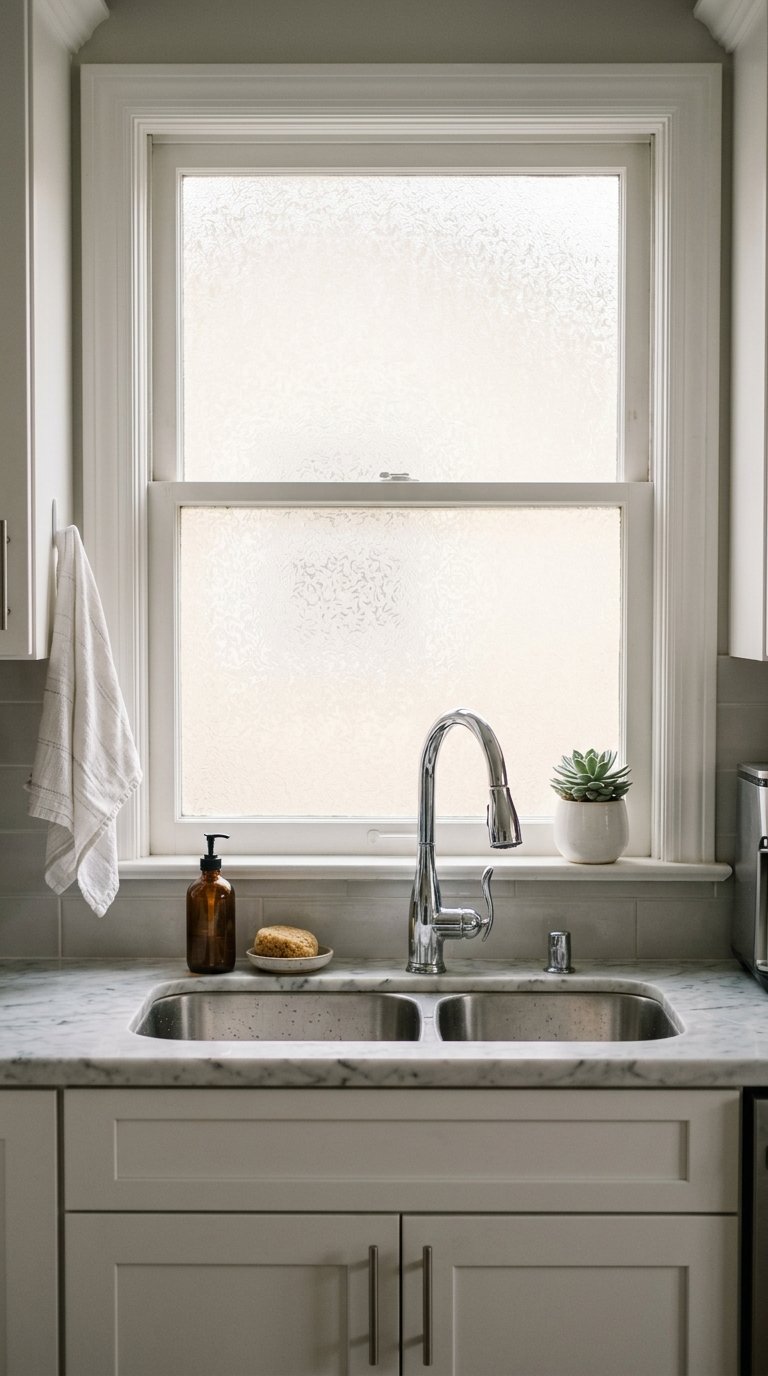
Frosted glass on a kitchen window solves one specific problem: the kitchen faces a neighbor’s property, a sidewalk, or a shared driveway and you want natural light without the feeling of performing your morning routine for an audience. Frosted glass passes approximately 80 to 90 percent of available light while eliminating visible detail through the glass.
Pilkington’s Satin glass is the frosted glass specification that glaziers recommend most for residential kitchen windows. It delivers a consistent, fine-textured surface that scatters light evenly across the room without the blurry, aqueous quality of cheaper acid-etched glass options. Replacement glazing in a standard 24×36-inch sash using Pilkington Satin costs $150 to $300 for the glass alone before the glazier’s installation labor.
For renters or homeowners who want a reversible option, Rabbitgoo’s window privacy film on Amazon costs $15 to $25 for a standard roll that covers a 36×84-inch window. The film applies with water and removes without adhesive residue, which makes it a practical option for rental kitchens where permanent glazing changes are not permitted. The light transmission sits slightly lower than true frosted glass but the privacy performance is comparable.
9. A Sliding Window for Easy Operation in Tight Spaces
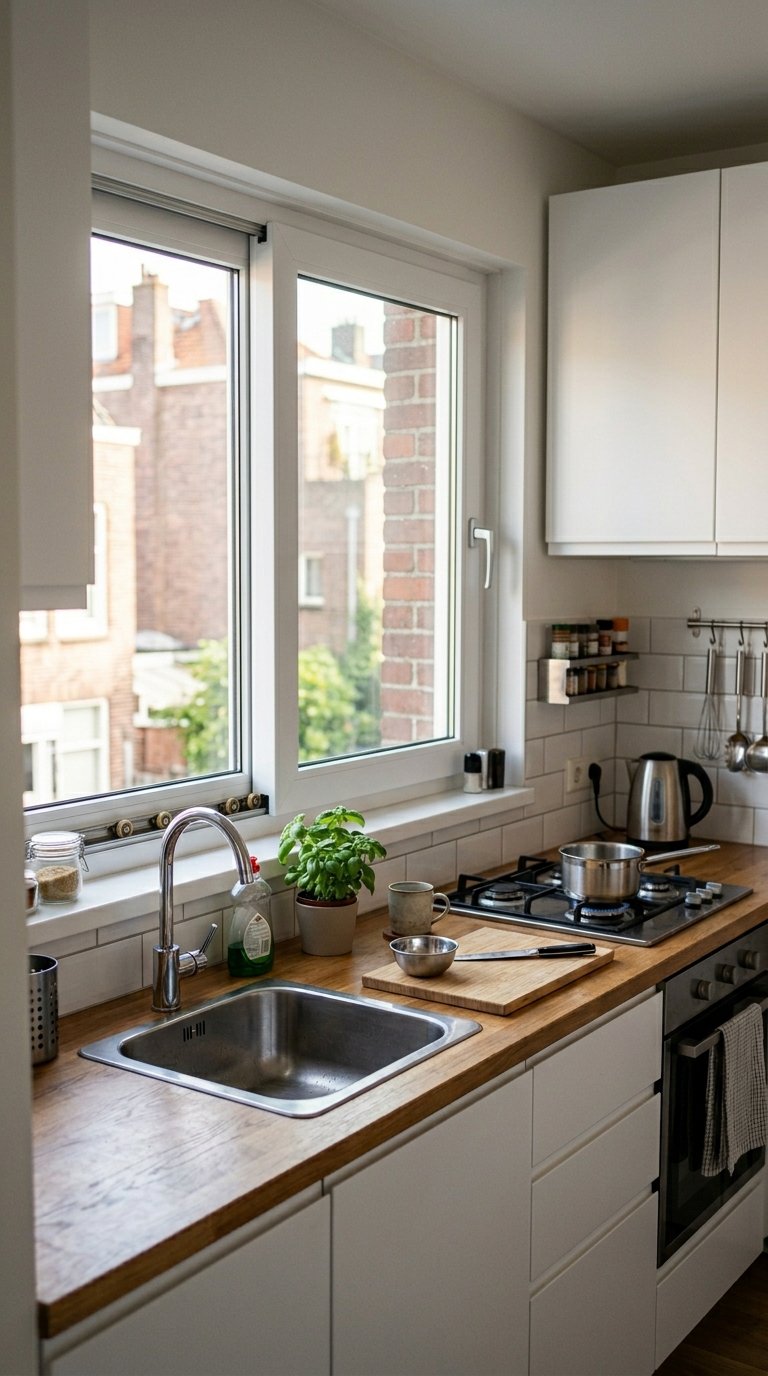
A sliding window opens horizontally on a track rather than swinging in or out, which makes it the right choice for kitchen windows above counters where a casement sash would hit you in the head or swing over a pot on the stove. The horizontal slide keeps the sash within the window frame footprint at all times.
JELD-WEN’s V-4500 series sliding window in a 48×36-inch size costs $200 to $400 per unit at Home Depot. The vinyl frame handles kitchen moisture well and the sliding operation requires no hardware maintenance beyond keeping the track clear of grease and debris. Wipe the track with a damp cloth monthly and apply a silicone-based track lubricant like 3-in-One Professional Garage Door Lubricant at $8 per can every six months to keep the sash gliding smoothly.
The limitation of a sliding window is that it opens to a maximum of 50 percent of the total window area, since one sash always covers the other in the open position. For kitchens that need maximum ventilation, a casement window of the same rough opening size delivers significantly more airflow. Use the sliding window where operation clearance is the constraint and accept the ventilation trade-off as the cost of the practicality.
10. A Window Seat Nook With Built-In Storage Below
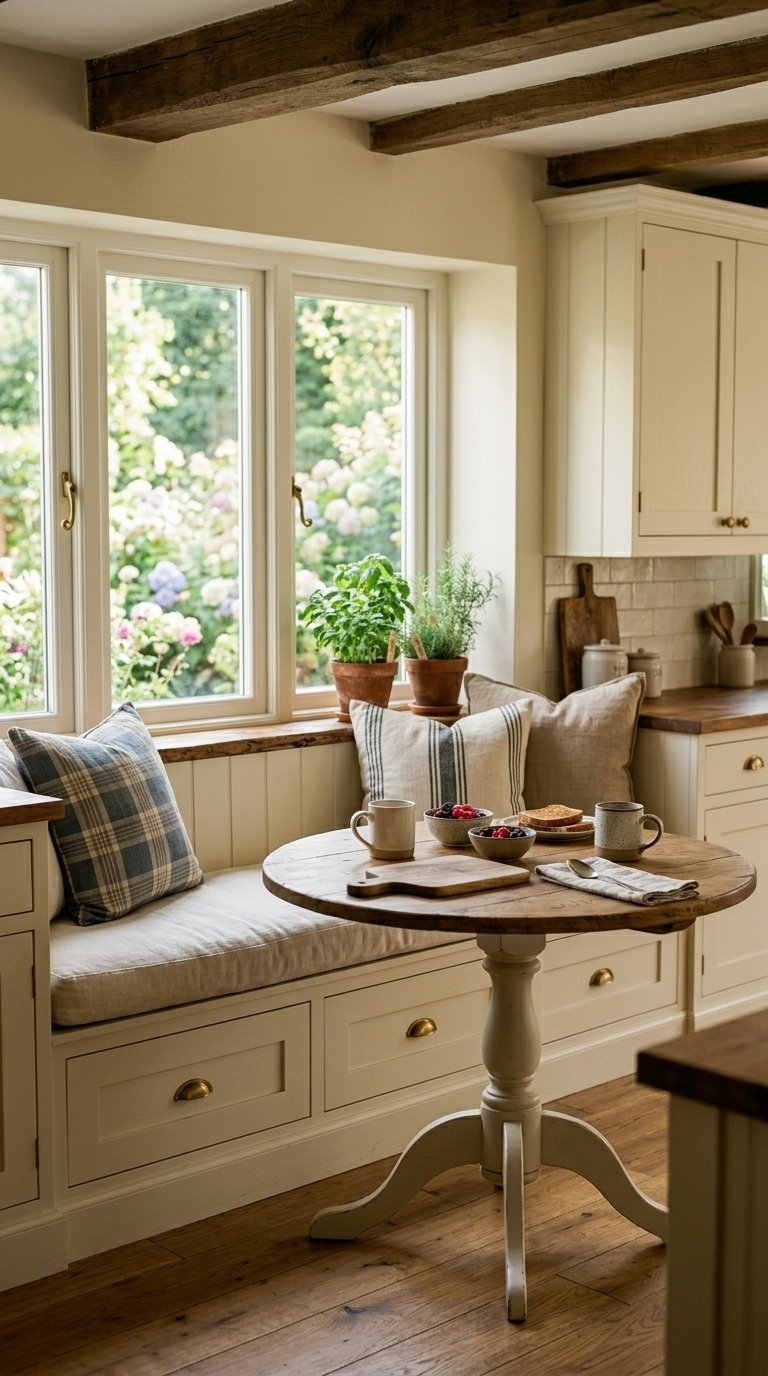
A window seat nook in a kitchen eating area combines natural light, seating, and storage in a single architectural element that no separate furniture arrangement replicates. The built-in bench below the window holds cushioned seating above and enclosed storage drawers or cabinets below, turning dead wall space into the most useful corner of the kitchen.
Custom window seat cabinetry from IKEA’s Sektion system runs approximately $200 to $500 in cabinet materials for a standard 60-inch bench run. The Sektion base cabinets in a 30-inch height configuration provide the structural bench form, and a custom cushion from Comfort Works cut to the bench dimensions costs $80 to $200 depending on fabric and thickness. The total built-in window seat project cost sits in the $400 to $900 range for a DIY build using IKEA components.
Pair the window seat with three vertically oriented double-hung or casement windows above the bench height to create a bright, enclosed nook that reads as architecturally intentional rather than furniture arranged near a window. The vertical window alignment above the horizontal bench creates a proportional relationship that feels designed. IMO, this is the highest-return kitchen window project on this list for homeowners with a dining alcove or breakfast nook adjacent to the kitchen.
11. Roman Shades for Clean, Fabric Window Treatments
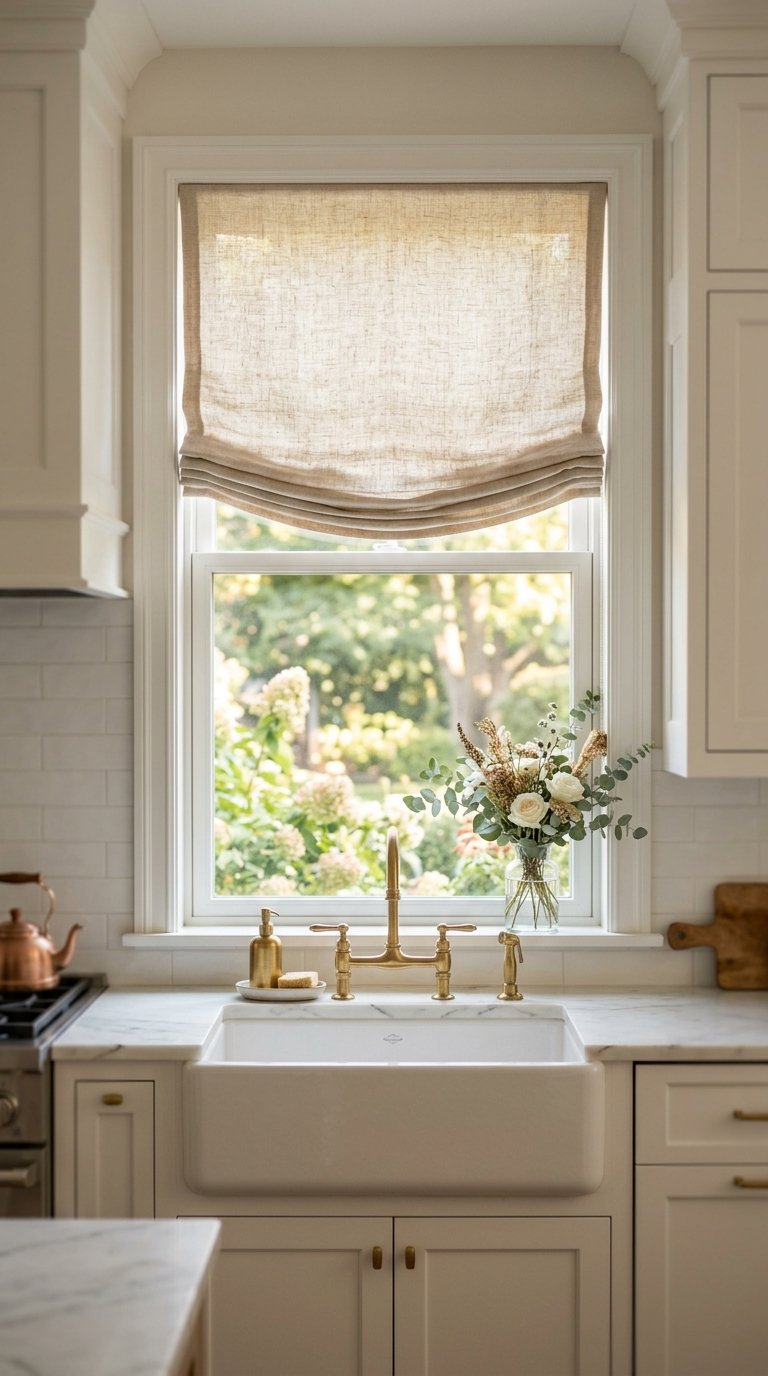
Roman shades fold into horizontal fabric panels when raised and drop into a flat, clean surface when lowered. In a kitchen, they deliver privacy and light control without the dust-collecting slats of blinds or the hanging fabric panels of curtains that catch cooking steam and absorb odors.
Smith and Noble’s custom Roman shades in a flat or relaxed fold style cost $100 to $300 per window depending on size and fabric. Specify a moisture-resistant fabric like their Washed Linen or Faux Silk Shantung for kitchen environments where humidity and steam are regular conditions. Standard cotton Roman shades absorb moisture and develop a stale fabric smell within months in an active cooking kitchen.
For a budget version, IKEA’s Tupplur roller blind at $20 to $40 per window delivers comparable light control in a roller format rather than a Roman fold. It is not a Roman shade and it does not look like one, but it provides a clean, flat surface that wipes down easily and costs a fraction of the custom option. Use it in rental kitchens or as a temporary solution while you save for the custom shades.
12. Café Curtains for Lower Privacy With an Open Upper Window
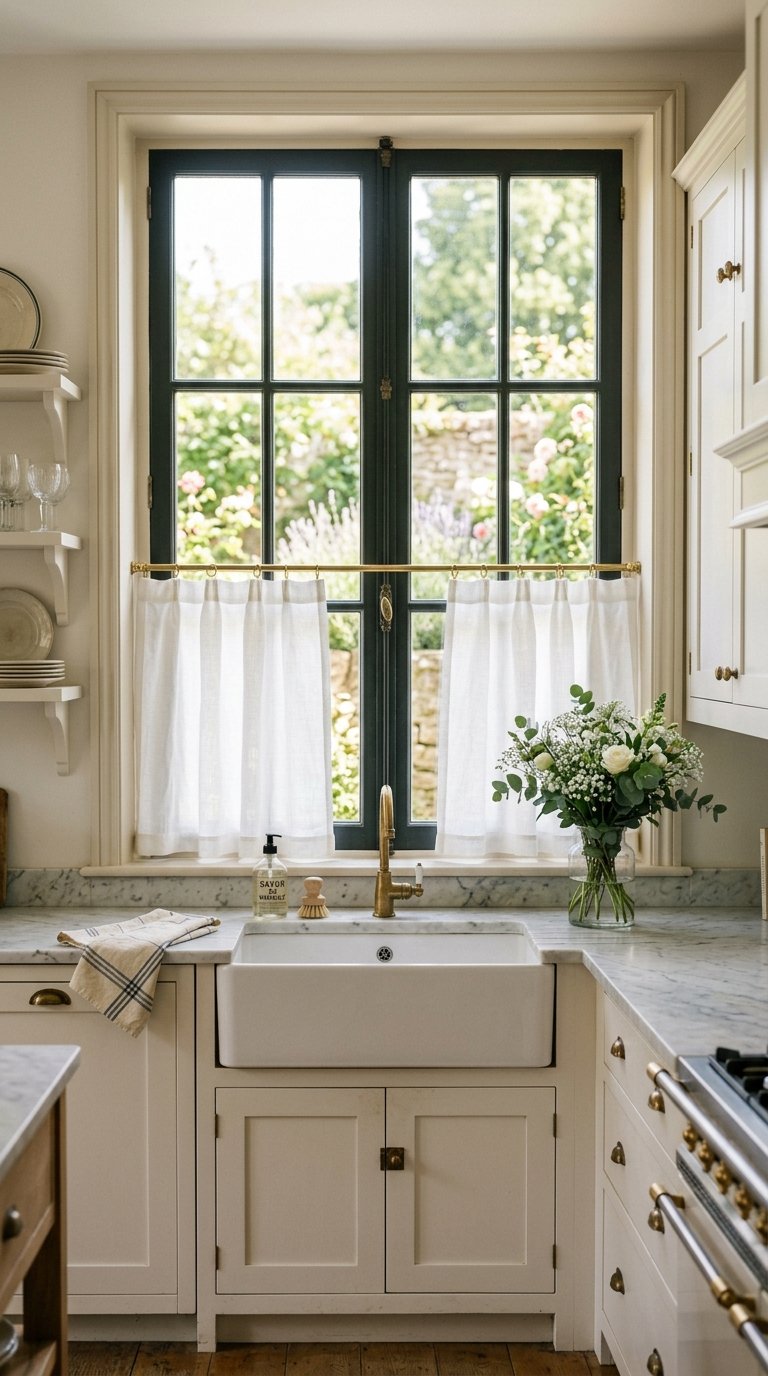
Café curtains cover only the lower half of a kitchen window, which gives you street-level privacy while leaving the upper portion of the window completely open to light and sky. The French café aesthetic that gives these curtains their name translates directly to residential kitchens where the goal is light and openness without full exposure to the sidewalk or neighbor’s view.
Anthropologie’s Rosette Trim cafe curtains at $48 to $88 per panel in a 24-inch drop length cover the lower half of a standard 36×48-inch kitchen window. The cotton-linen blend handles kitchen humidity better than pure cotton and hangs with enough weight to stay flat without a rod pocket insert. Use a tension rod from Command at $12 to $18 per rod inside the window frame for a no-drill installation that works in rentals.
Position the curtain rod at the mid-point of the window height rather than at the sill. A café curtain hung too low reads as a half-drawn shade. A café curtain hung at the exact center reads as intentional and architectural. Measure the window height and divide by two before marking your rod placement.
13. Woven Wood Shades for Texture and Warmth
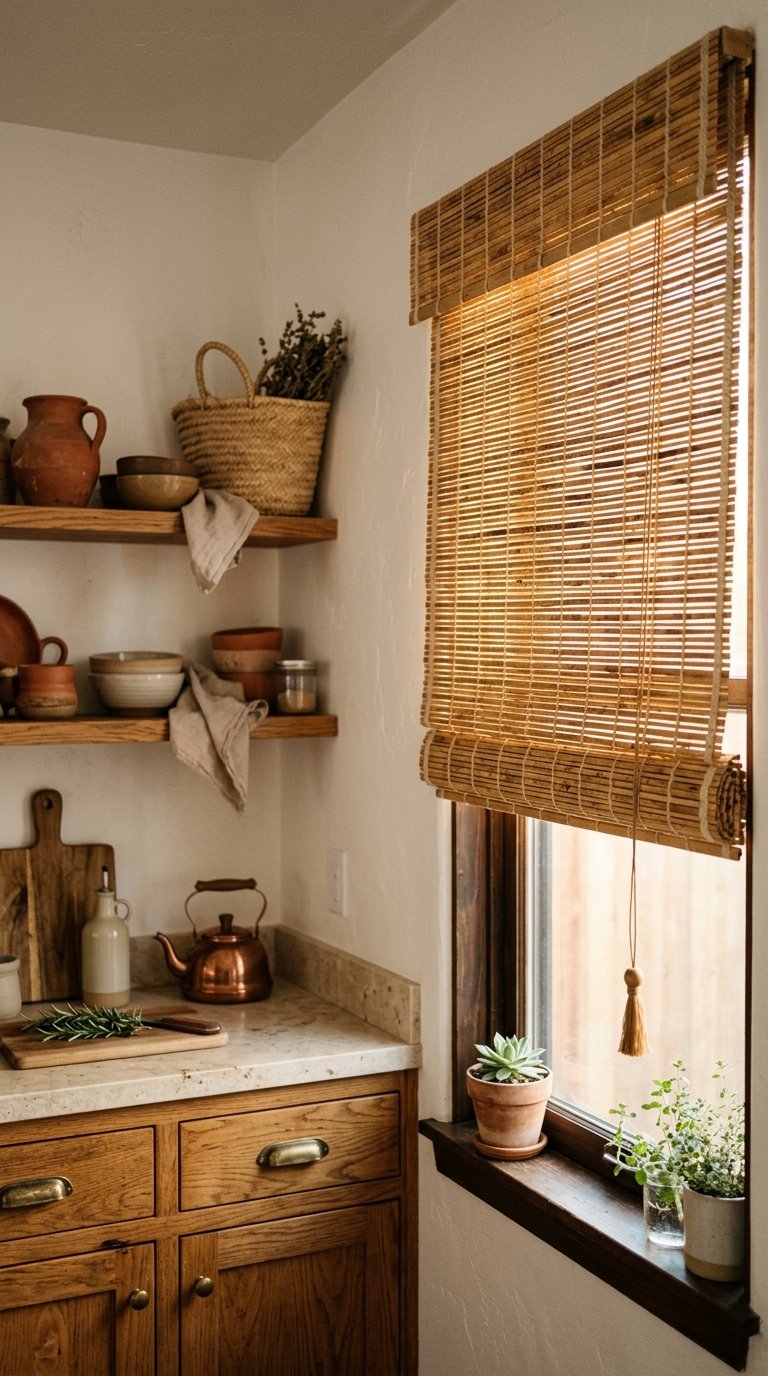
Woven wood shades bring a material texture to a kitchen window that fabric shades and vinyl blinds do not provide. The bamboo, jute, or rattan construction of woven wood shades adds warmth and organic character to kitchens that feel flat or overly polished with standard window treatments.
Blinds.com’s Woven Wood Roman Shades in a bamboo or grasscloth weave cost $60 to $180 per window in standard sizes. Specify a privacy liner backing for kitchen windows that face a street or shared property line. Without a liner, woven wood shades filter light but do not block the view from outside, which defeats the privacy function in kitchens with close neighbors.
Woven wood shades do not perform well in kitchens above the stove or adjacent to the sink where steam and grease hit the material directly. The natural fibers absorb cooking residue and the material deteriorates faster than any synthetic alternative. Place them on kitchen windows away from the cooking zone and use a more washable treatment at the sink and range positions.
14. Plantation Shutters for a Permanent, Durable Treatment
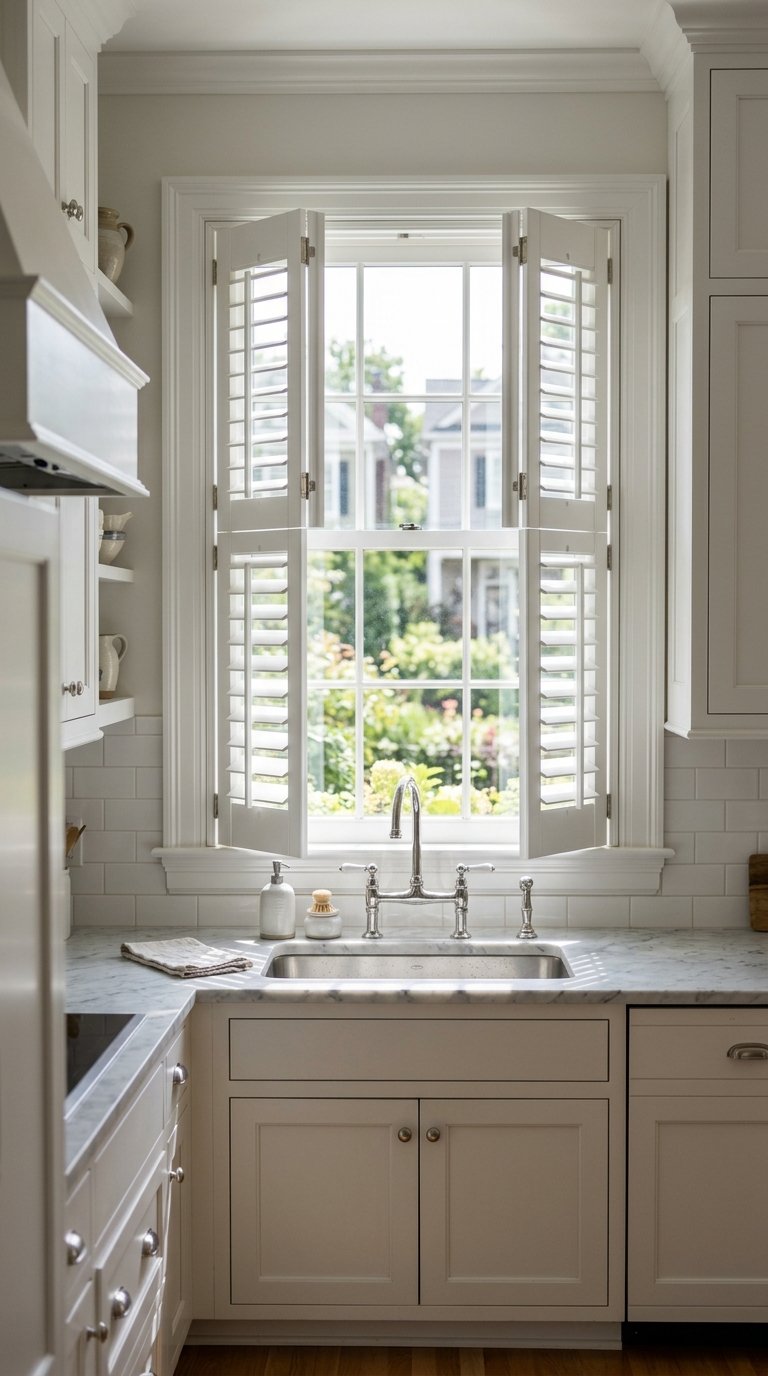
Plantation shutters are the highest-cost and highest-durability window treatment option for a kitchen. The wide-slat louvered panels mount inside the window frame on hinges and fold open or closed to control light and privacy without any fabric or pull cord to manage. They wipe clean with a damp cloth, which makes them the most maintenance-practical kitchen window treatment on this list.
The Shutter Store’s custom faux wood plantation shutters in a 36×48-inch window size cost $250 to $450 per window including installation. Faux wood performs better than real wood in kitchen environments because it does not warp, crack, or split under the humidity cycling that cooking produces. Real wood plantation shutters cost more and require more maintenance in a kitchen than in any other room in the house.
The installation requires a minimum 2.5-inch frame depth inside the window casing to mount the shutter frame flush with the wall. Measure your window frame depth before ordering. Plantation shutters ordered without a depth check are the most common and most expensive window treatment mistake homeowners make. The return and reorder process adds four to eight weeks to the project timeline.
15. Window Film for a Decorative Frosted or Stained Glass Effect
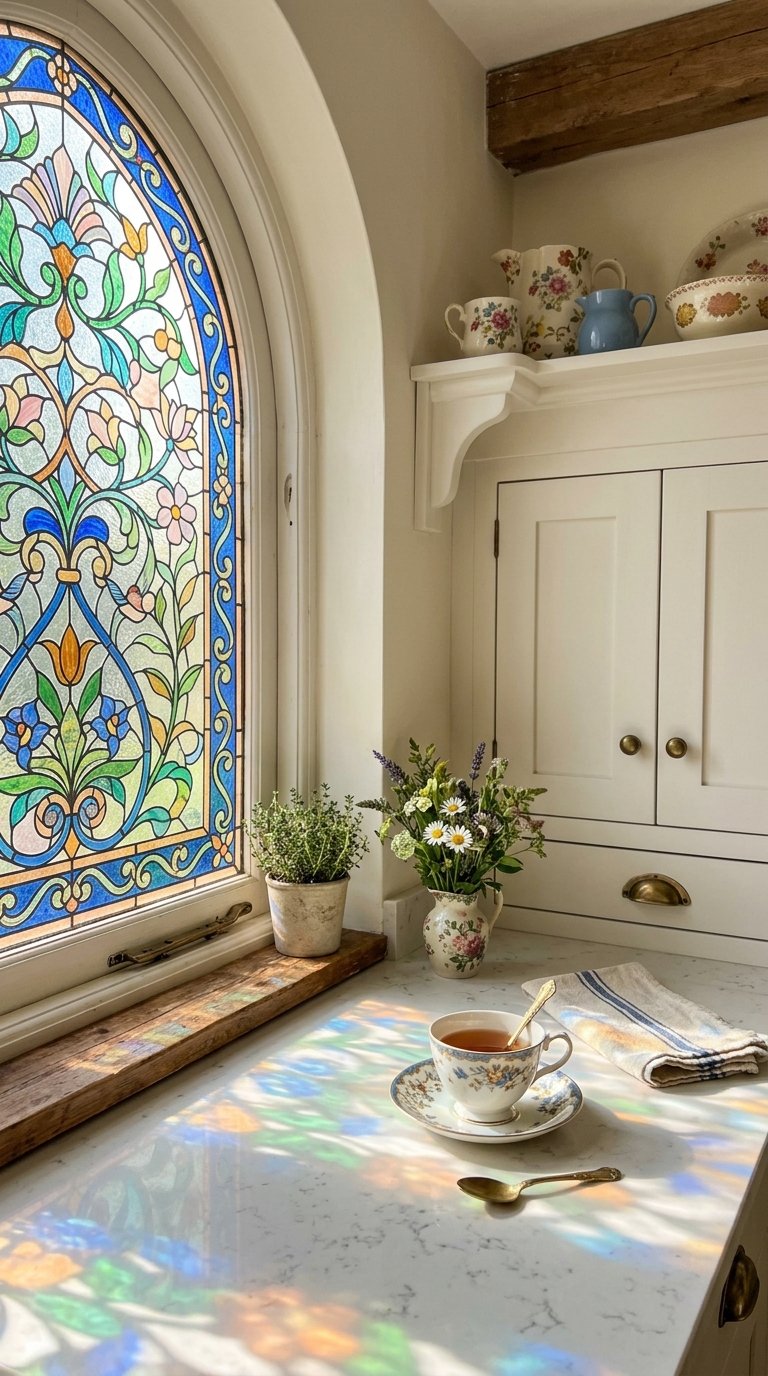
Decorative window film applies directly to existing glass and transforms a plain kitchen window into a patterned, frosted, or stained glass visual in under an hour. No contractor required, no permit needed, and no permanent modification to the glass or frame.
Artscape’s decorative window film in a leaded glass or botanical pattern costs $25 to $45 per 24×36-inch panel on Amazon. The film applies with water and a squeegee, removes without adhesive residue, and delivers a stained glass visual that works in farmhouse, cottage, and traditional kitchen styles. The light transmission through the patterned film sits at 70 to 80 percent, which keeps the kitchen bright while adding decorative character to a plain window.
For a frosted geometric pattern rather than a stained glass look, Solyx’s SX-SF-15 window film in a hexagonal or linen texture costs $3 to $6 per square foot through professional glaziers and $15 to $30 per roll through online retailers. The film works on any smooth glass surface and requires no special tools beyond a spray bottle, a plastic squeegee, and 30 minutes of patience.
16. A Pass-Through Window Between Kitchen and Outdoor Space
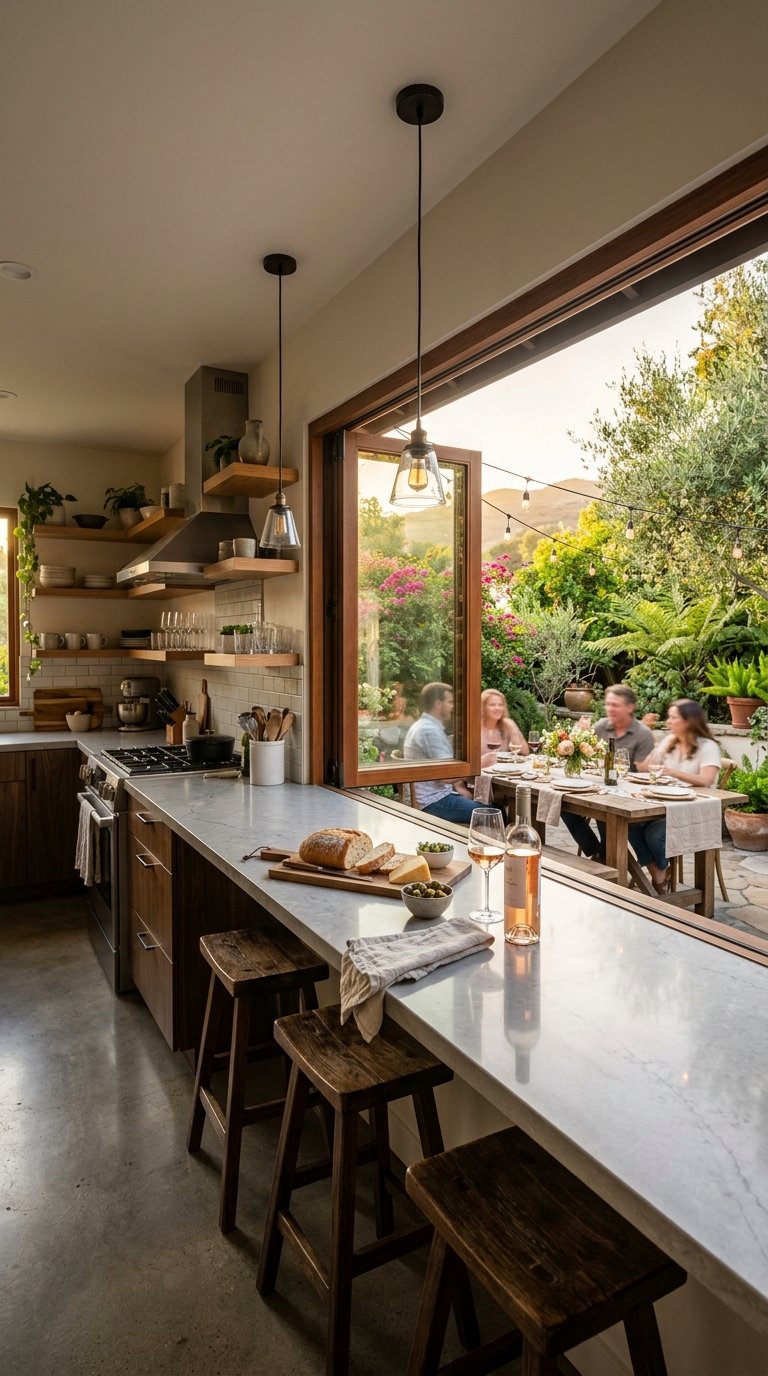
A pass-through window opens between the kitchen interior and an outdoor patio, deck, or yard to create a serving and entertaining connection between the cooking space and the outdoor space. The window sash folds up or slides open to create a counter-height opening that passes food, drinks, and conversation between the kitchen and the outdoor dining area.
Marvin’s Ultimate Bi-Fold window in a 60×36-inch size costs $1,200 to $2,000 per unit and folds completely open to create a full-width pass-through opening. The sash panels fold accordion-style to one side, leaving the full rough opening clear for service and airflow. This is the premium option. A more budget-conscious pass-through uses a standard awning or casement window modified with a fold-up sash by a local glazier for $400 to $800 in materials and labor.
The pass-through window requires a countertop extension on both sides of the opening to function as a practical service surface. Install a 12-inch deep exterior shelf below the exterior opening using a pressure-treated 2×12 board finished with Defy Extreme wood stain at $45 per quart to match the interior counter height. The shelf holds plates, glasses, and serves dishes on the outdoor side without requiring a separate table setup for every gathering. 🙂
17. A Skylight Over the Kitchen for Overhead Natural Light
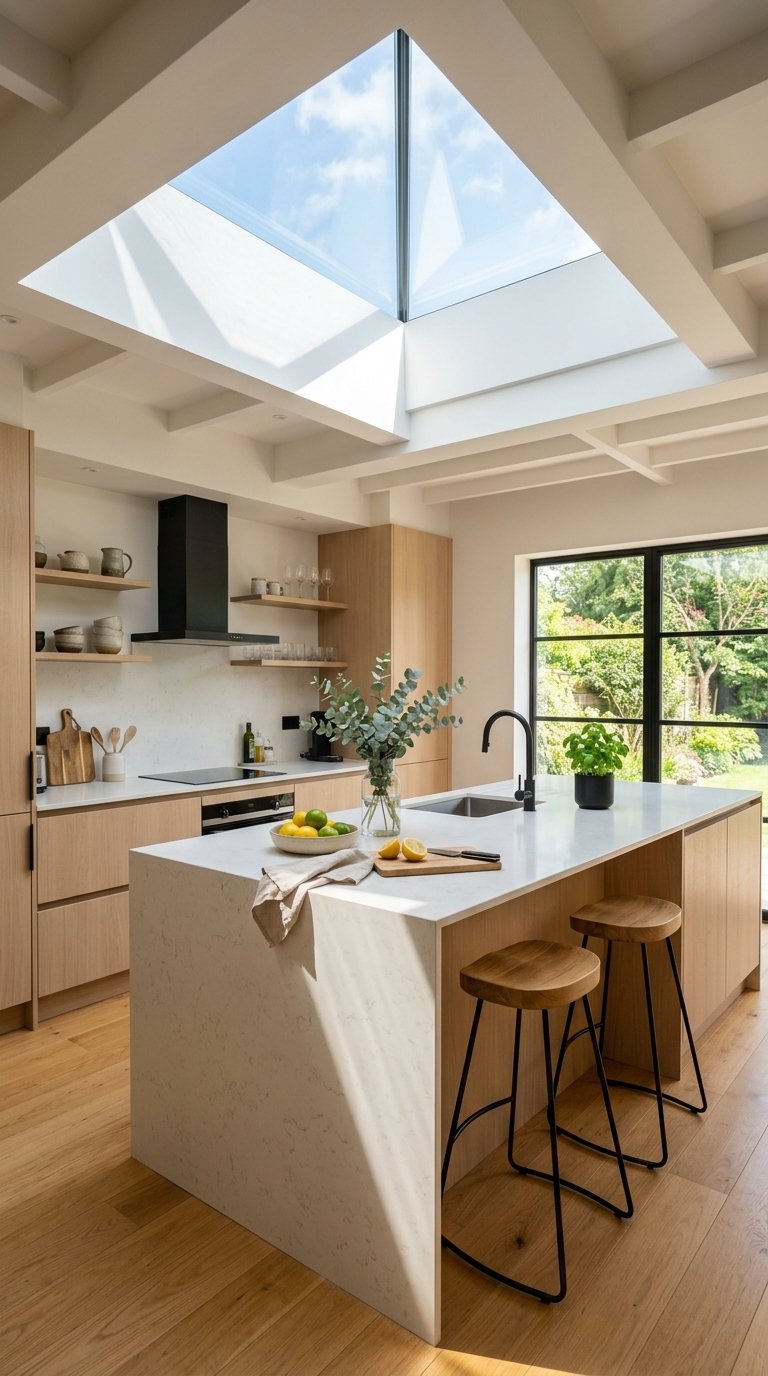
A skylight in the kitchen ceiling delivers natural light from directly above the room rather than from a wall, which eliminates shadows in the center of the kitchen that wall windows always leave. A single 24×48-inch skylight over the main prep area can reduce the need for artificial task lighting during daylight hours by a measurable amount.
VELUX’s FS M04 fixed skylight in a 30×46-inch size costs $350 to $600 per unit before installation. Installation adds $800 to $2,000 depending on roof pitch, framing complexity, and whether a light shaft tunnel is required to connect the skylight to the kitchen ceiling below. The total skylight project budget sits in the $1,200 to $2,600 range for most single-story kitchens with accessible roof structure.
For kitchens directly below an upper floor rather than a roof, a solar tube or tubular skylight like the VELUX TGR 014 at $200 to $400 per unit routes daylight through a reflective tube from the roof through the upper floor structure to a ceiling diffuser in the kitchen below. The total light output of a 14-inch solar tube equals approximately one 100-watt incandescent bulb in full sun, which noticeably brightens a dark kitchen without a full skylight installation.
18. Black Window Frames for a Graphic, Modern Kitchen
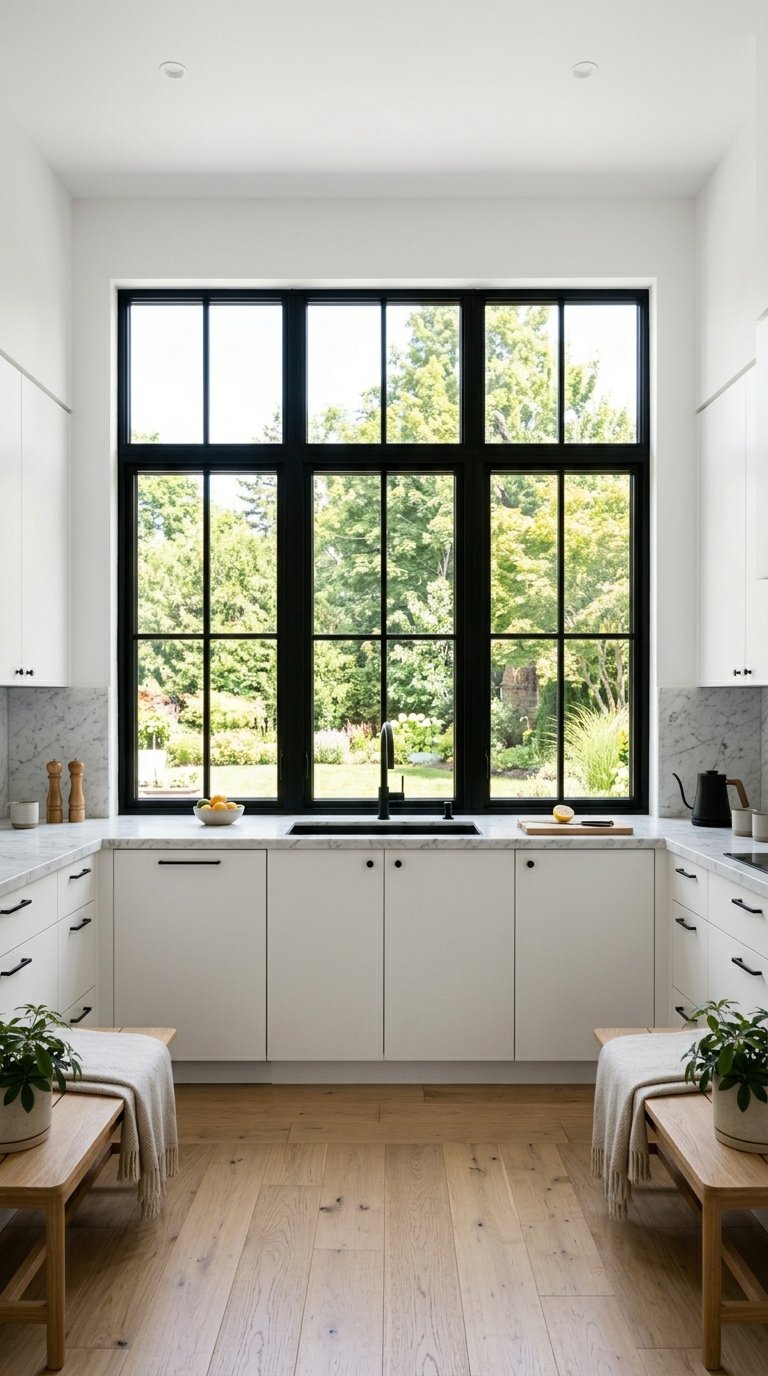
Black window frames on kitchen windows create a graphic contrast between the glass, the frame, and the wall that white or wood frames do not produce. The frame reads as a design element rather than a functional border, which makes the window itself a visual feature of the kitchen rather than a hole in the wall.
Andersen’s 100 Series windows with a Black interior finish cost approximately $50 to $100 more per unit than the standard white interior option. The black fiberglass composite frame does not require painting and holds its finish under kitchen humidity without chipping or peeling the way painted wood frames do. The color consistency between the interior and exterior frame on the Andersen 100 Black Series is one of its most practical advantages over painted alternatives.
Pair black window frames with white or light gray walls, white cabinets or light wood cabinets, and matte black hardware throughout the kitchen to build a cohesive palette where the window frames participate in the overall design rather than standing alone. Black frames on a dark wall read as absorbed and invisible. Black frames on a light wall read as bold and architectural. The contrast is the entire point.
19. A Corner Window to Open Up a Tight Kitchen Corner
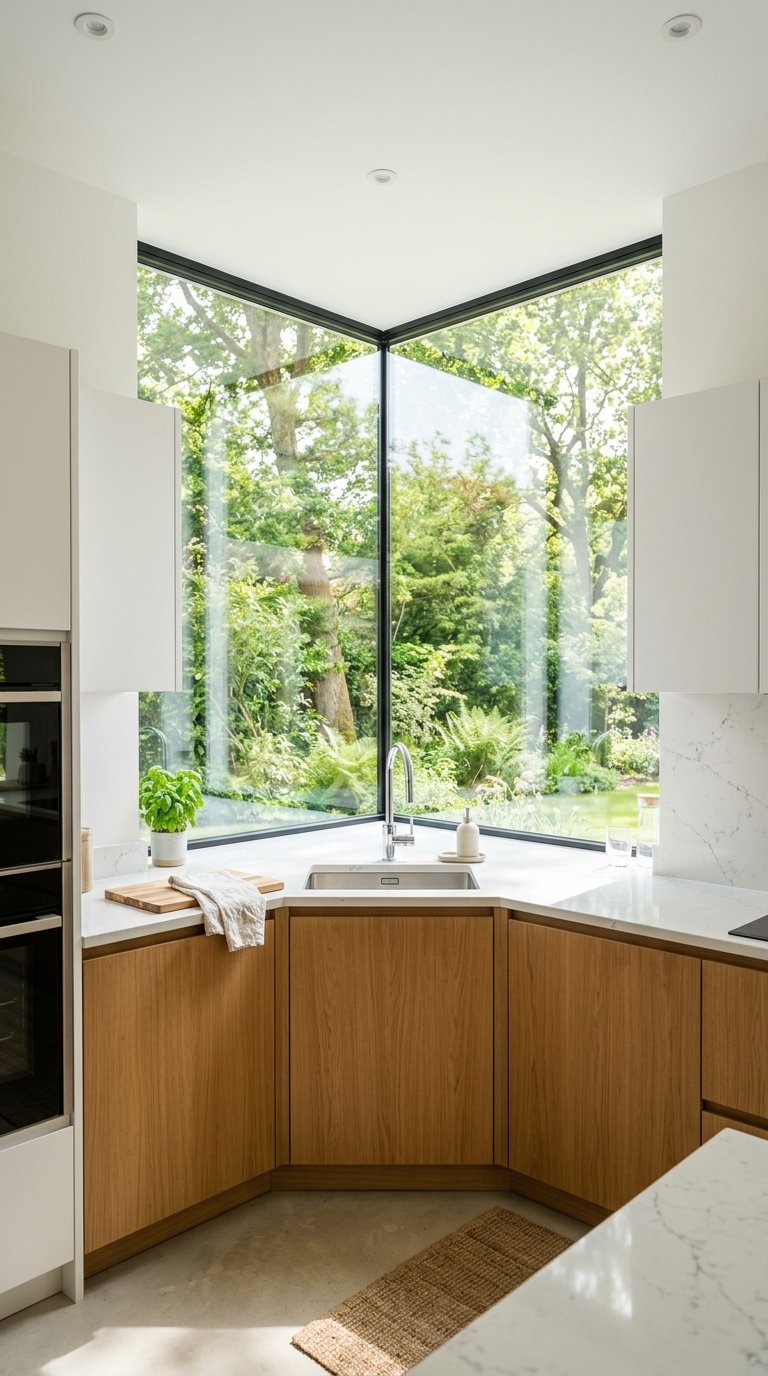
A corner window removes the solid wall at a kitchen corner and replaces it with two window panels that meet at the corner without a structural post between them. The result is an unobstructed corner view and a dramatic flood of light from two directions simultaneously into the corner of the kitchen that typically receives the least natural light in the room.
Marvin’s Signature Ultimate corner window configuration costs $3,000 to $6,000 per corner unit before installation, which requires structural engineering to transfer the corner load to the foundation without the standard corner post. The structural modification adds $2,000 to $5,000 in framing and engineering costs on top of the window unit price, making this the highest-investment window idea on the list.
The result justifies the cost in kitchens where the corner is dark, cramped, and the primary reason the room feels smaller than it is. A corner window in a kitchen that previously had a solid wall at the corner transforms the spatial experience of the room more completely than any other single modification. Architects specify corner windows in kitchen renovations precisely because the light and spatial impact exceeds what any other window configuration delivers at the same location.
20. No Window Treatment at All for a Clean, Minimal Kitchen
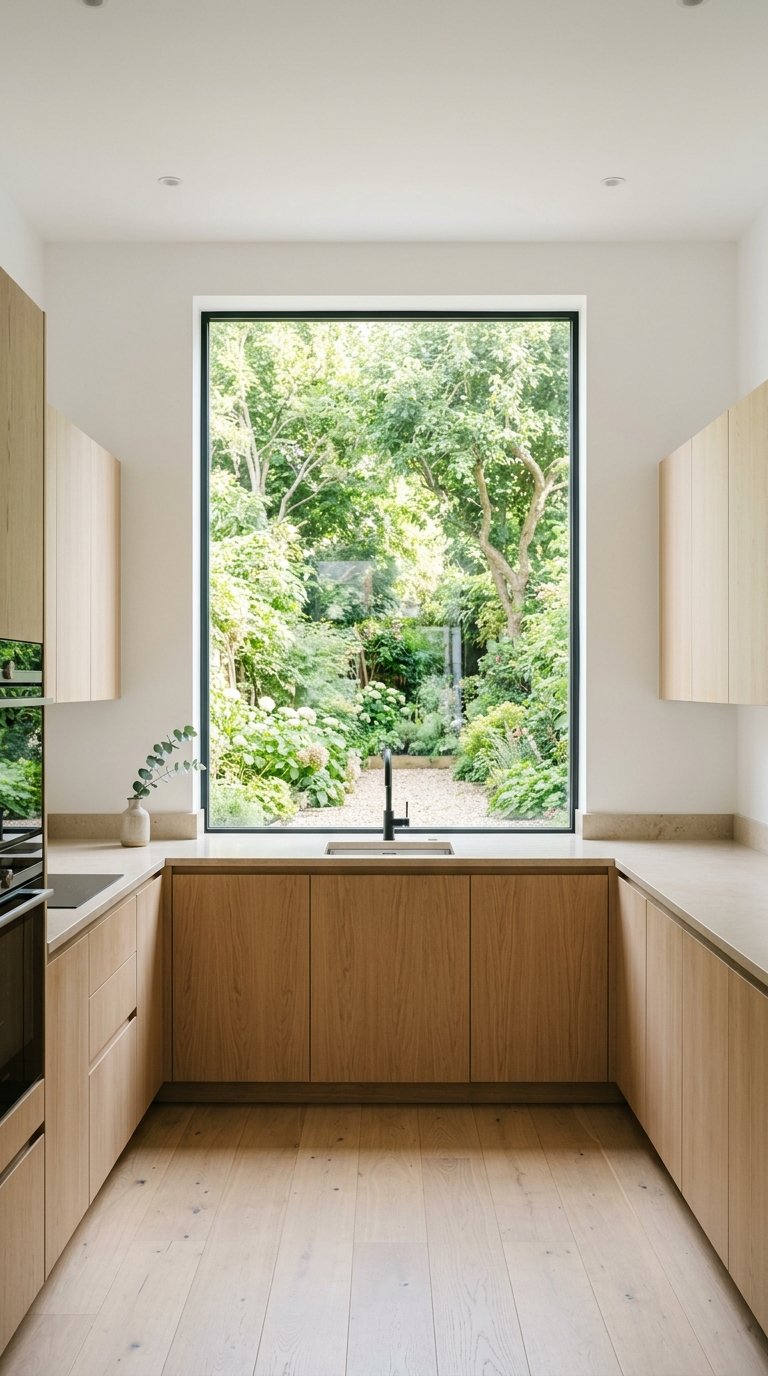
No window treatment is a legitimate design choice for kitchens that face a private yard, a garden, or a non-overlooked outdoor space. A bare window in a kitchen delivers maximum light, maximum simplicity, and zero maintenance. You never wash a window shade you do not own.
The practical requirement for a bare kitchen window is privacy from the exterior. If your kitchen faces a public street, a shared driveway, or a neighbor’s window within 30 feet, a bare window creates a privacy problem that outweighs the simplicity benefit. If your kitchen faces a private outdoor space with no sightlines from neighboring properties, the bare window is the cleanest and most functional option available.
Apply a UV-filtering window film like 3M’s Prestige 70 series at $6 to $10 per square foot installed to bare kitchen windows that receive direct south or west sunlight for multiple hours per day. The film reduces solar heat gain and UV fading of cabinet finishes and flooring without reducing visible light transmission by more than 30 percent. You keep the clean, treatment-free look while protecting the kitchen interior from sun damage.
21. Window Boxes Below Kitchen Windows for a Farmhouse Look
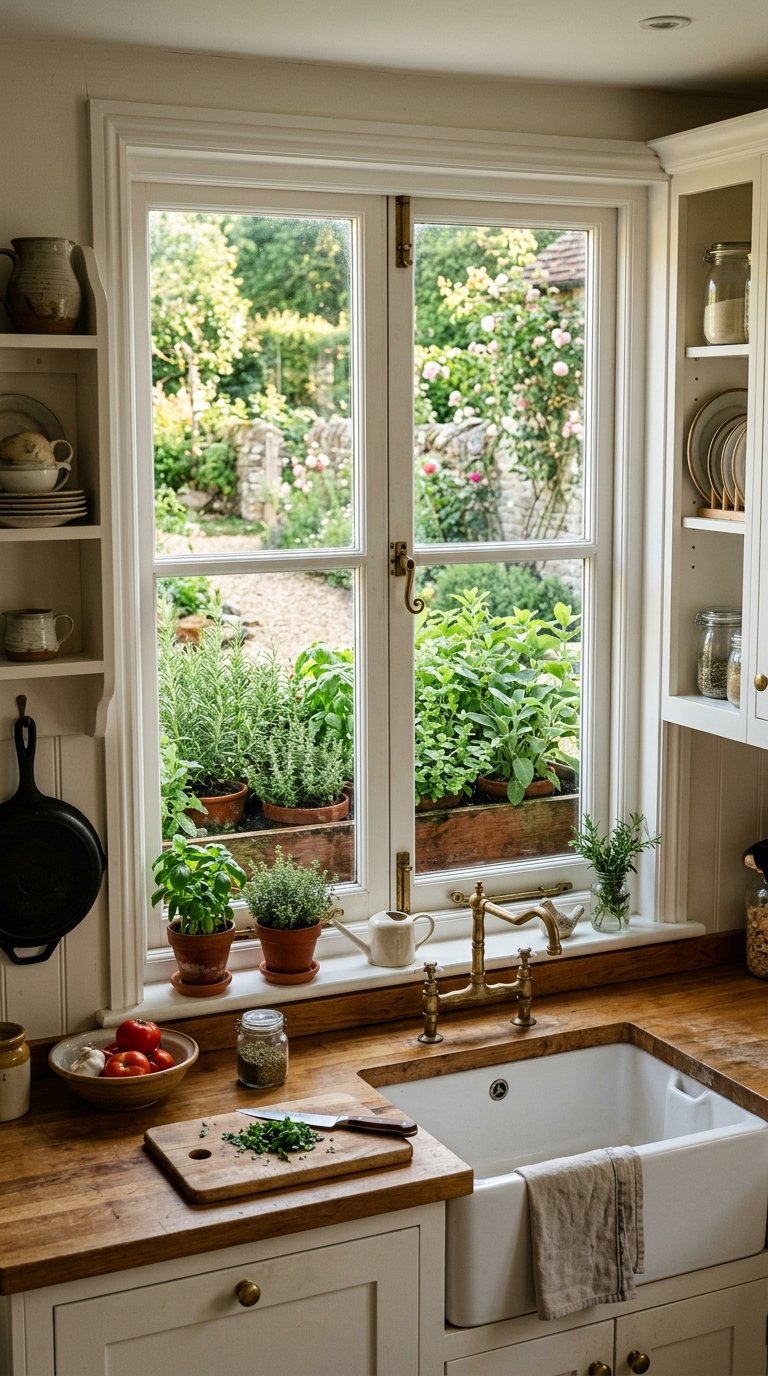
Window boxes mounted below exterior kitchen windows bring the farmhouse aesthetic to the exterior of the home while framing the kitchen view with plant material that changes with the seasons. The visual effect from inside the kitchen is a living frame around the window rather than a blank exterior wall below the glass.
Hooks and Lattice’s fiberglass window boxes in a 36-inch length cost $80 to $120 per box and hold their finish without rotting, splitting, or fading the way wood boxes do under irrigation and weather exposure. Mount them with Talon window box brackets from the same manufacturer at $25 to $40 per pair directly into the exterior wall studs, not into the window casing. A window box mounted to the casing rather than the studs fails under the weight of wet soil and plants within one to three growing seasons.
Plant trailing rosemary, thyme, and creeping oregano in kitchen window boxes rather than ornamental flowers to combine the farmhouse visual with a functional herb garden accessible from inside. A kitchen window box planted with culinary herbs gives you the exterior farmhouse aesthetic and a herb supply that costs $3 to $5 per plant at any garden center rather than $4 to $6 per bunch at the grocery store every week.
22. Motorized Window Shades for Smart Kitchen Integration
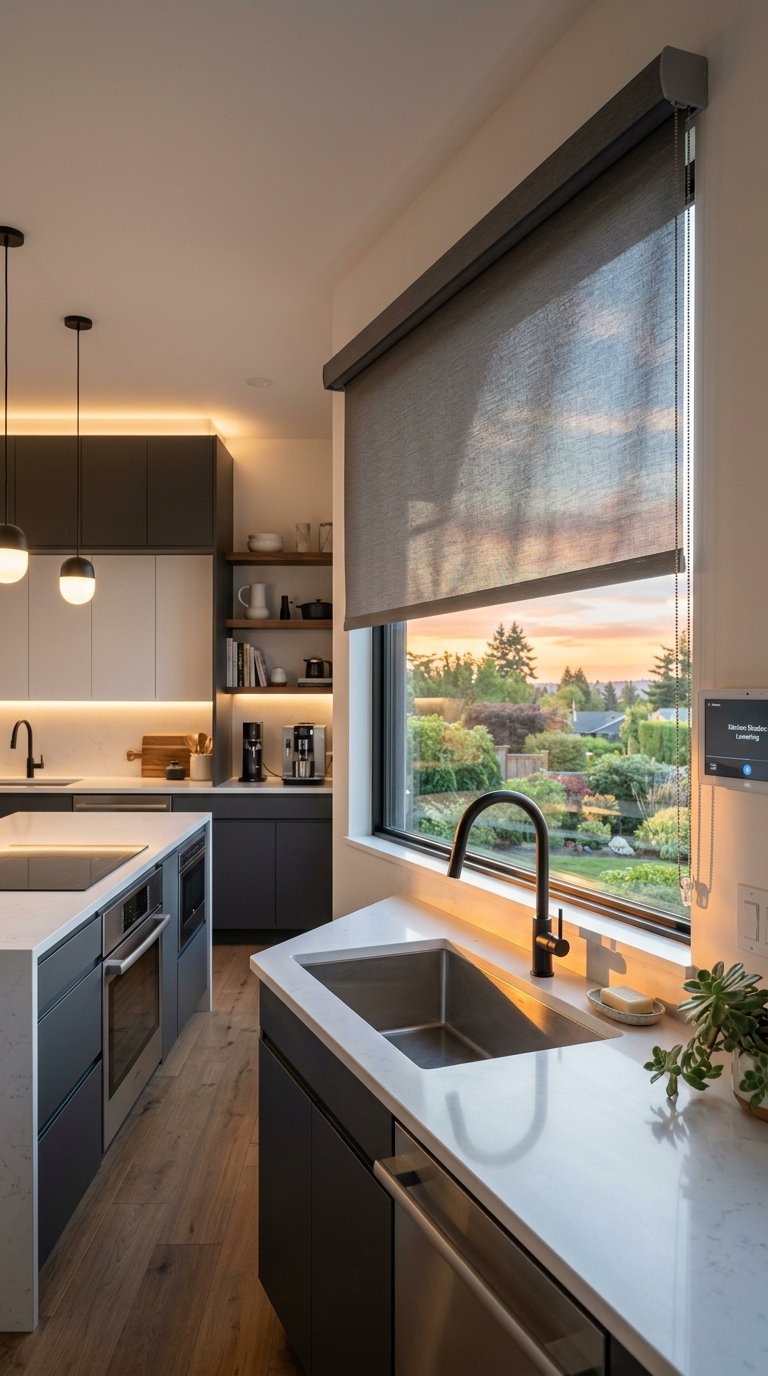
Motorized window shades operate through a wall switch, a remote control, or a smart home system, which means you adjust the kitchen window treatment without climbing onto the counter or reaching over the stove. In a kitchen where the window sits above the sink or behind the range, motorized operation is a practical necessity rather than a luxury.
Lutron’s Serena smart shades in a roller format cost $200 to $400 per window and integrate with Apple HomeKit, Amazon Alexa, and Google Home. Program them to raise automatically at sunrise and lower at sunset through the Lutron app, which gives the kitchen optimal light throughout the day without any manual adjustment. The Serena shade system runs on a rechargeable battery that Lutron rates for one year per charge under standard daily use.
For a more budget-conscious motorized option, Chicology’s motorized roller shades on Amazon cost $80 to $150 per window with a compatible hub. The build quality sits below the Lutron standard but the basic motorized function performs reliably for kitchens without a full smart home system. The hub costs an additional $30 to $50 and controls up to 20 shades on a single Wi-Fi connection.
23. Stained Glass Panels as Fixed Kitchen Window Art
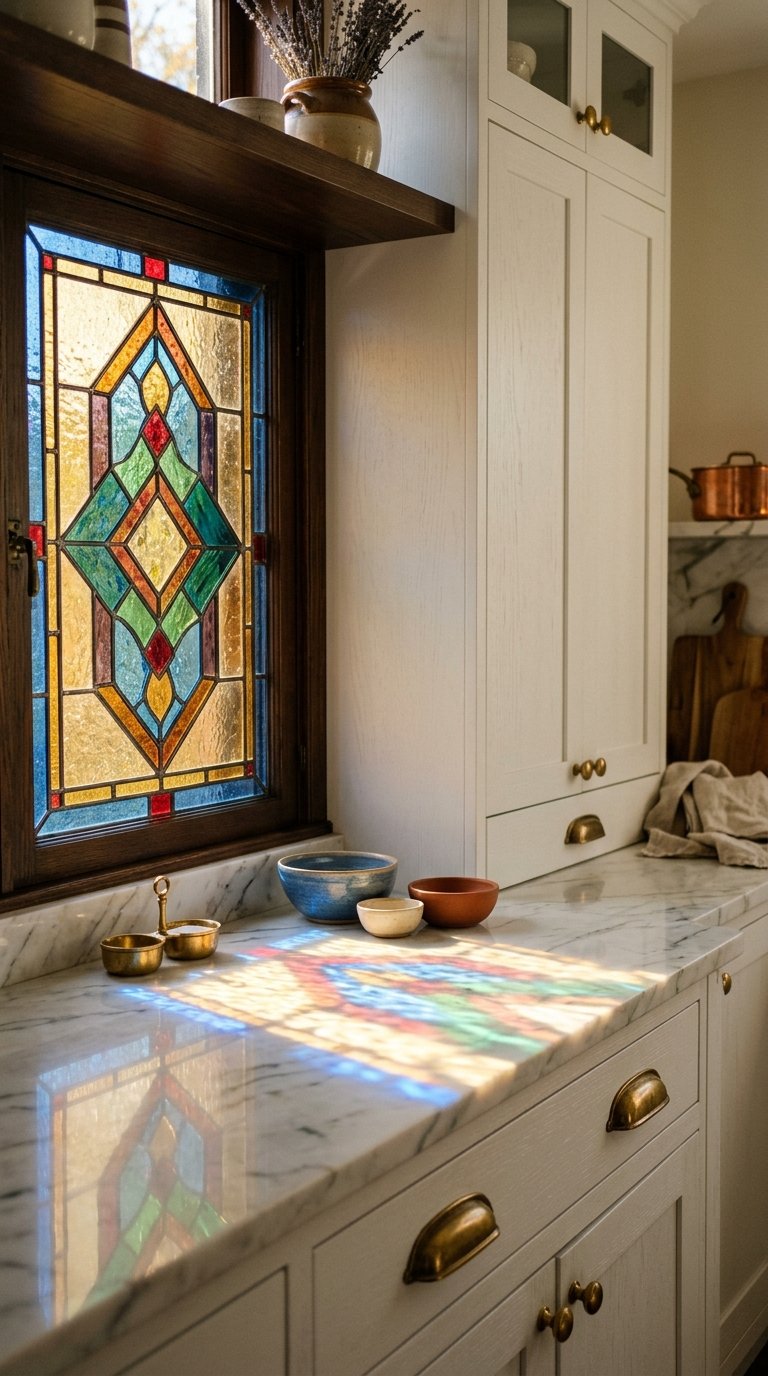
Stained glass panels installed in a kitchen window frame replace the standard clear or frosted glass with a fixed, colored glass composition that casts colored light patterns across the kitchen interior throughout the day. The light behavior of stained glass changes every hour as the sun angle shifts, which gives the kitchen a surface that performs differently in the morning than in the afternoon.
Custom stained glass panels from a local glass studio cost $150 to $500 per square foot depending on the complexity of the design and the type of glass used. Antique glass, which has slight surface variation and color depth that machine-rolled glass lacks, runs at the higher end of the price range. A 24×36-inch panel in a geometric pattern using antique glass costs approximately $600 to $1,200 from a regional glass artist and delivers a one-of-a-kind installation that no manufactured product replicates.
For a fraction of the cost, stained glass window film from Artscape at $25 to $45 per panel provides a comparable colored light effect without the structural modification or the budget commitment of true leaded glass. The film version lacks the material depth and the authentic light refraction of real stained glass, but it delivers 80 percent of the visual character at 5 percent of the cost. Use the film version to test the stained glass aesthetic in your kitchen before committing to a custom glass commission.
Final Thoughts
Your kitchen window is not decorative. It controls light, airflow, privacy, and the visual scale of the room. Every idea on this list addresses a specific kitchen problem, a dark corner, a privacy gap, a ventilation failure, a tight space that feels smaller than it is.
The highest-impact changes at the lowest cost are the window treatment swaps: café curtains at $48 per panel, Rabbitgoo privacy film at $25 per roll, and Artscape decorative film at $35 per panel. These change how your kitchen window looks and functions today, without a contractor, a permit, or a structural modification.
The highest-impact structural changes, the corner window, the bay window, and the pass-through, require investment and planning but transform the spatial experience of the kitchen in ways that paint, furniture, and lighting never fully achieve. Pick the idea that solves your kitchen’s specific window problem. Everything else in the room responds to that one change.