21 Black Kitchen Backsplash Ideas for a Bold Upgrade
Most backsplashes blend into the kitchen and disappear. A black backsplash does the opposite. It anchors the entire room, creates immediate contrast against cabinets and countertops, and turns the wall behind your stove into the most intentional surface in the kitchen. The boldness of a black backsplash is exactly the point, and when you pair it correctly, it works in traditional farmhouses, sleek modern kitchens, and everything in between.
These 21 ideas give you specific tile types, real brand recommendations, accurate price ranges, and the exact reasons each pairing works. No mood boards. No vague inspiration. Real kitchens, real materials, and honest advice on what to buy and how to make it work.
1. Black Subway Tile With White Cabinets for Maximum Contrast
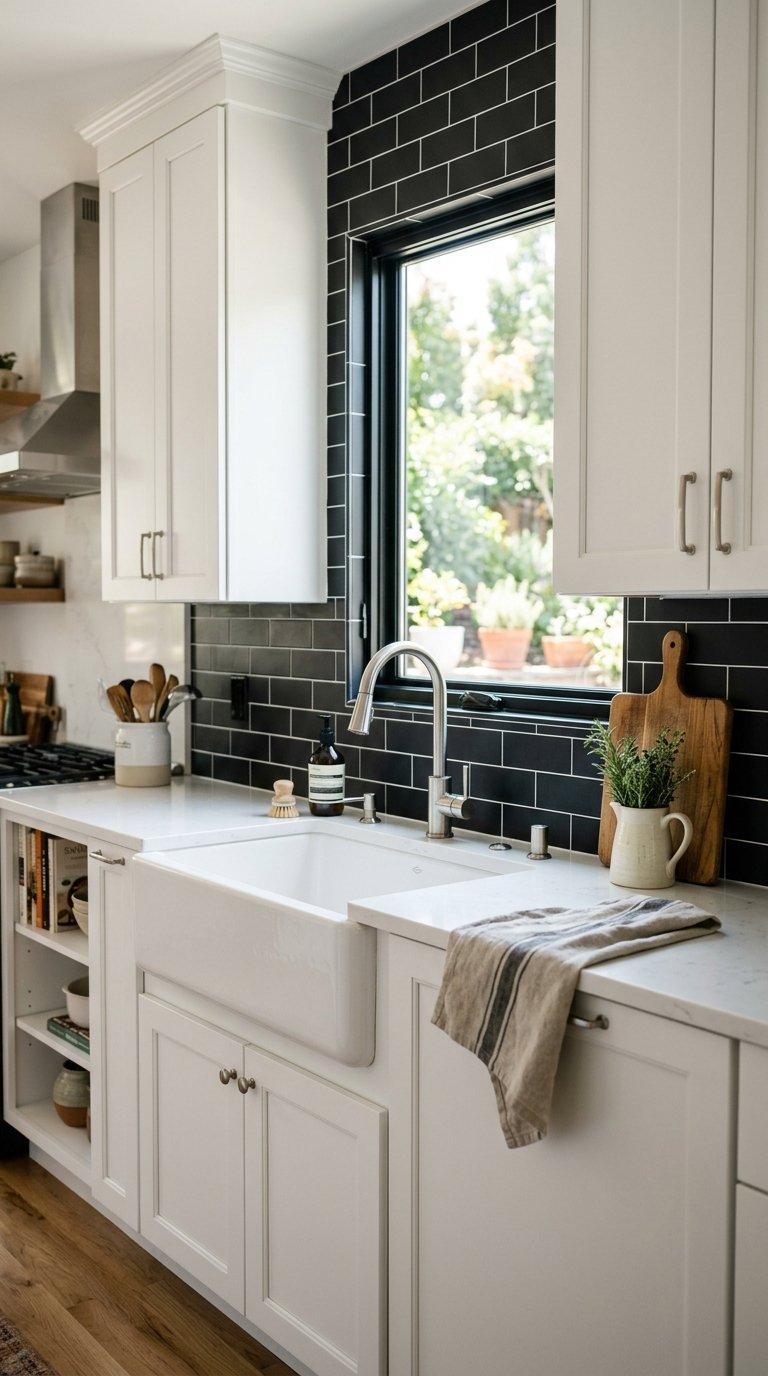
Black subway tile against white cabinets is the highest-contrast backsplash combination in residential kitchen design, and it works because the two surfaces do exactly opposite things. The white cabinets push the wall surface forward visually. The black tile pulls the backsplash back into depth, creating a layered effect that a matching cabinet-and-backsplash palette never achieves.
Daltile’s Rittenhouse Square 3×6-inch matte black ceramic subway tile costs $2.49 per square foot at Home Depot. For a standard 30-square-foot backsplash behind the stove and sink, your material cost sits under $80. Matte black outperforms glossy black in kitchens because matte hides water spots and grease splatter between cleanings, which is the one practical weakness of any dark backsplash surface.
Use a white or light gray grout from Mapei’s Keracolor U line at $18 per bag to define each tile individually against the black surface. A black grout on black subway tile eliminates the grid pattern and the wall reads as a flat dark surface. The white grout keeps the tile pattern visible and reinforces the graphic contrast that makes this combination work.
2. Black Hexagon Mosaic Tile Behind the Range
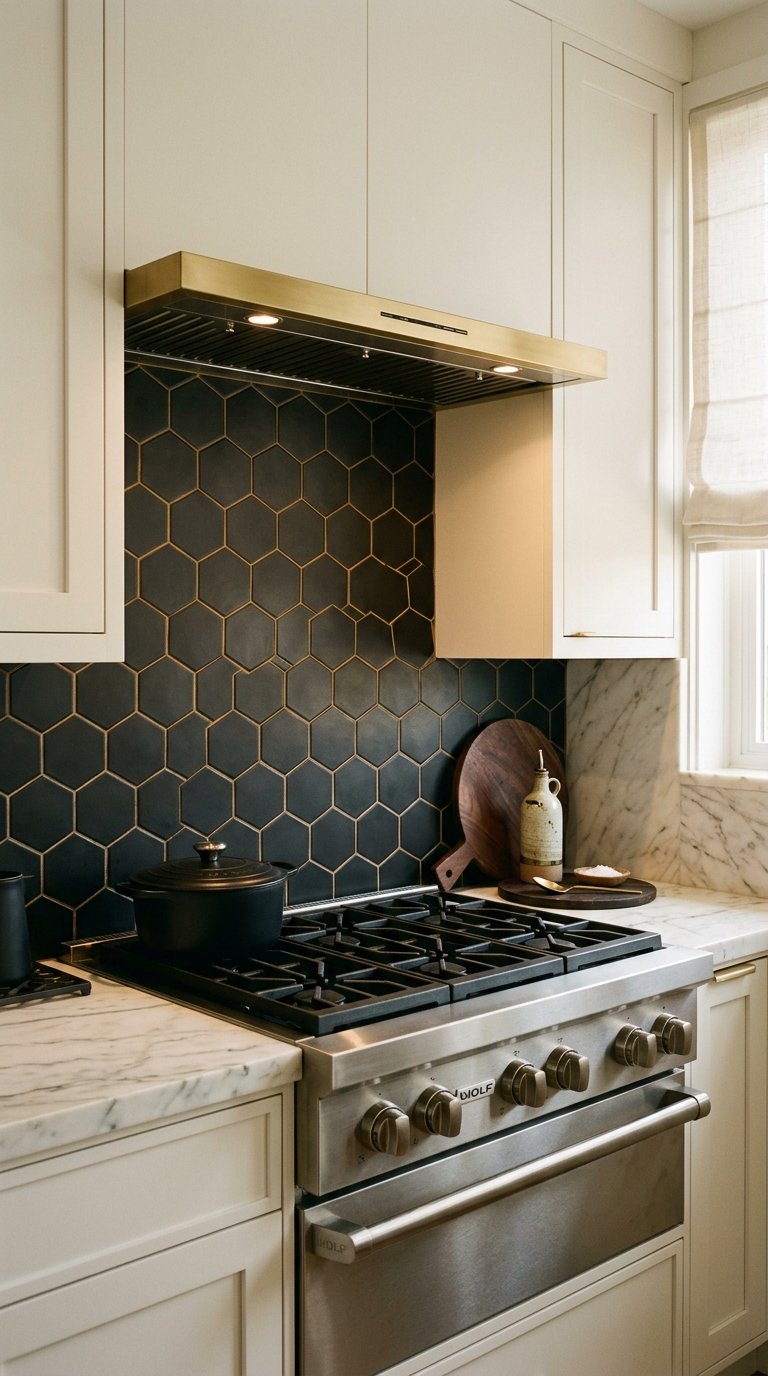
A black hexagon mosaic tile behind the range creates a focal point on the kitchen wall that draws the eye toward the cooking zone rather than letting it wander across a flat, undifferentiated backsplash surface. The geometric density of the hexagon pattern at small scale, typically 1 to 2 inches per tile, delivers visual texture that no large format tile replicates.
TileBar’s 2-inch matte black porcelain hexagon mosaic costs $8.99 per square foot. A focused range backsplash of approximately 15 square feet runs $135 in tile materials before installation. Install the hexagon mosaic only behind the range and extend a simpler subway or large format black tile across the remaining backsplash run to keep the budget manageable and the focal point concentrated.
Pair the black hexagon backsplash with brass or unlacquered brass grout from Mapei’s Flexcolor CQ in Antique Gold at $22 per quart. The warm metallic grout between matte black hexagon tiles creates a surface that reads as both graphic and luxurious. FYI, this grout-and-tile combination photographs as one of the most shared kitchen backsplash details on design platforms and costs under $200 to execute on a standard range backsplash.
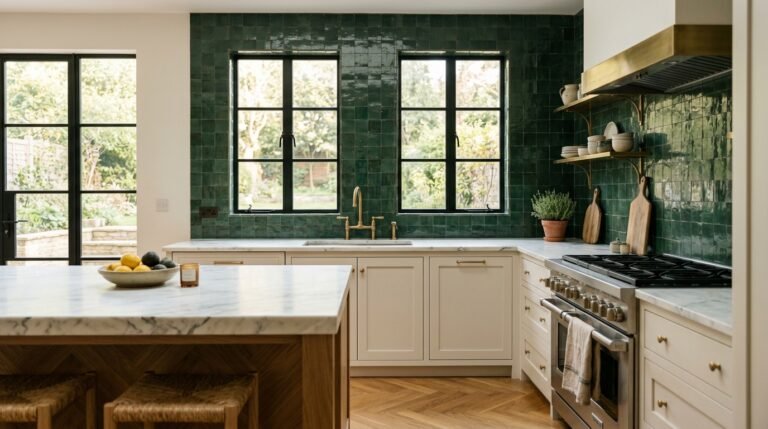
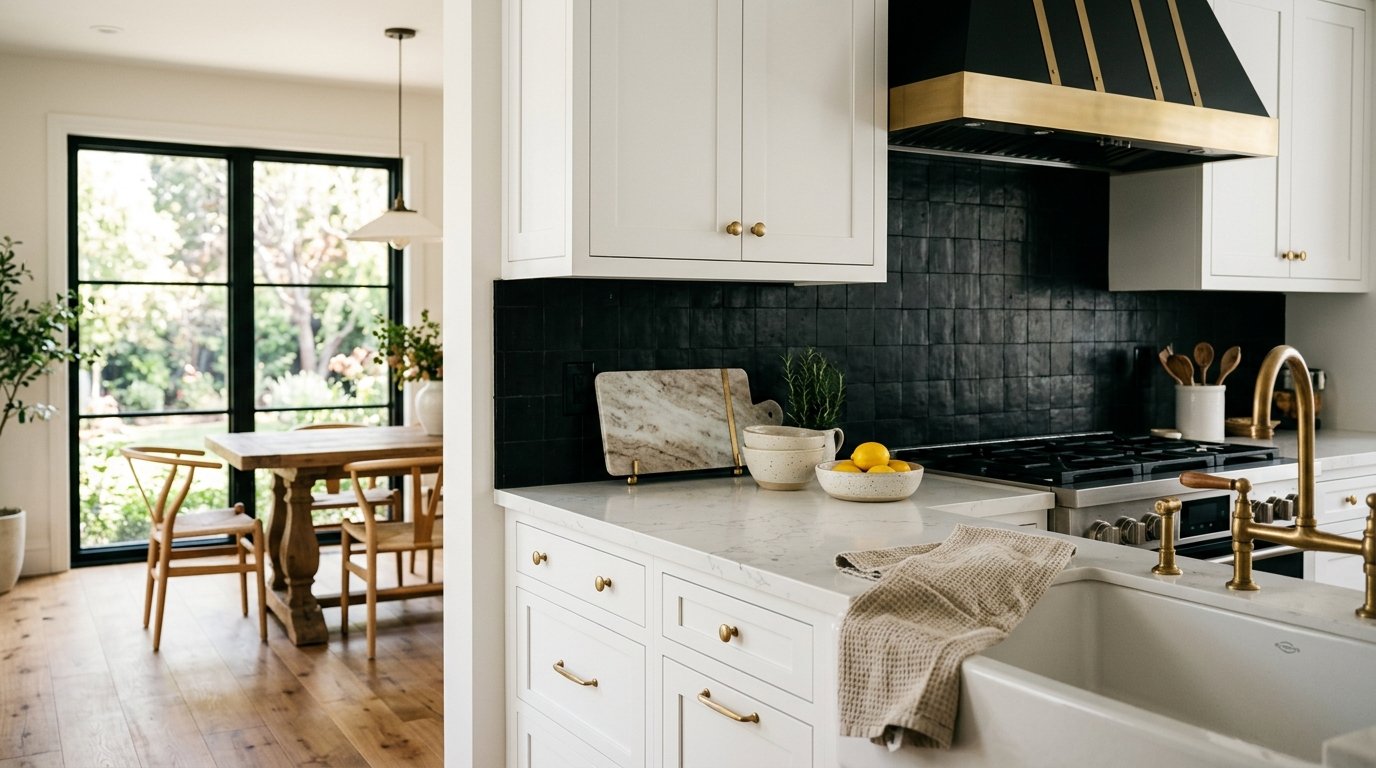
3. Black Zellige Tile for a Handmade, Reflective Backsplash
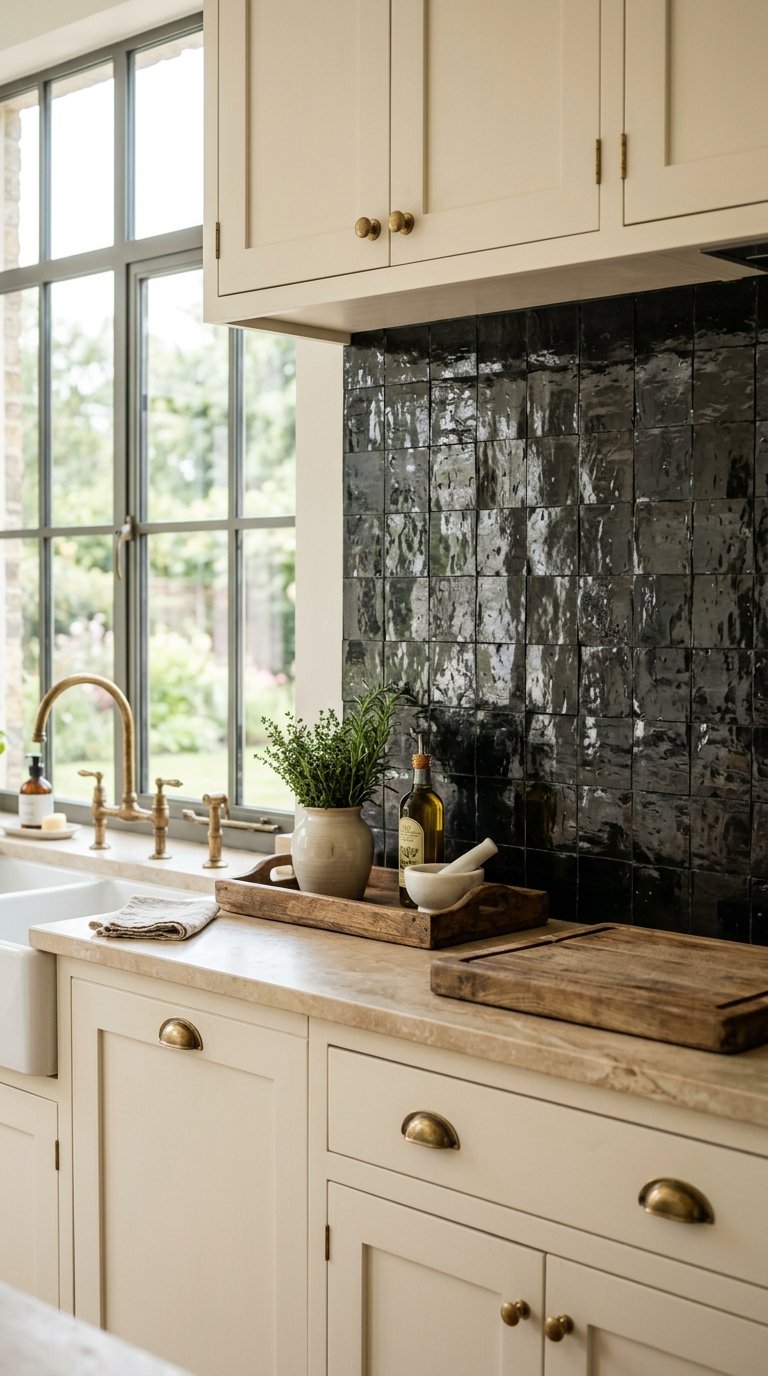
Black zellige tile is hand-cut Moroccan glazed terracotta with an irregular surface and a reflective glaze that catches kitchen light differently at every angle. A black zellige backsplash does something no flat tile achieves: it shifts between matte and glossy, dark and luminous, depending on where you stand and where the light hits. The surface reads as alive rather than static.
Clé Tile’s black zellige costs $28 to $35 per square foot, which puts a standard 30-square-foot backsplash in the $840 to $1,050 material range. The price reflects the hand-production process in Morocco and the material authenticity that no mass-produced glazed porcelain replicates. Install it in a running bond pattern with tight joints and no grout for a wall-to-wall surface that reads as continuous.
Pair black zellige with white or cream cabinets and unlacquered brass hardware from Rejuvenation’s cup-pull collection at $18 per pull. The warm gold of the brass against the black zellige glaze creates a combination that design publications have featured consistently since 2019. The zellige surface does the design work and the brass hardware reinforces it without adding a third competing element.
4. Black Marble Slab Backsplash for a Seamless, Luxurious Kitchen
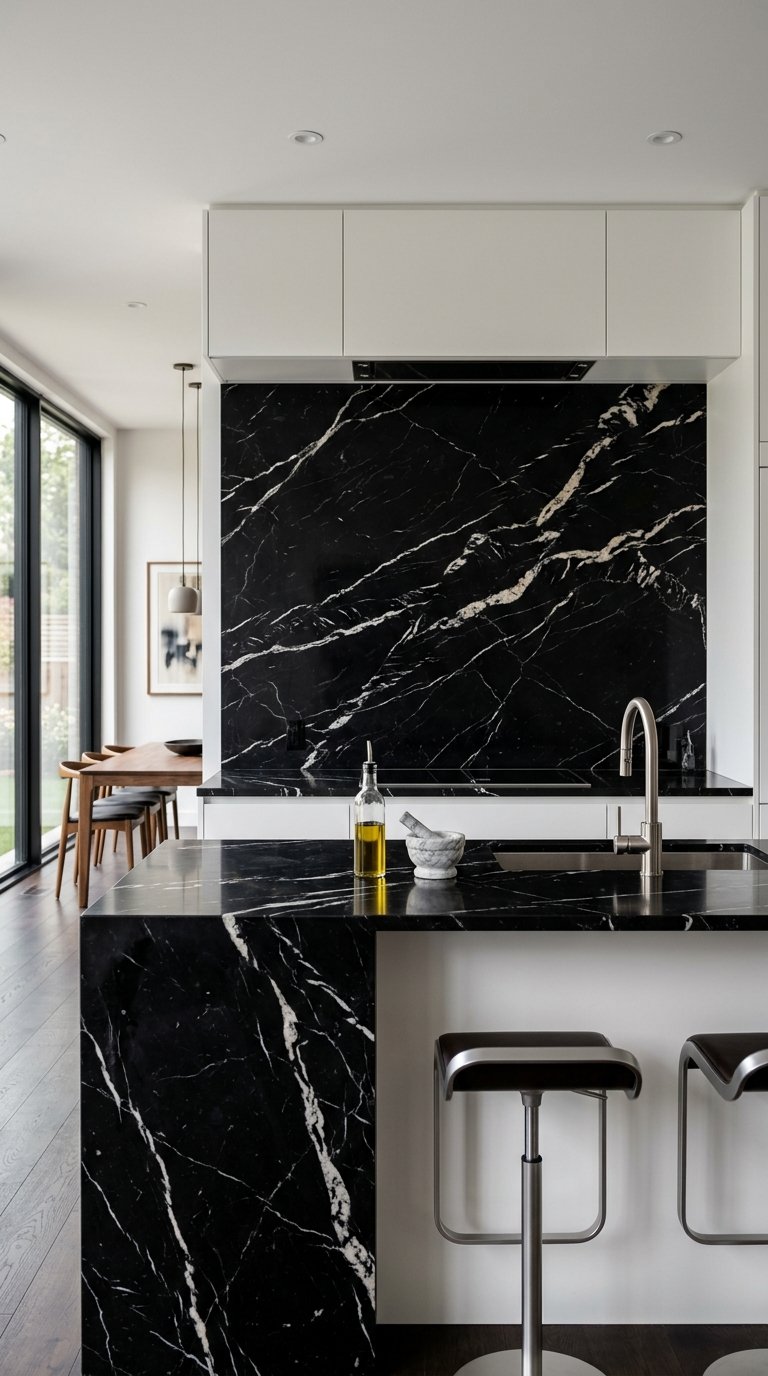
A black marble slab backsplash uses a single continuous stone surface from countertop to upper cabinet with no tile joints, no grout lines, and no pattern repeat. The result is a backsplash that reads as architectural rather than decorative, which suits luxury kitchen renovations where the goal is a seamless, material-focused aesthetic.
Nero Marquina black marble from Stone Center Online costs $12 to $22 per square foot in slab format. A 30-square-foot backsplash runs $360 to $660 in stone materials before fabrication and installation labor, which adds $400 to $800 depending on complexity. The white veining in Nero Marquina moves across the black field in a natural, irregular pattern that no tile reproduction approximates.
Seal the marble surface with StoneTech BulletProof Sealer at $30 per quart before installation and reapply annually in a kitchen environment. Black marble shows etching from acidic foods and liquids, including lemon juice, tomato, and vinegar, more visibly than light marble because the etch mark lightens the black surface. Seal consistently and wipe acidic spills immediately to prevent permanent surface damage.
5. Matte Black Large Format Tile for a Modern, Minimal Backsplash
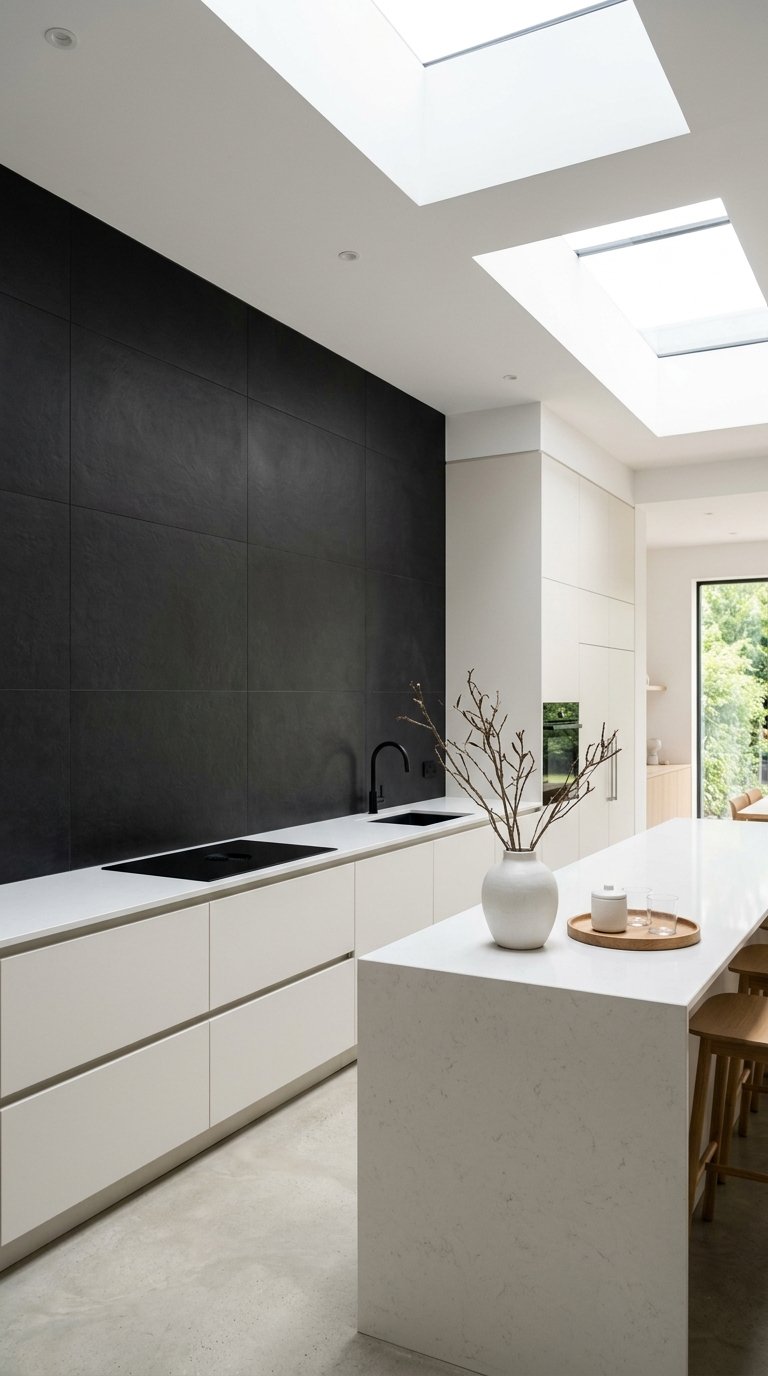
Large format matte black tile in a 12×24 or 24×24-inch size reduces grout lines across the backsplash to a minimum and creates a continuous dark surface that reads as clean and architectural. In modern and minimalist kitchens where the goal is a backsplash that recedes rather than dominates, large format matte black delivers that result without pattern or texture.
Emser Tile’s Lucida series in 24×24 matte black porcelain costs $4.49 per square foot. A 30-square-foot backsplash runs approximately $135 in tile materials. Use a matching dark charcoal or black non-sanded grout from Custom Building Products’ Polyblend Plus at $12 per bag to minimize joint visibility and keep the surface reading as one continuous dark plane.
Pair large format matte black tile with white or light gray handleless cabinetry and white quartz countertops from Silestone’s Iconic White line at $55 to $75 per square foot. The matte black tile disappears visually between the white surfaces, creating a kitchen palette that reads as precise and intentional. Ever wondered why Scandinavian kitchens look so considered? This material relationship is a significant part of the answer.
6. Black Penny Round Mosaic for a Retro, Textured Backsplash
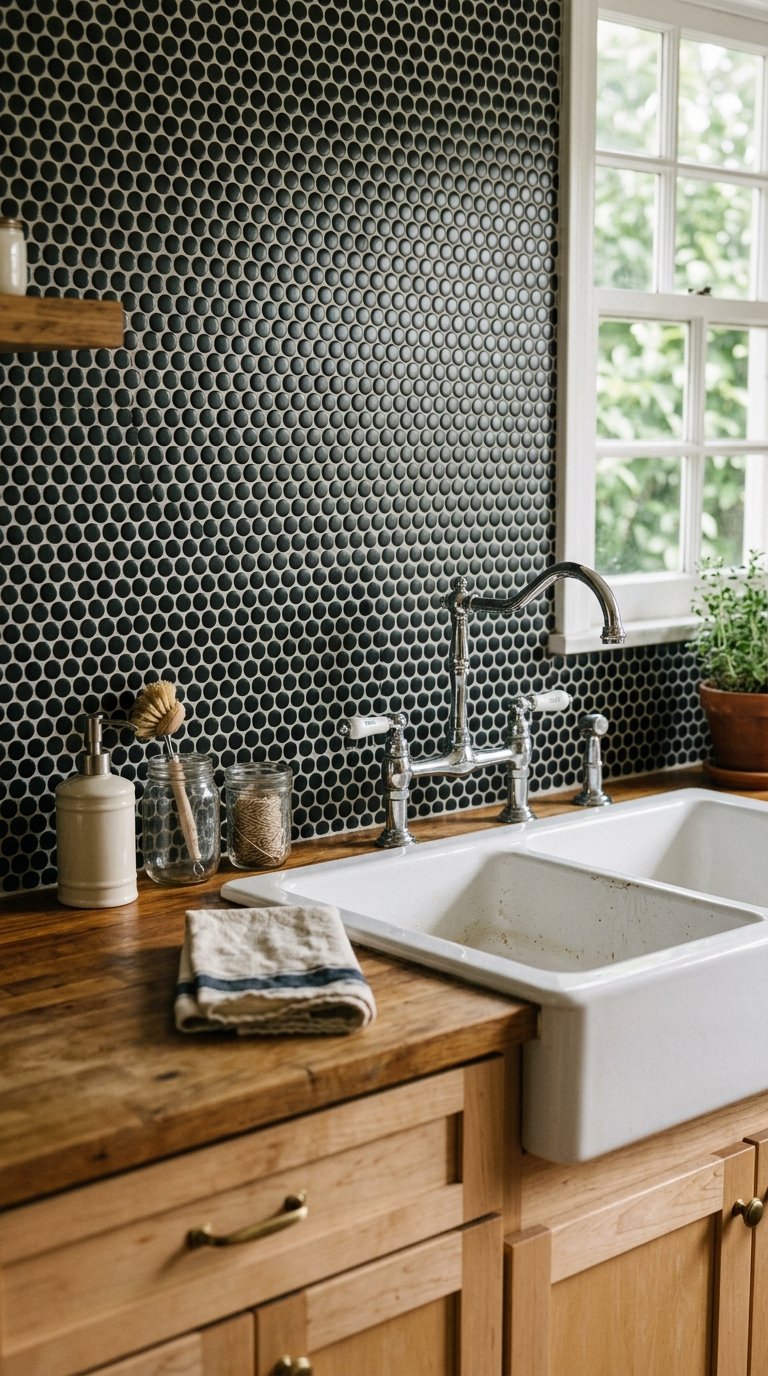
Black penny round mosaic tile brings the same dense, textured surface to a kitchen backsplash that it delivers on a floor, but at the wall height where the texture reads as decorative rather than functional. The 1-inch circular format covers the backsplash in a tight, repetitive pattern that holds visual interest across a large surface without introducing a bold geometric shape.
Wayfair’s 1-inch matte black porcelain penny round mosaic sheets cost $9 to $12 per square foot on mesh backing. A 30-square-foot backsplash runs $270 to $360 in materials. The mesh backing installs like standard sheet mosaic tile, which makes it manageable for a confident DIY tiler without professional experience. Allow an extra 10 percent in materials for cuts at outlets, switches, and cabinet edges.
Use a light gray or warm white grout between the black penny rounds rather than black. The contrast between the dark tile and the lighter grout reads as a surface with depth and texture at close range, while reading as a soft, unified dark surface from across the kitchen. Black grout on black penny rounds flattens the entire effect and the texture disappears.
7. Black Handmade Ceramic Tile for an Artisan Backsplash
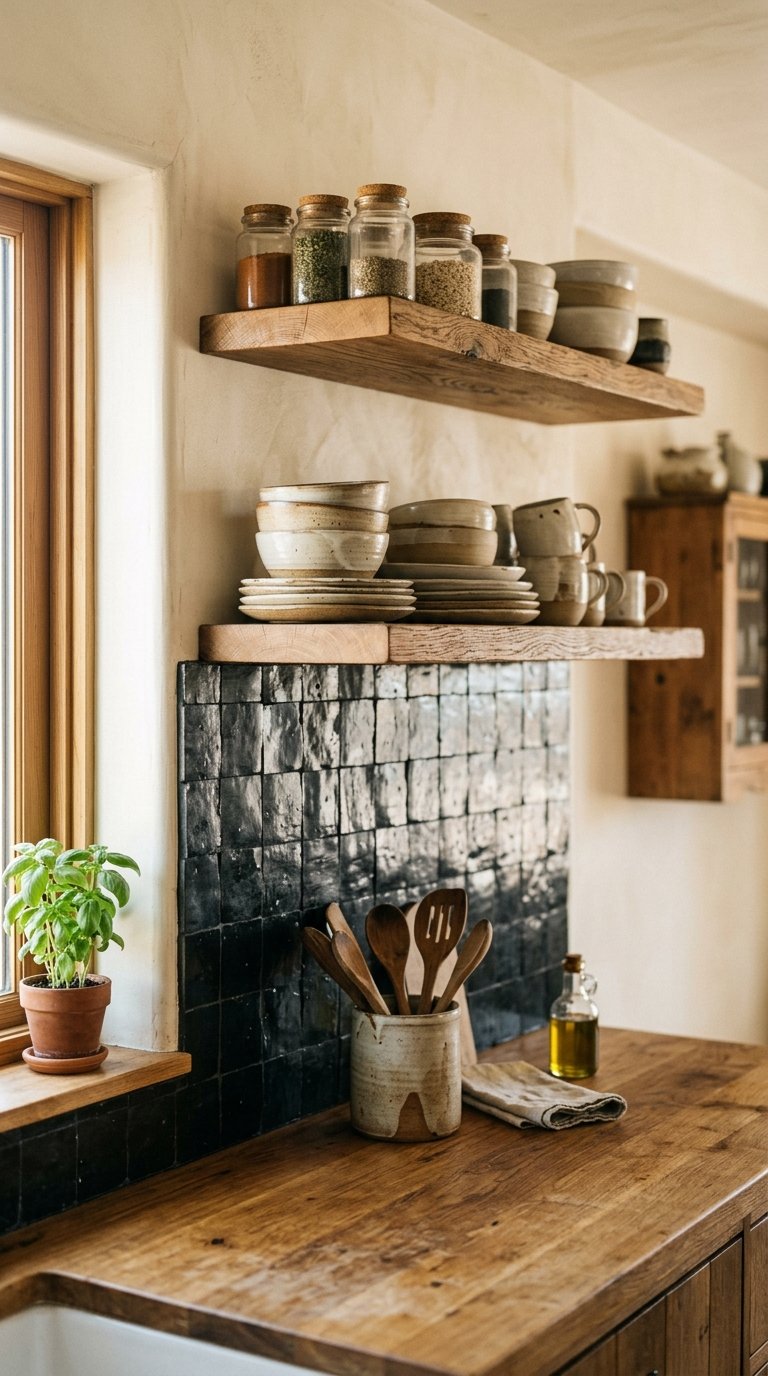
Handmade black ceramic tile brings surface variation, slight warping, and color depth to a kitchen backsplash that machine-made tile does not provide. Each tile varies slightly in tone from near-black to deep charcoal, and the irregular surface catches light in a way that creates a backsplash with genuine material character.
Fireclay Tile’s handmade 4×4-inch ceramic in Midnight costs $18 to $22 per square foot. A 30-square-foot backsplash runs $540 to $660 in tile materials. The price reflects the hand-production process in California and the material consistency that Fireclay maintains across their handmade line. IMO, Fireclay’s handmade ceramic tile delivers more visual interest per dollar than any other artisan tile brand at this price point.
Pair the handmade black ceramic with natural wood open shelving, brass or warm bronze hardware, and a cream or warm white countertop to build a kitchen palette that feels both artisan and considered. The slight surface variation of the handmade tile against the clean lines of the wood shelving creates a tension between the organic and the architectural that makes the kitchen feel designed rather than assembled.
8. Black Grouted White Tile Backsplash for a Graphic Twist
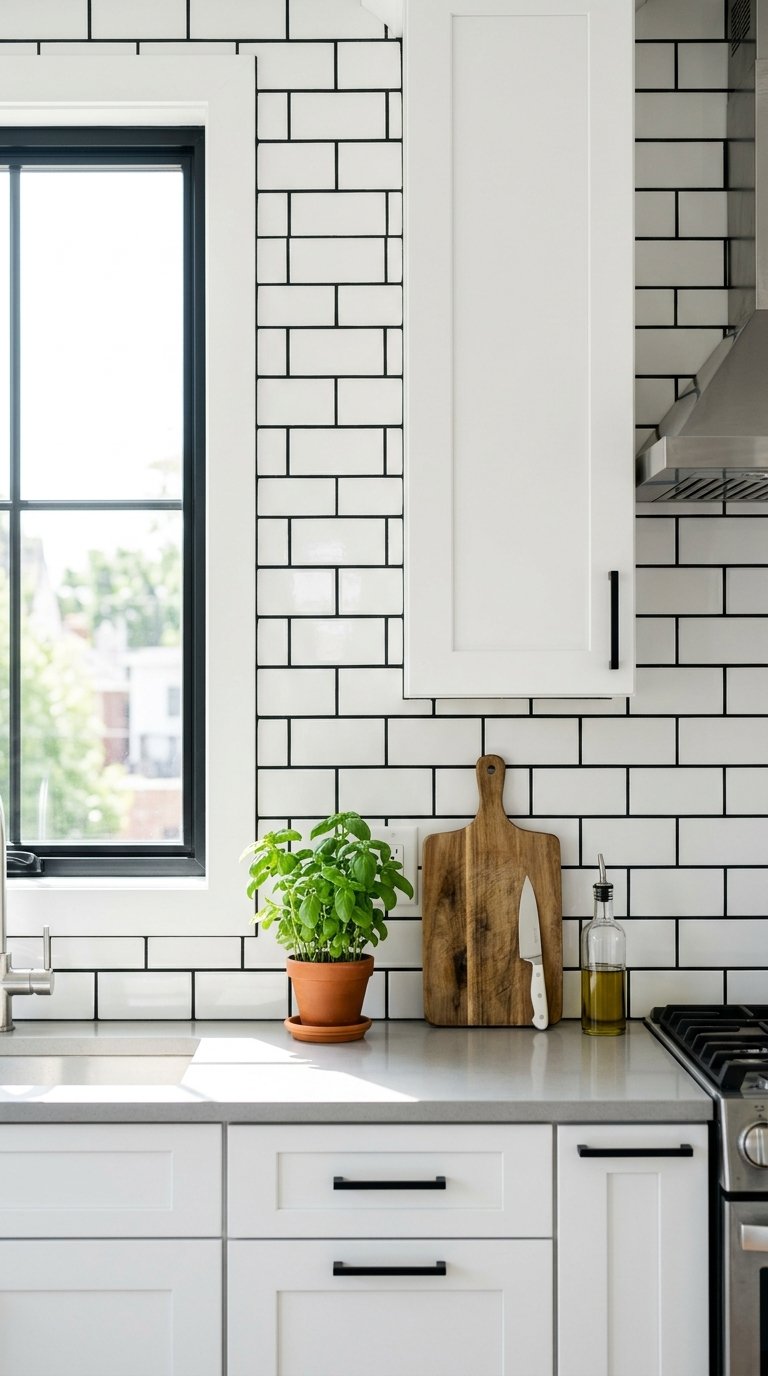
White tile with black grout is the backsplash inversion that delivers a black kitchen element without committing to a black tile surface. The black grout grid reads as a graphic pattern across the white tile field, which creates a strong visual element without the full darkness of a black tile backsplash.
American Olean’s Bright White 3×6-inch ceramic subway tile costs $1.89 per square foot at Home Depot. Combine it with Mapei Ultracolor Plus FA in Carbon at $22 per bag for the black grout. The combination costs under $100 in materials for a standard 30-square-foot backsplash and delivers a graphic result that costs significantly more in most tile stores when sold as a pre-designed black and white backsplash concept.
This is the budget-conscious path to a black backsplash kitchen aesthetic. The white tile reflects more light than a black tile surface, which keeps the kitchen bright while the black grout grid delivers the graphic contrast. For kitchens with limited natural light, white tile with black grout performs better than a true black tile backsplash because it maintains brightness while adding the dark graphic element.
9. Black Soapstone Tile for a Natural, Matte Backsplash
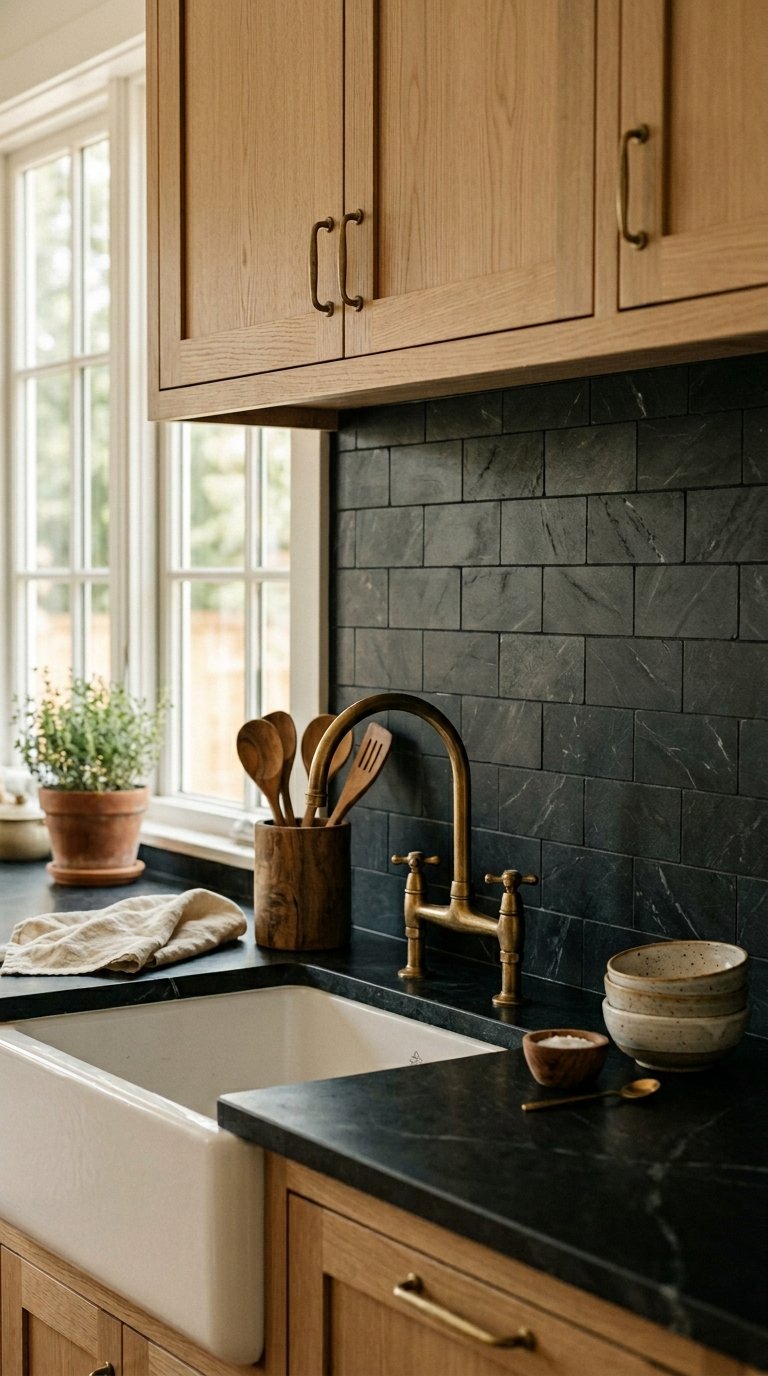
Soapstone tile brings a natural stone surface to the kitchen backsplash with a specific quality no other black material replicates: it develops a patina over time that makes the surface look richer and more complex at five years than at installation. The stone is naturally non-porous, which means it does not require sealing and resists water and grease absorption without any maintenance product.
Virginia Mist soapstone from M S International in a 6×12-inch honed tile costs $8 to $14 per square foot. A 30-square-foot backsplash runs $240 to $420 in materials. The natural variation in the stone surface means no two tiles are identical, which gives the backsplash a genuine handmade quality at a manufactured price point. Apply food-grade mineral oil to the surface with a cloth once or twice per year to deepen the natural color and accelerate the patina development.
Soapstone scratches more easily than porcelain or ceramic tile, which at the backsplash height matters less than it would on a countertop surface. Light surface scratches in the backsplash zone at eye and splash height develop into the patina character over time rather than degrading the surface. Use a food-grade mineral oil touch-up on any visible scratches to blend them into the natural stone color.
10. Black Brick Tile Backsplash for an Industrial Kitchen
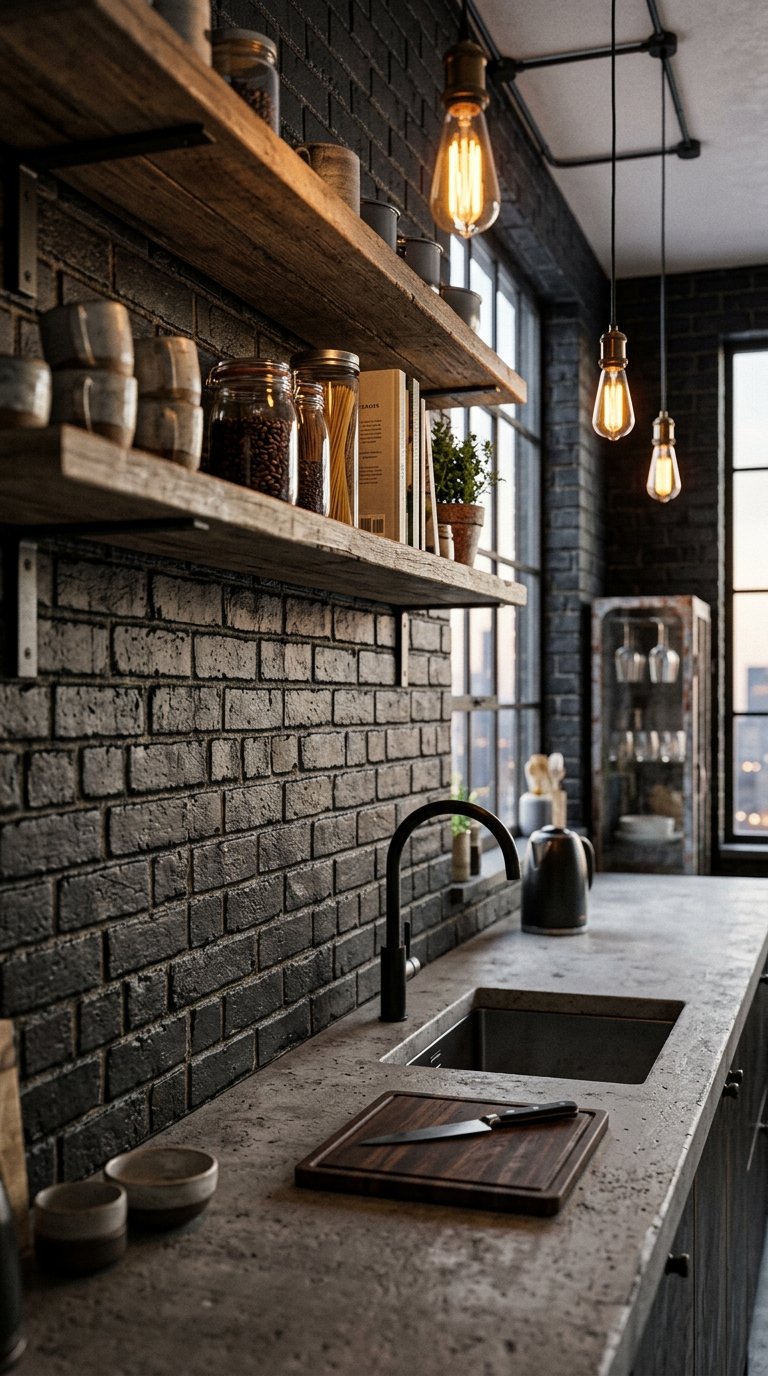
Thin black brick tile on the kitchen backsplash brings the raw, structural quality of an exposed brick wall to a kitchen interior without the depth, weight, or demolition that real brick requires. The familiar module of the brick shape and the rough surface texture read as authentic building material rather than decorative tile, which suits industrial, loft, and modern farmhouse kitchens specifically.
Inglenook Brick Tile’s 2.25×7.5-inch thin brick in Charcoal Black costs $8 to $12 per square foot. A 30-square-foot backsplash runs $240 to $360 in materials. Install in a running bond pattern with a dark charcoal mortar joint to reinforce the authentic brick-and-mortar aesthetic. A white grout joint on a black brick backsplash reads as a tiled surface rather than a brick wall, which defeats the design intent entirely.
Pair the black brick backsplash with raw steel or matte black open shelving brackets from Shelf Supports Plus at $8 to $15 per bracket, reclaimed wood shelf boards, and exposed Edison bulb pendants to build the full industrial kitchen aesthetic. The combination of black brick, raw steel, wood, and warm bulb light is the most cohesive material palette for an industrial kitchen and every element reinforces the others.
11. Black Glass Tile for a Reflective, High-Gloss Backsplash
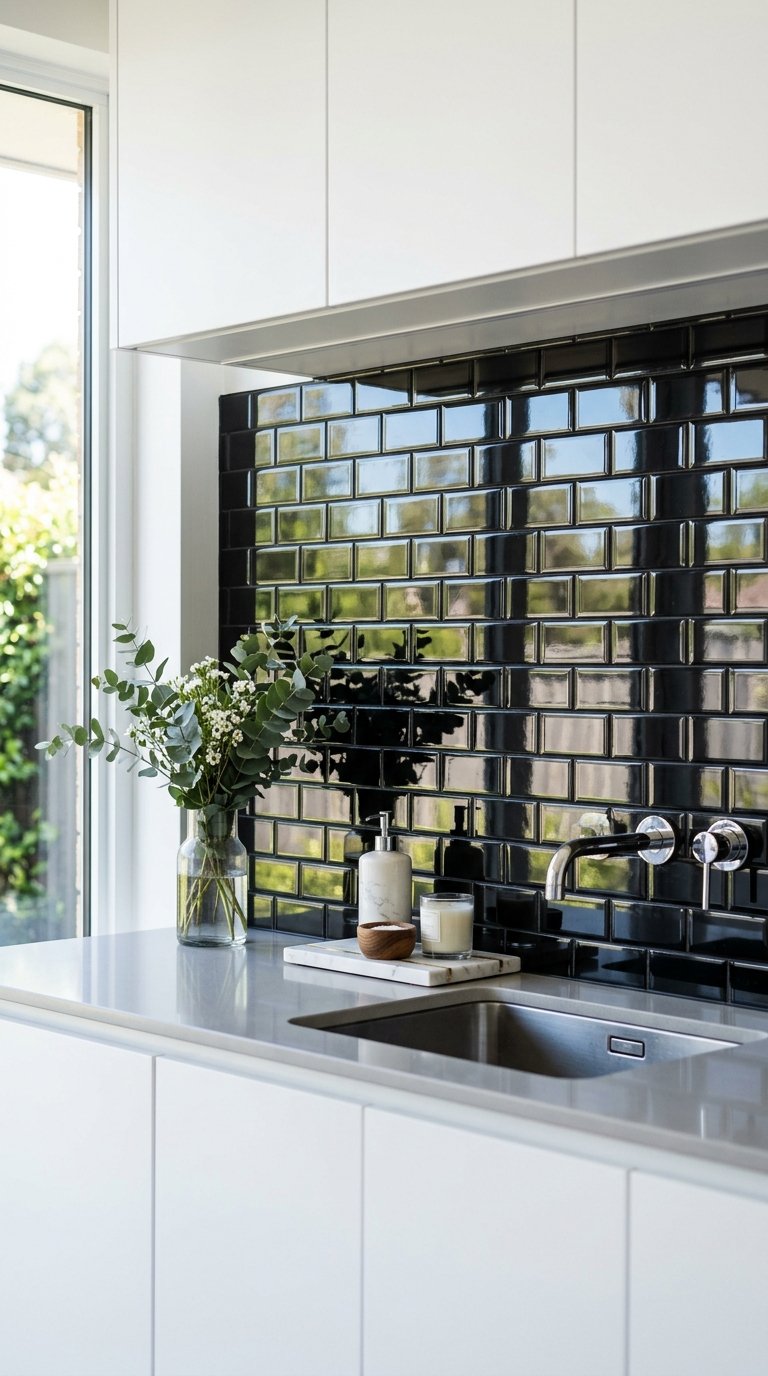
Black glass tile is the highest-reflectivity backsplash option on this list. The glossy glass surface bounces light around the kitchen at every angle, which prevents the dark backsplash from absorbing light and making the room feel dim. In kitchens with limited natural light, black glass tile performs better than any matte black surface because it reflects rather than absorbs.
Bedrosians’ 3×6-inch black glass subway tile costs $12 to $18 per square foot. A 30-square-foot backsplash runs $360 to $540 in materials. Use a white or light gray non-sanded grout between the glass tiles to define the joints without competing with the reflective glass surface. Sanded grout scratches glass tile edges during installation and leaves a permanently hazed joint that dulls the reflective quality of the finished surface.
The practical downside of black glass tile in a kitchen is visibility of water spots, fingerprints, and grease splatter. Every mark shows on the reflective surface, which demands more frequent cleaning than matte black alternatives. Wipe the surface with a microfiber cloth and a diluted white vinegar solution daily in an active cooking kitchen to maintain the reflective clarity that makes the glass tile worth its price premium over matte options.
12. Black Arabesque Tile for a Moroccan-Inspired Kitchen
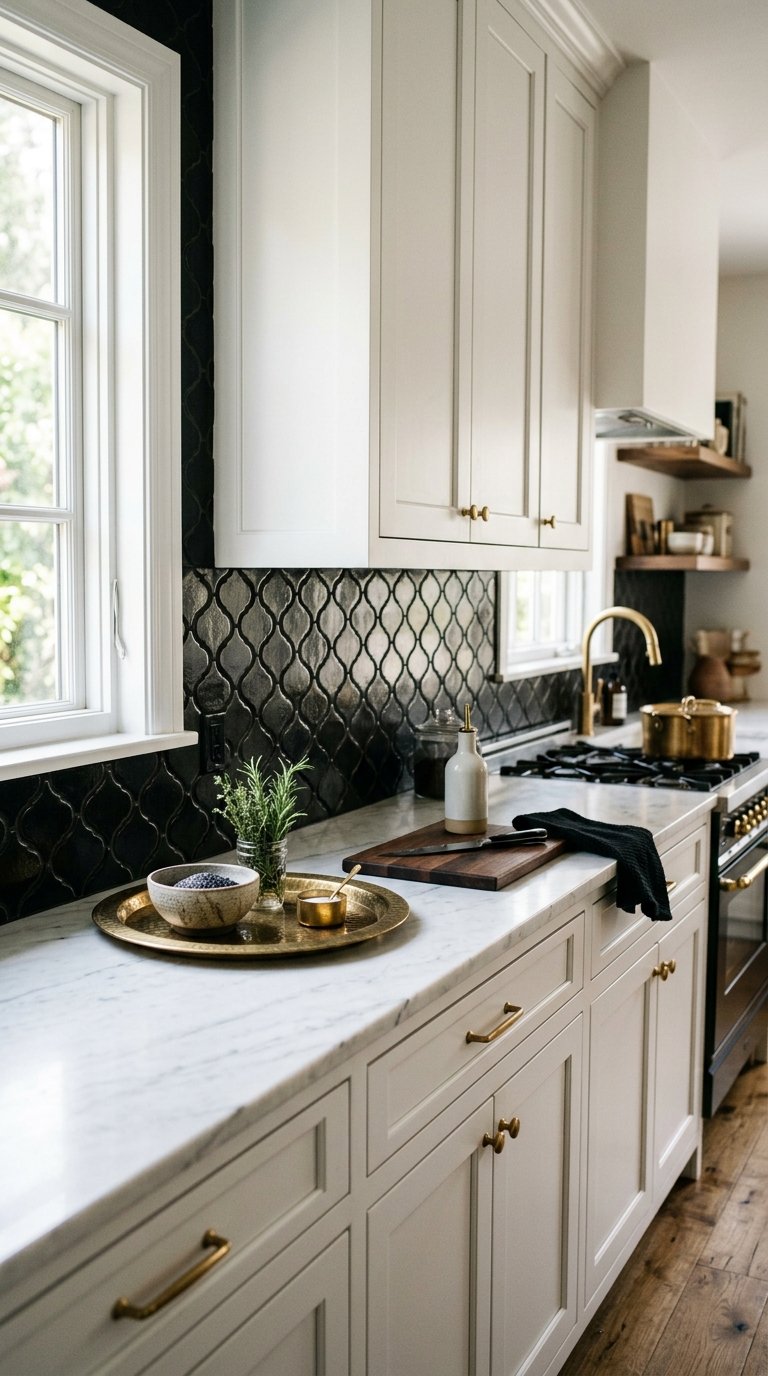
Arabesque tile uses a pointed oval shape with curved sides that locks together in a continuous pattern across the backsplash without grout lines interrupting the form. In black, the arabesque shape creates a dense, elegant surface that reads as Moroccan-influenced without requiring any other Moorish design element in the kitchen.
TileBar’s 3×6-inch black porcelain arabesque mosaic costs $11.99 per square foot. A 30-square-foot backsplash runs approximately $360 in tile materials. The shape requires precise layout planning before installation. Start from the center of the backsplash and work outward symmetrically so the cut tiles at the edges match on both sides and the pattern reads as intentional from the front.
Pair the black arabesque backsplash with white or cream shaker cabinets, unlacquered brass hardware, and a white marble or marble-look quartz countertop to create a kitchen that reads as globally influenced without feeling themed. The arabesque shape carries the Moroccan reference and every other surface in the kitchen stays clean and simple to let the pattern breathe. This is exactly the backsplash idea that sounds bold in description and photographs as sophisticated in execution.
13. Black Herringbone Tile for a Directional Backsplash Pattern
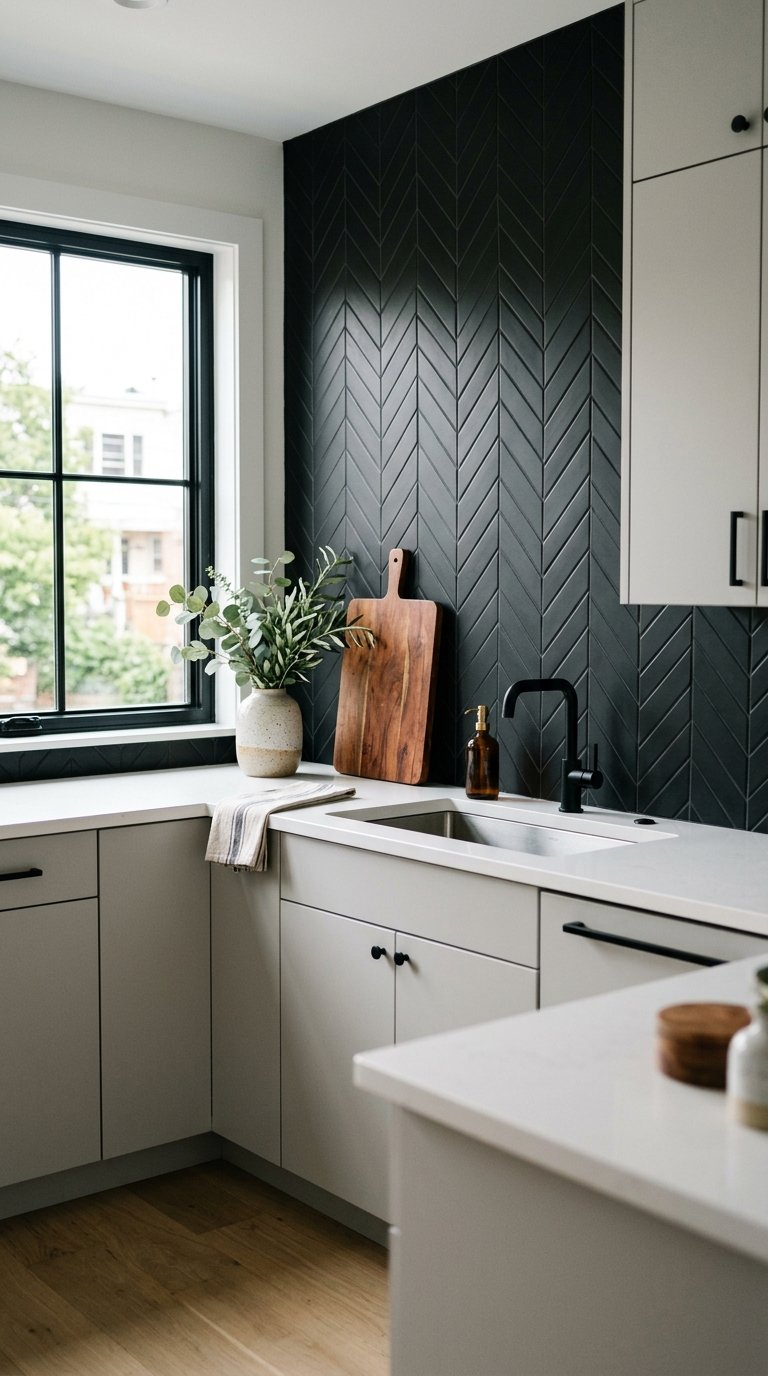
A black herringbone tile pattern on the kitchen backsplash creates directional movement across the wall surface that no straight-set tile layout produces. The V-shaped arrangement of the herringbone draws the eye horizontally across the backsplash, which makes the kitchen feel wider and makes the backsplash zone feel more expansive than the same tile set in a standard running bond.
MSI’s 2×8-inch matte black porcelain plank tile in a herringbone layout costs $4.49 per square foot. The longer plank format emphasizes the herringbone angle more dramatically than a standard 3×6 subway tile does. Budget an extra 15 percent in tile materials for the increased waste from the angled cuts at the perimeter of the backsplash, around outlets, and at cabinet edges.
Use a medium gray grout from Mapei Keracolor in Warm Gray at $18 per bag to keep the herringbone pattern visible without introducing a stark white joint on the black surface. The warm gray grout sits in the middle ground between black tile and white grout, creating a softer contrast that reads as refined rather than graphic. The directional pattern does enough visual work on its own without the added punch of a high-contrast white grout joint.
14. Black Encaustic Cement Tile Backsplash for Bold Pattern
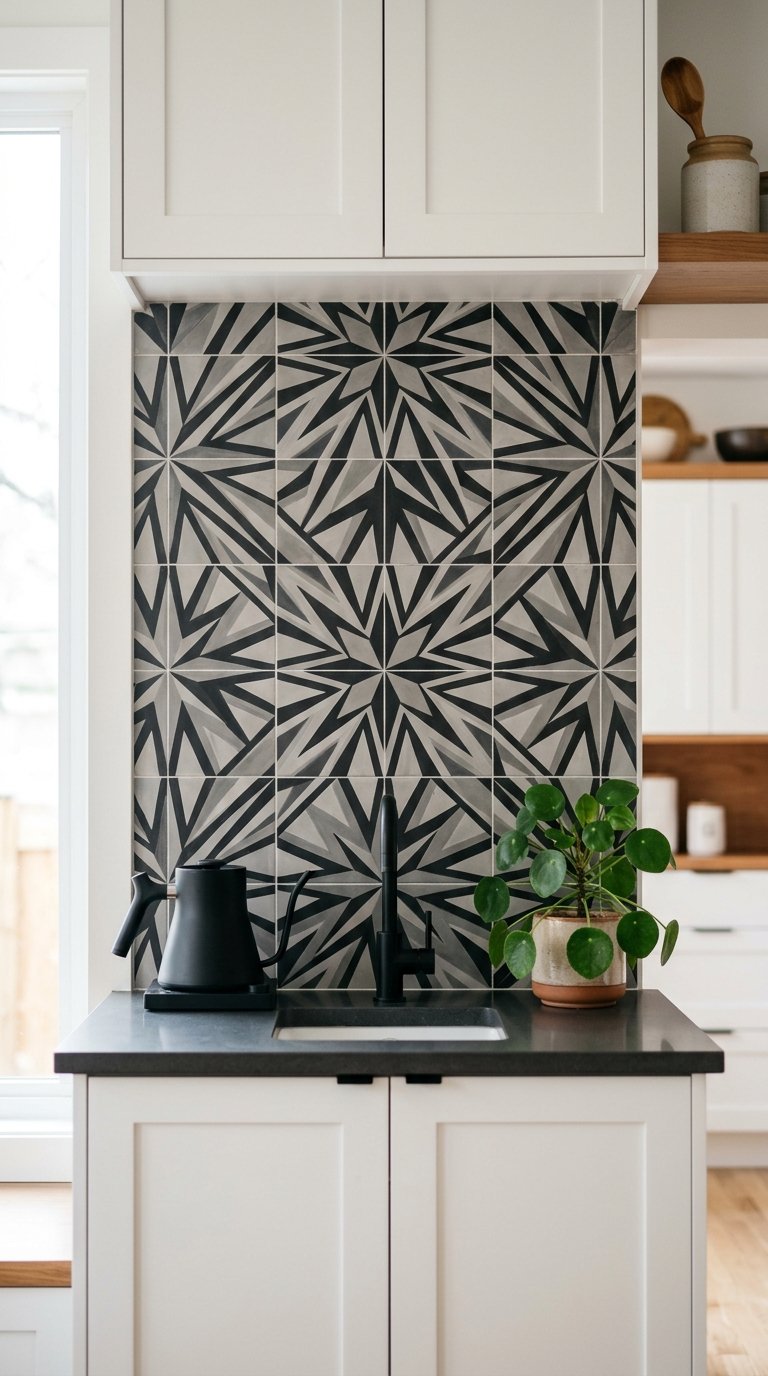
Encaustic cement tile on a kitchen backsplash delivers the same handmade character and bold geometric pattern as on a floor but at the wall height where the pattern functions as pure decoration rather than functional surface. A black encaustic cement tile backsplash in a geometric or star-and-cross pattern creates the most visually complex backsplash surface on this list.
Cement Tile Shop’s black geometric encaustic tile starts at $12 per square foot for stock patterns. A 30-square-foot backsplash runs approximately $360 in tile materials. Seal the cement surface with a penetrating impregnating sealer from Miracle Sealants at $25 per quart before grouting and reapply annually. Unsealed cement tile at the backsplash height absorbs cooking grease and water permanently and the pattern colors shift irreversibly within months of installation.
Use black encaustic cement tile as a full-height backsplash between the countertop and upper cabinets only behind the range rather than across the full kitchen backsplash run. The pattern density of encaustic cement tile at a full kitchen backsplash length overwhelms a small to mid-size kitchen. Concentrated at the range wall, it creates a focused, designed focal point and the material cost stays manageable at 10 to 15 square feet rather than 30 or 40.
15. Black Shiplap Backsplash for a Farmhouse Kitchen
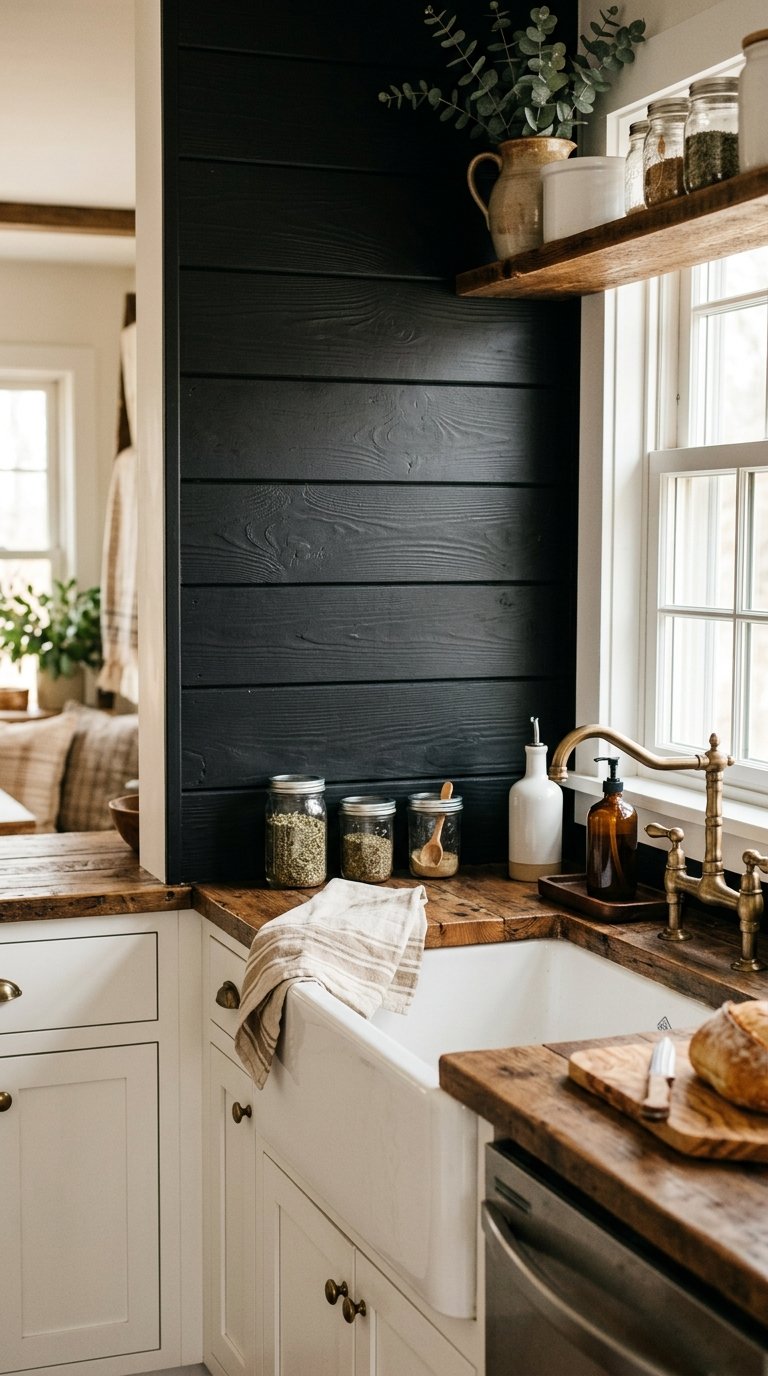
Black painted shiplap on the kitchen backsplash is not a tile at all, which is precisely why it belongs on this list. Horizontal wood shiplap planks painted in a flat or satin black deliver the farmhouse backsplash aesthetic with a material warmth that no ceramic or porcelain tile replicates. The wood grain reads through the black paint, giving the surface depth and texture at a material cost well below any tile option.
Metrie’s 4-inch primed pine shiplap at $1.50 to $2.50 per linear foot from Home Depot covers a standard 30-square-foot backsplash for approximately $120 to $180 in materials. Paint the installed shiplap with Benjamin Moore Advance in Onyx 2133-10 at $75 to $85 per gallon in a satin finish for a hard, scrubbable surface that handles kitchen splash and grease cleaning. The Advance formula’s alkyd-modified acrylic base delivers a factory-finish hardness that standard latex wall paint does not.
Apply a water-resistant primer from Zinsser’s Bulls Eye 1-2-3 at $20 per quart to the raw wood before painting to prevent moisture absorption in the backsplash splash zone. Shiplap without a primer and sealing coat absorbs water behind the stove and sink over time, which leads to swelling, paint failure, and mold growth in the wall cavity. Prep the surface correctly and black painted shiplap outperforms most tile options in visual warmth and character.
16. Black Stacked Stone Backsplash for a Natural, Textured Kitchen
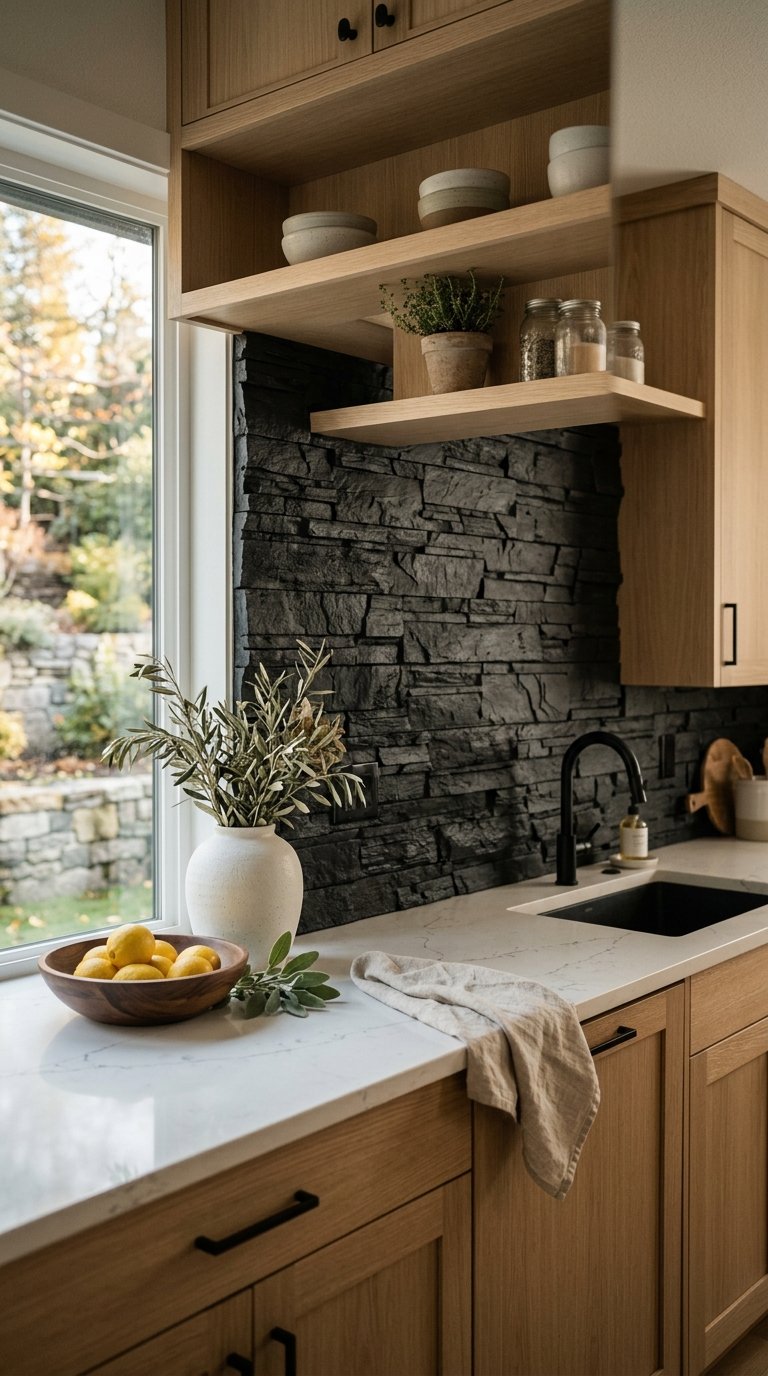
Stacked stone veneer panels on the kitchen backsplash deliver the visual mass and texture of a stone wall at a fraction of the weight and installation complexity of real stone construction. The three-dimensional surface of the stacked stone ledge panels creates shadow lines across the backsplash that change throughout the day as the light angle shifts.
MSI’s Stacked Stone ledger panels in Smoky Black cost $8 to $12 per square foot. A 30-square-foot backsplash runs $240 to $360 in materials. The panels install with a standard polymer-modified thinset directly onto drywall or cement board in the backsplash zone. Cut the panels with an angle grinder fitted with a diamond blade to size for the outlets and cabinet edges.
Seal the stacked stone surface with Aqua Mix Sealer’s Choice Gold at $30 per quart before grouting the panel joints to prevent permanent staining from cooking oils and water. The porous stone surface absorbs any liquid it contacts within seconds of exposure, which makes sealing a non-negotiable step rather than an optional maintenance task. Reapply the sealer annually in an active cooking kitchen.
17. Black Backsplash With Open Shelving for an Editorial Look
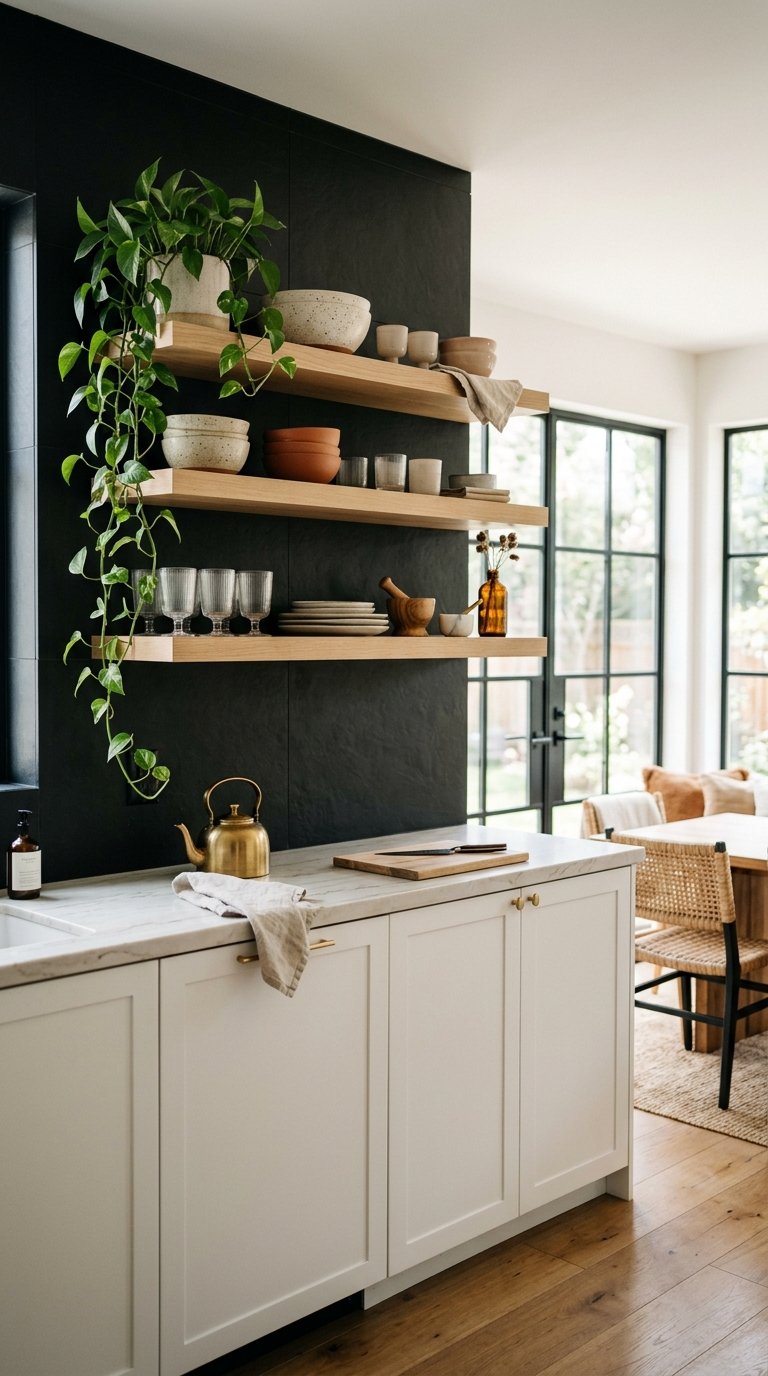
A black backsplash paired with open wood shelving instead of upper cabinets creates the kitchen aesthetic that design publications feature most consistently in residential project profiles. The combination works because the dark backsplash surface makes the shelving and its contents pop with maximum contrast, turning everyday kitchen objects, dishes, jars, and plants, into a styled display against the dark wall.
White oak floating shelves from Shelf Lumber at $40 to $80 per shelf in a 48-inch length pair with black zellige or matte black large format tile behind them for the combination that reads most editorially. Mount the shelves with concealed rod hardware from Floating Shelf Co. at $30 to $50 per shelf kit to keep the shelf profile clean and uninterrupted against the black backsplash surface.
The key to making open shelving against a black backsplash work in a real kitchen rather than a styled photo shoot is restraint in the objects you display. Edit the shelf contents to a maximum of three types of objects per shelf: one type of dish or glass, one storage canister set, and one plant or cutting board. More than three object types per shelf reads as clutter rather than display, and the black backsplash amplifies clutter more than any light background surface does.
18. Black Backsplash in an All-White Kitchen for One Bold Surface
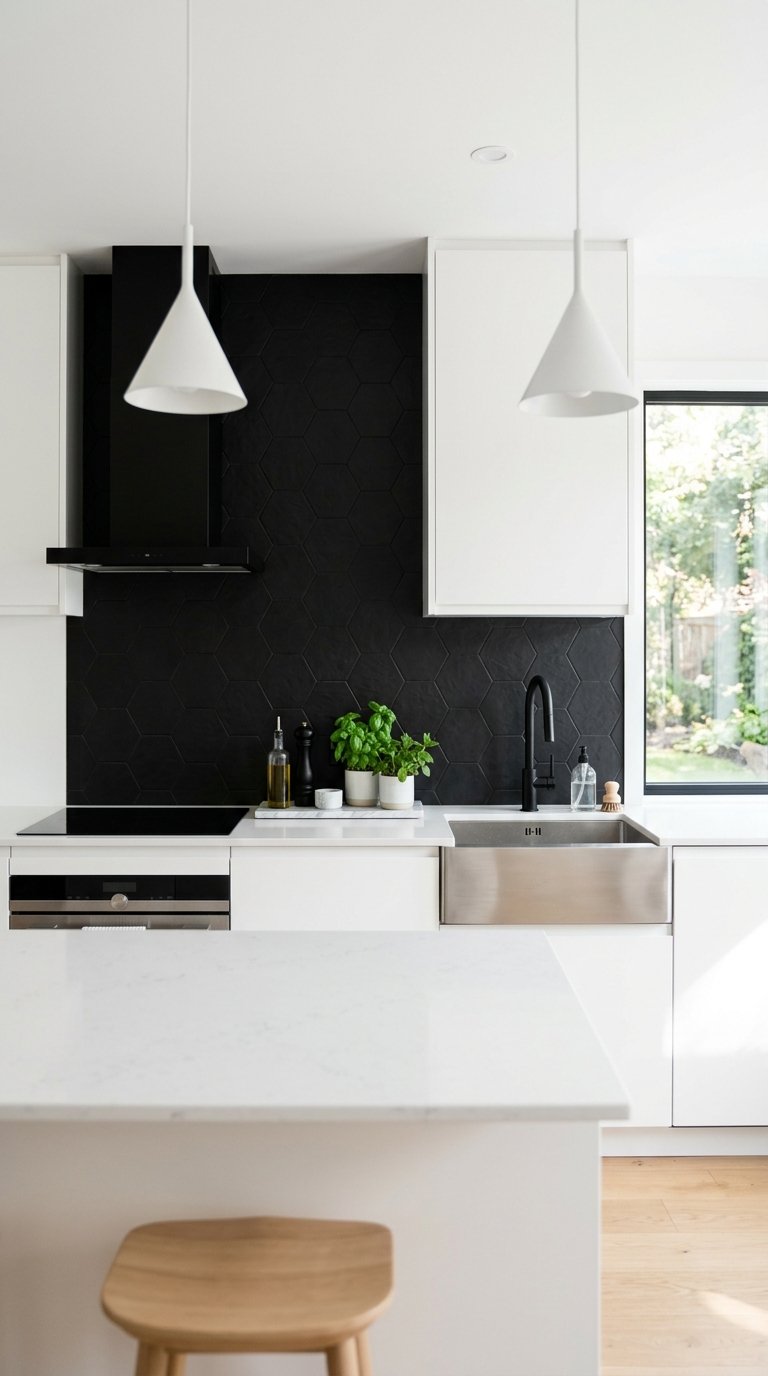
A black backsplash in an otherwise all-white kitchen gives the room one deliberate focal point in a palette that would read as blank without it. The white cabinets, white countertops, and white walls create a clean canvas, and the black backsplash lands as the single surface that holds the entire room’s visual weight.
Dal-Tile’s Vibe 12×12 matte black porcelain tile costs $2.99 per square foot. In a full all-white kitchen with a 30-square-foot backsplash, the material cost sits under $100. Keep the grout in a matching dark gray or black from Mapei’s Ultracolor Plus to prevent the joints from breaking up the solid dark surface. The all-white-plus-black-backsplash combination relies on the backsplash reading as a solid, unified dark element. A white grout joint fragments it.
This is the highest-impact, lowest-cost way to change an existing all-white kitchen’s aesthetic without touching the cabinets, countertops, or flooring. The black backsplash does more design work per dollar than any other single surface change in a white kitchen. If you want one change that transforms how the room looks and feels, this is it.
19. Black Backsplash With Navy Cabinets for a Tonal, Moody Kitchen
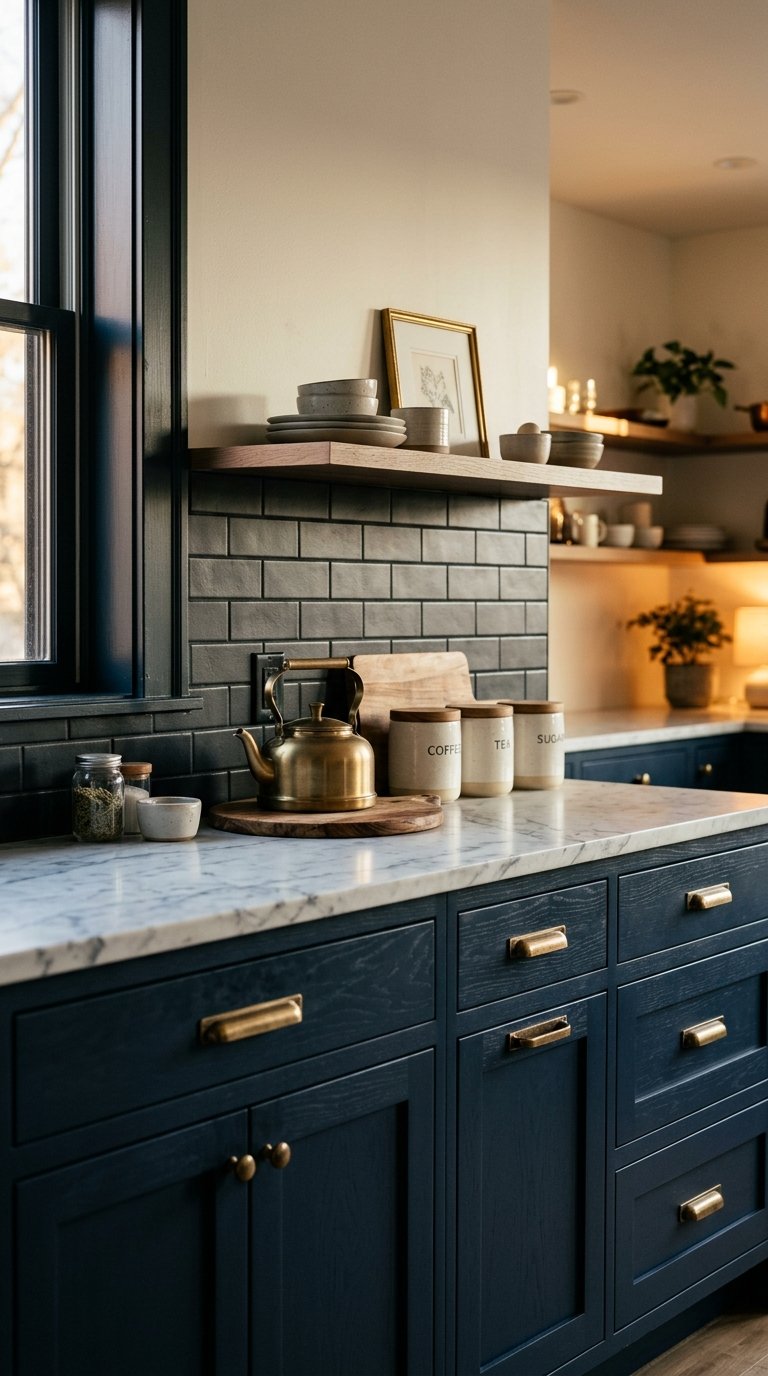
Pairing a black backsplash with navy blue cabinets creates a tonal, moody kitchen palette where the two dark surfaces sit in the same color family but at different depths. The navy cabinets bring blue warmth to the lower half of the room and the black backsplash sits at the middle height as a darker, more saturated anchor behind the stove and sink.
Benjamin Moore Hale Navy HC-154 on the cabinets with Daltile’s 3×6 matte black ceramic subway tile on the backsplash creates this specific combination at a manageable budget. A gallon of Benjamin Moore Advance in Hale Navy costs $75 to $85 and the Daltile matte black tile runs $2.49 per square foot, keeping the combined material cost well under $500 for a standard kitchen cabinet and backsplash project.
Add warm brass hardware from Emtek’s Transitional collection at $20 to $35 per piece to prevent the navy-and-black palette from reading as flat or funereal. The brass introduces warmth and light into a palette of two cool, dark surfaces. Without the brass or a comparable warm metallic element, the navy-and-black kitchen feels oppressive rather than moody. The hardware does not need to be expensive. It needs to be warm.
20. Black Backsplash With Wood Accents for a Warm Industrial Kitchen
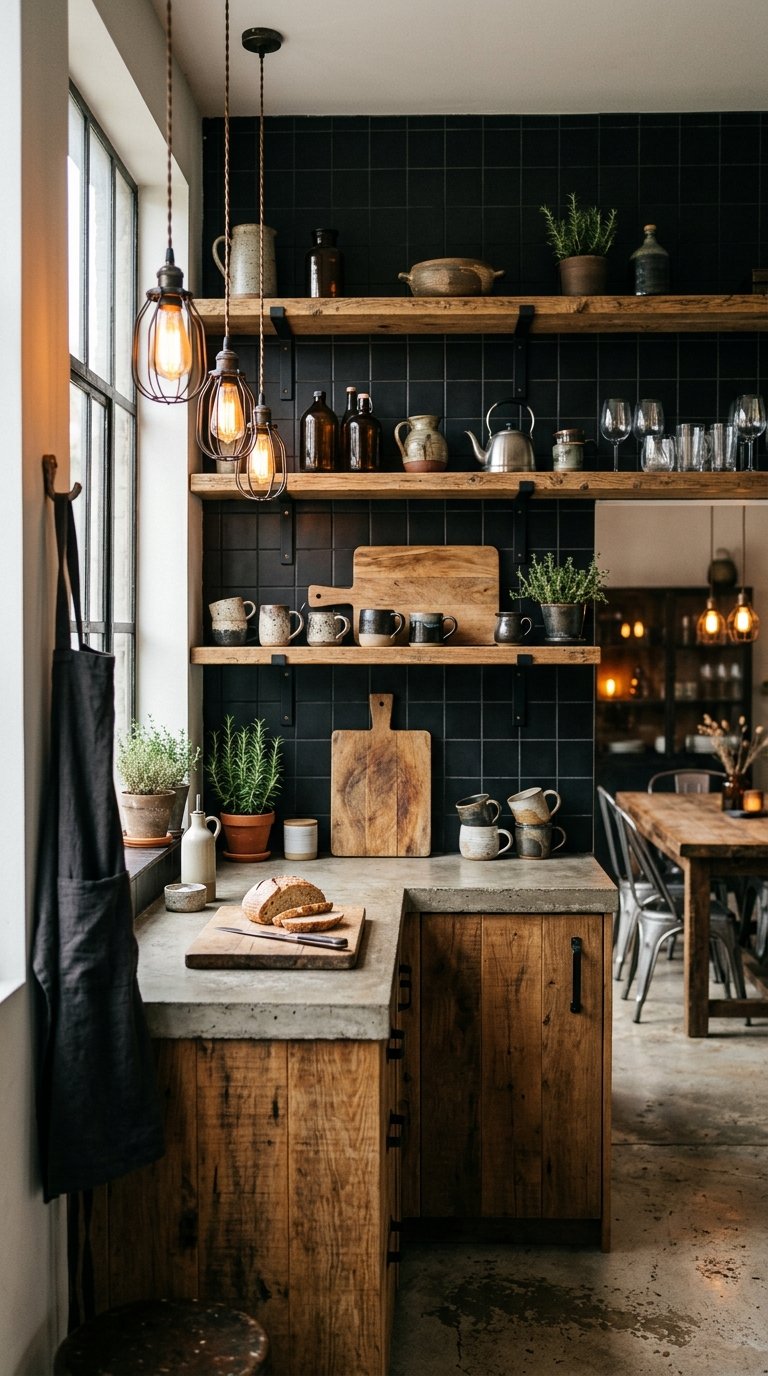
Black tile backsplash against warm wood cabinet fronts or open shelving creates the warm industrial aesthetic that sits between the cold precision of a full modern kitchen and the rustic warmth of a farmhouse kitchen. The black tile provides the graphic, industrial edge and the wood surfaces provide the warmth and organic character that prevents the kitchen from reading as a commercial space.
IKEA’s Axstad dark gray cabinet fronts at $60 to $150 per door in a medium-density fiberboard wood grain format pair with TileBar’s matte black 4×4 ceramic tile at $6.99 per square foot for a combination that delivers the warm industrial look at an IKEA cabinet budget. The Axstad wood grain reads as warm against the black tile in a way that a painted wood cabinet front does not, because the grain pattern itself carries warmth independently of the color.
For open shelving in the warm industrial kitchen, reclaimed Douglas fir shelf boards at 2-inch thickness from a local salvage yard cost $3 to $8 per linear foot and add material authenticity that new lumber finished to look reclaimed never fully replicates. The combination of reclaimed wood, IKEA cabinetry, and matte black tile delivers a high-design aesthetic at a budget that most homeowners can access without a full renovation investment. 🙂
21. Full-Height Black Backsplash From Counter to Ceiling
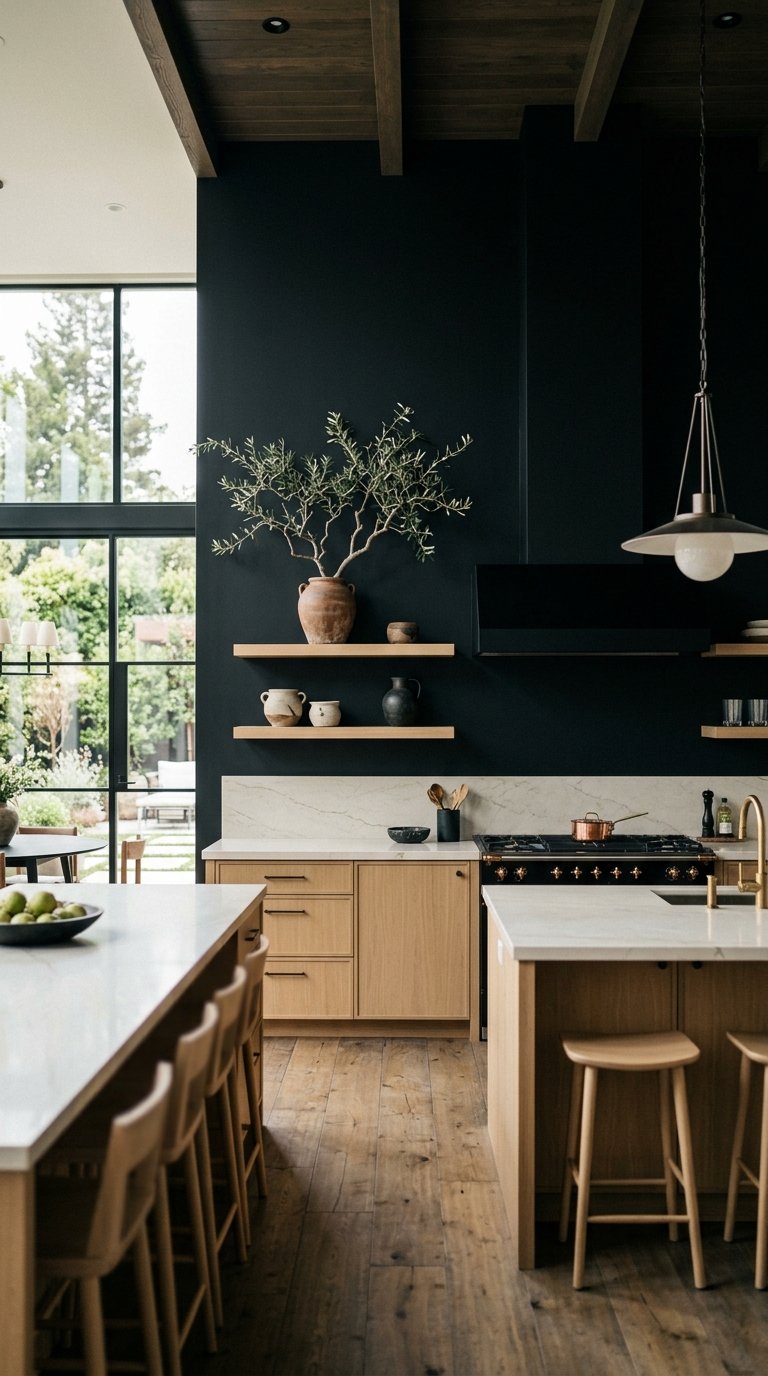
A full-height black backsplash runs from the countertop surface all the way to the ceiling without stopping at the upper cabinet line. In kitchens with open shelving or no upper cabinets at all, this creates a dramatic, continuous dark wall that frames the entire cooking zone as a single architectural element rather than a tiled backsplash band.
Porcelanosa’s Venis Ferroker Grafito in a 23×47-inch large format porcelain costs $11 per square foot. A full-height backsplash from counter to a 9-foot ceiling covering approximately 60 square feet runs $660 in tile materials before installation. The large format reduces grout lines across the full height of the wall, which keeps the surface reading as continuous and architectural rather than tiled. Use a matching dark epoxy grout from Laticrete’s SpectraLOCK at $45 per unit to make the joints disappear entirely.
The full-height black backsplash requires the most confident design commitment of every idea on this list. It works in kitchens with strong natural light, high ceilings, and light or neutral cabinets and countertops that provide enough contrast to prevent the room from reading as a dark tunnel. Get those three conditions right and the full-height black backsplash delivers a kitchen that no tile-band backsplash at standard height ever achieves.
Final Thoughts
A black kitchen backsplash solves one problem better than any other backsplash choice: it gives the room a definitive visual anchor. Every surface in a kitchen competes for attention until one surface takes charge. A black backsplash takes charge immediately.
The lowest-cost entry point is white subway tile with black grout from American Olean at under $100 in materials for a standard backsplash. The highest-impact material investment is black zellige from Clé Tile at $28 to $35 per square foot for a surface that no photograph fully captures and no guest stops noticing.
Pick the idea that fits your kitchen’s specific condition. Low light kitchen? Go black glass tile for reflectivity. Farmhouse style? Black painted shiplap or black handmade ceramic. Modern and minimal? Large format matte black porcelain with matching dark grout. Industrial aesthetic? Black brick tile with raw steel shelving brackets.
Every option on this list works. The only wrong move is choosing a backsplash that disappears into the wall and asks nothing of the room.