23 Kitchen Pantry Ideas to Organize Your Space for Good
Your kitchen pantry does the work that no other storage space in your house does. It holds the overflow from your cabinets, the bulk purchases you made at Costco, the appliances you use twice a year, and the snacks your family goes through in three days. If your pantry is a disorganized closet you avoid opening, or a cabinet system that never quite holds everything, these 23 ideas give you the specific details to fix it permanently.
Every idea below includes real product names, accurate price ranges, and the honest reason it works. No vague organization tips. No aspirational Pinterest boards. Just pantry solutions built for real kitchens and real budgets.
1. Floor-to-Ceiling Open Shelving Pantry
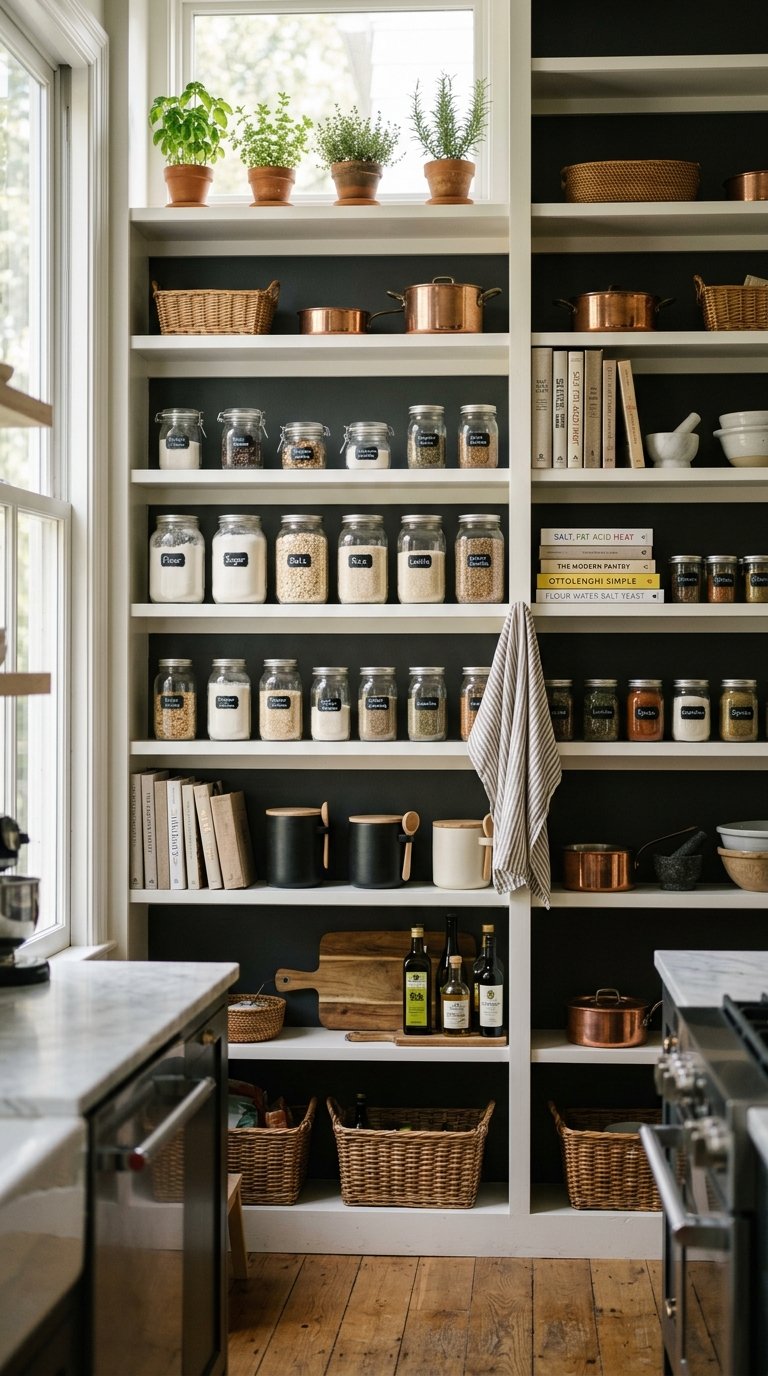
Floor-to-ceiling open shelves turn a blank wall into a full pantry system that holds more than any closed cabinet configuration of the same footprint. The full vertical height use is the key advantage. Most standard wall cabinets stop at 84 inches and waste the top 12 to 24 inches of wall space entirely.
IKEA’s KALLAX or IVAR shelf systems reach ceiling height when stacked and combined with extension units. A full 96-inch IVAR system in solid pine costs $180 to $280 depending on width. Paint the wall behind the shelves in a contrasting dark tone such as Benjamin Moore’s Black Beauty 2128-10 to make the shelving read as a designed pantry wall rather than storage bolted to a wall.
2. Pull-Out Drawer Pantry Cabinet
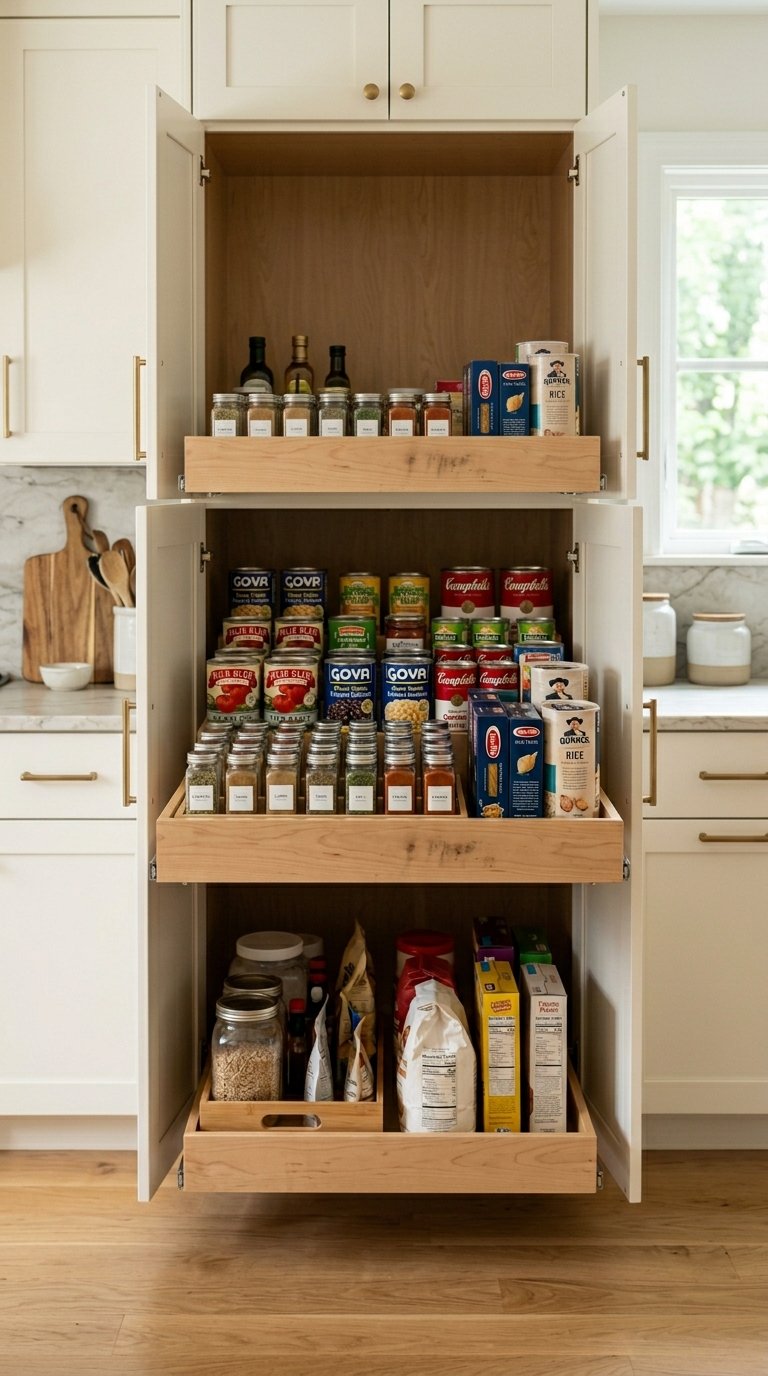
A pull-out drawer pantry cabinet replaces a standard deep pantry cabinet with a series of full-extension drawers that bring every item in the cabinet to the front of the opening. Items at the back of a standard cabinet get ignored because they require reaching and searching. A pull-out drawer system eliminates that entirely.
Rev-A-Shelf’s 4WD series pull-out pantry drawers fit inside a standard 18-inch or 24-inch base cabinet and cost $180 to $320 per unit. Each drawer extends fully beyond the cabinet face, giving you a clear view and full access to every item stored inside. Install two or three stacked units in a single tall pantry cabinet and your storage capacity doubles without adding a single inch of floor space.
3. Converted Closet Pantry With Door Organizers
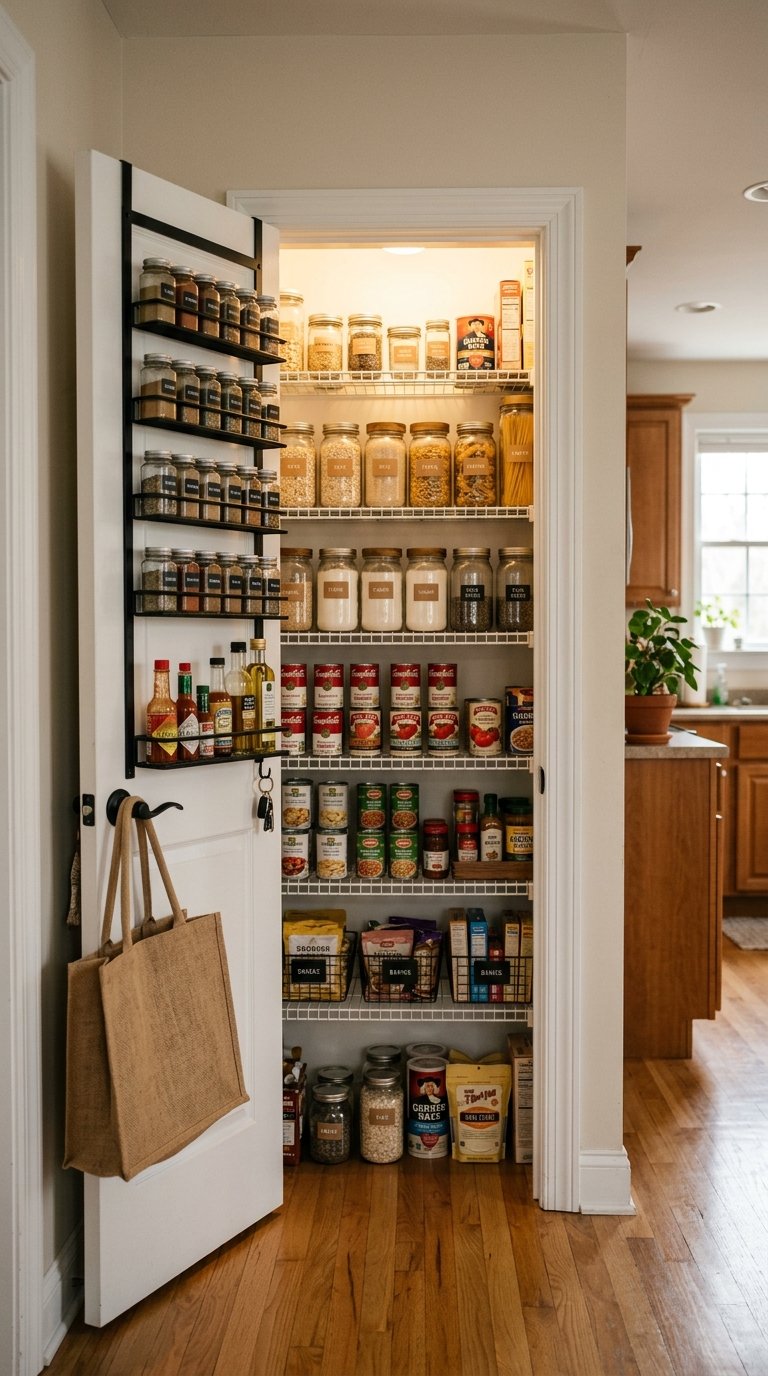
A standard coat closet or linen closet converts into a walk-in pantry for $300 to $800 in materials, depending on the shelving system you choose. The conversion adds more pantry storage than any cabinet upgrade delivers at the same price point.
Install an ELFA shelving system from The Container Store at $4 to $8 per linear foot for adjustable shelves along the back and side walls. Add an over-door organizer from SimpleHouseware at $25 to $35 to use the door face for spices, condiments, and small bottles. The total conversion cost stays under $600 for a standard 24×60-inch closet, and the result functions as a proper walk-in pantry.
4. Narrow Pull-Out Spice and Can Pantry
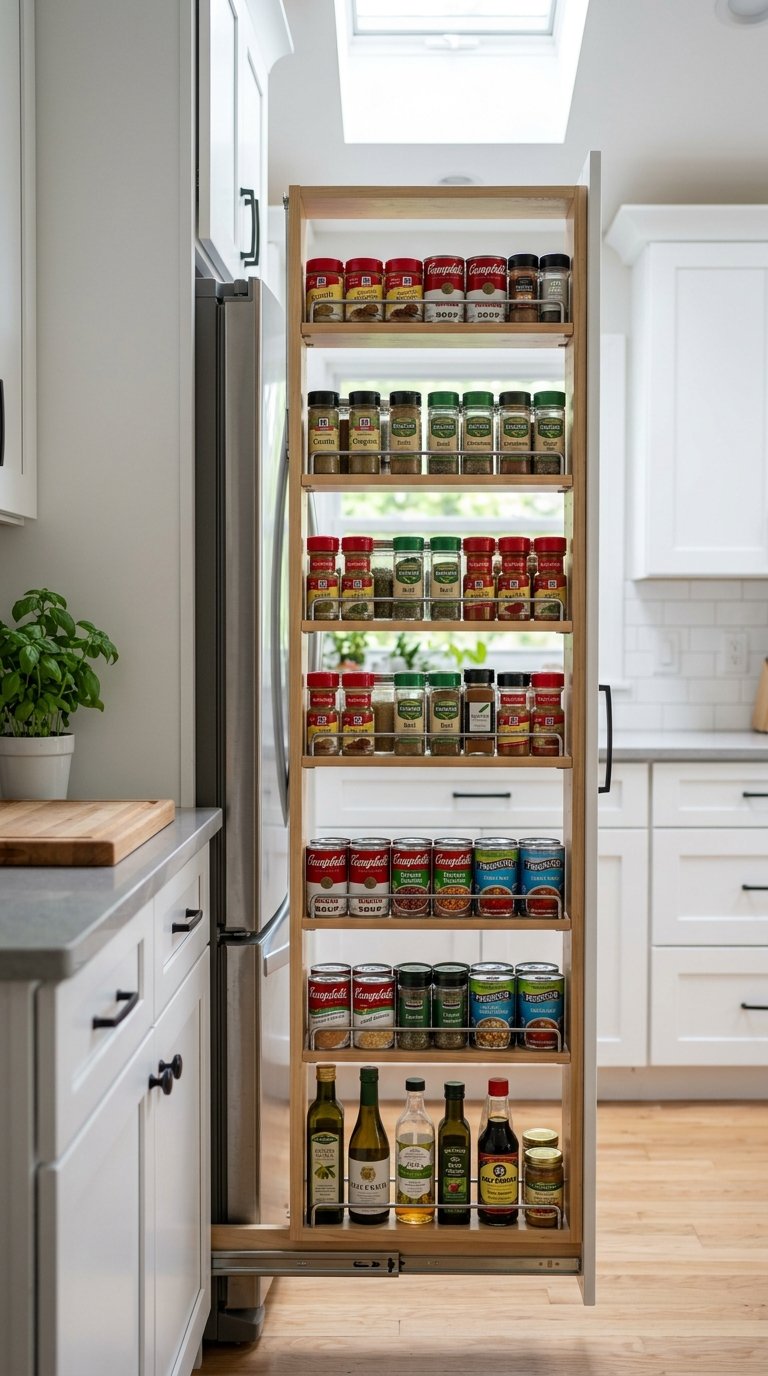
A narrow pull-out pantry tower fits in gaps between appliances or cabinets as small as 6 inches wide and holds more than 100 items in a footprint no standard cabinet uses. These slim pull-out units solve the specific problem of dead space between a refrigerator and a wall or between two base cabinets.
Rev-A-Shelf’s freestanding pull-out pantry tower in an 11-inch width costs $350 to $450 and holds up to 120 pounds across its multiple shelves. Knape and Vogt make a similar unit in 6-inch and 9-inch widths for tighter gaps, starting at $180. Both units roll smoothly on full-extension slides and lock in the closed position so nothing shifts when you push them back.
5. Pegboard Pantry Back Wall
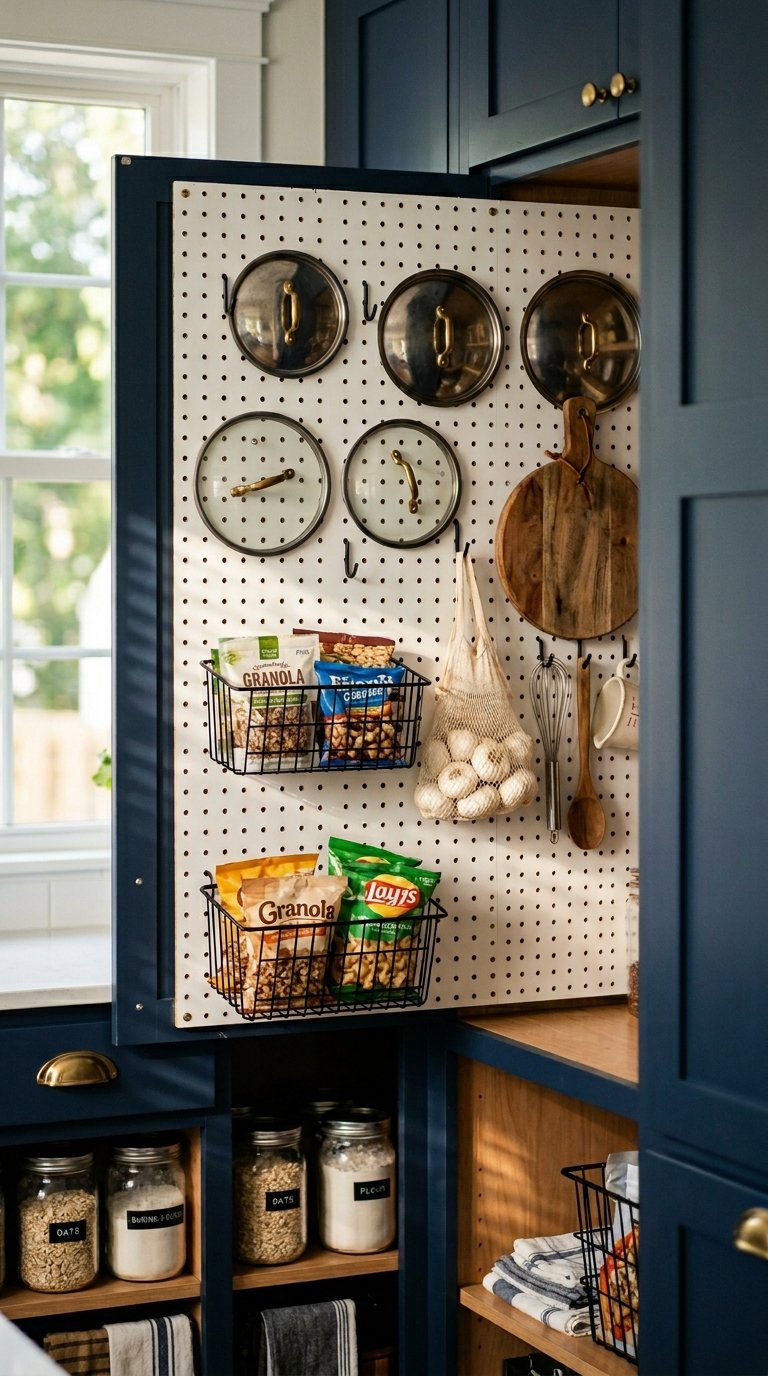
A pegboard back wall inside a pantry cabinet or pantry closet gives you fully customizable, rearrangeable storage for lids, utensils, small baskets, and bags. The entire layout changes in five minutes by moving the pegs, which no fixed shelf system offers.
Home Depot sells 4×8 pegboard sheets in 1/8-inch and 1/4-inch hardboard at $18 to $32 per sheet. Mount it directly to the pantry back wall with 1-inch standoff spacers to allow the hooks to engage fully. A complete pegboard wall with a starter hook kit from Wall Control costs under $80 for a standard pantry back wall and holds 50 to 75 individual items in the same space a single shelf would hold 20.
6. Open Butler’s Pantry Between Kitchen and Dining Room
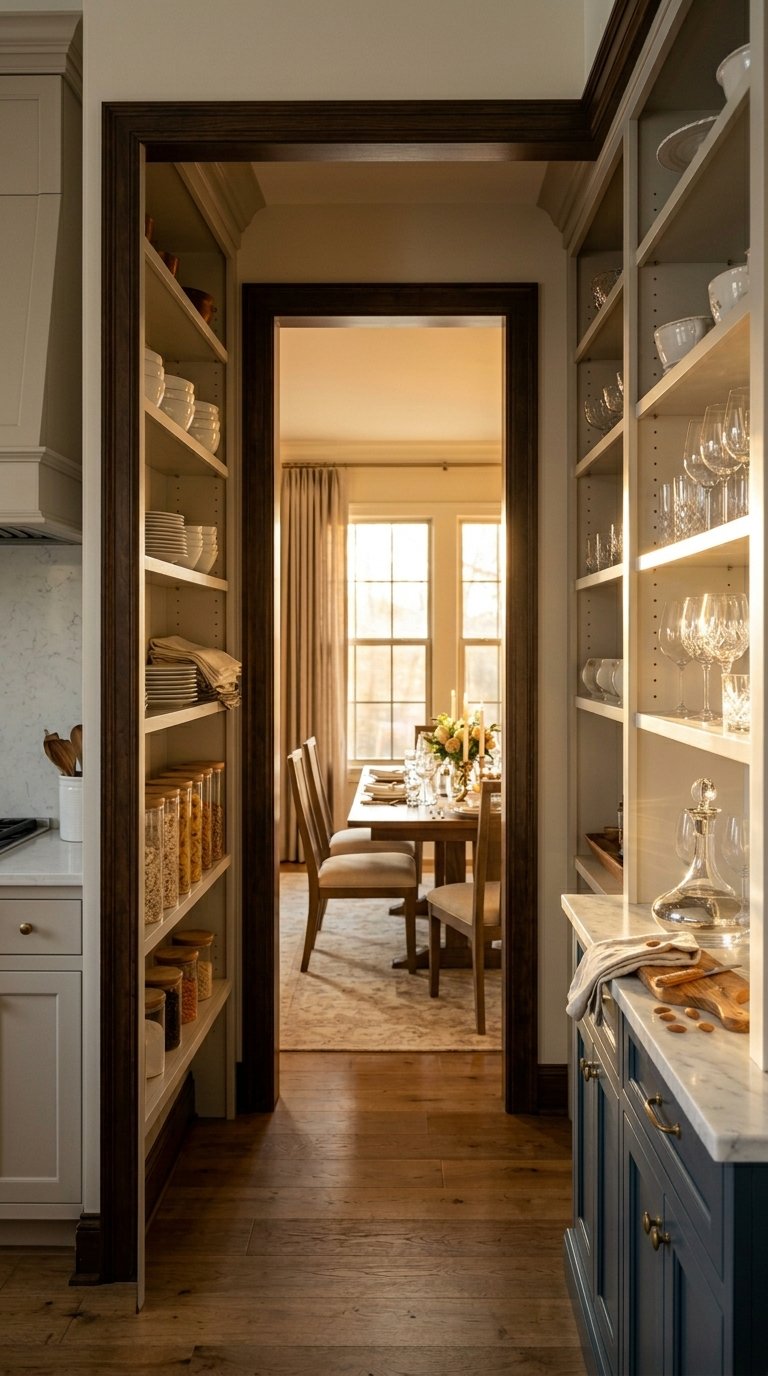
A butler’s pantry positioned between the kitchen and dining room creates a dedicated staging and storage zone that keeps the main kitchen clear during meals and entertaining. Historically, butler’s pantries held china, glassware, and serving pieces. In a modern home, they hold everything that overflows from the main kitchen.
Build a simple butler’s pantry with 12-inch deep open wall shelves from IKEA’s BODBYN system at $80 to $160 per wall section. Add a small countertop at 36 inches high for staging dishes and a lower cabinet for additional closed storage. The total build cost for a 6-foot butler’s pantry wall runs $400 to $900 depending on whether you use stock or semi-custom cabinetry.
7. Labeled Airtight Container System on Open Shelves
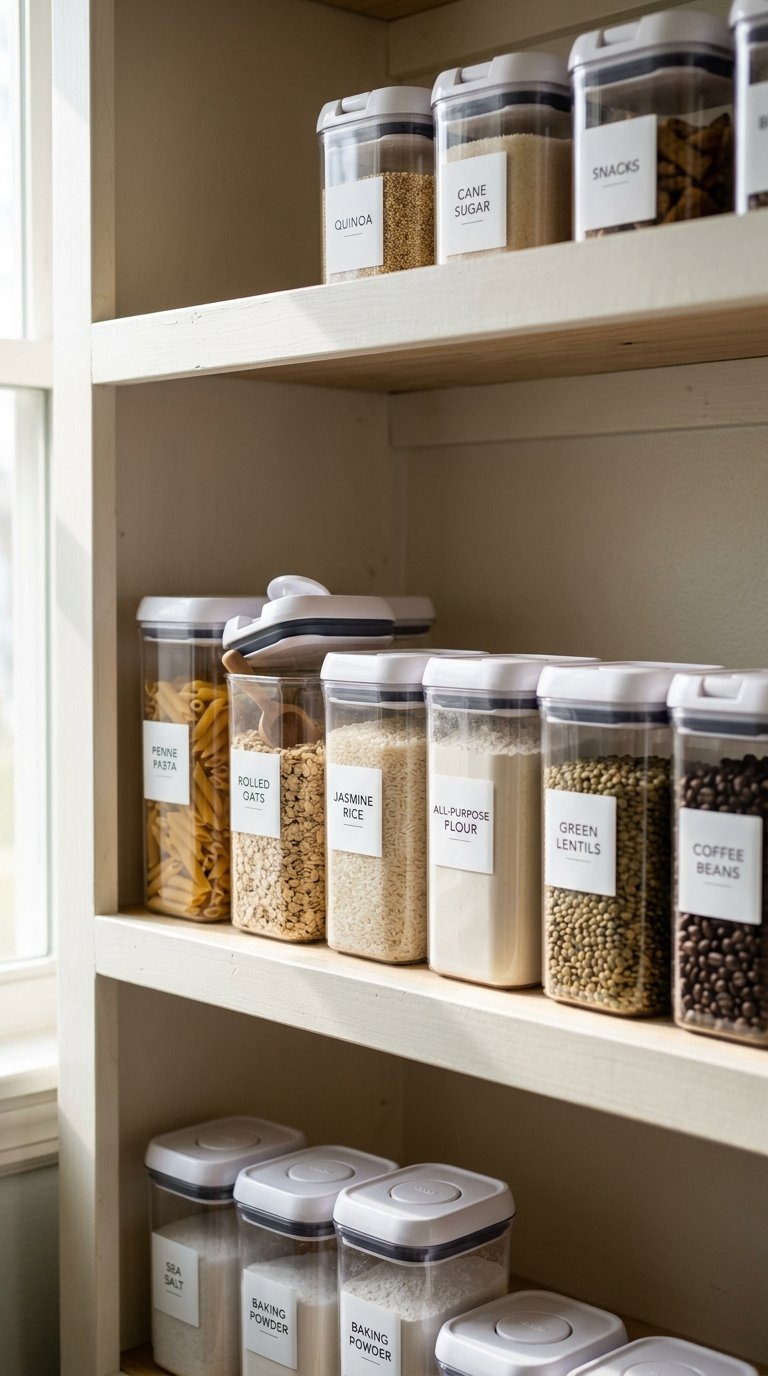
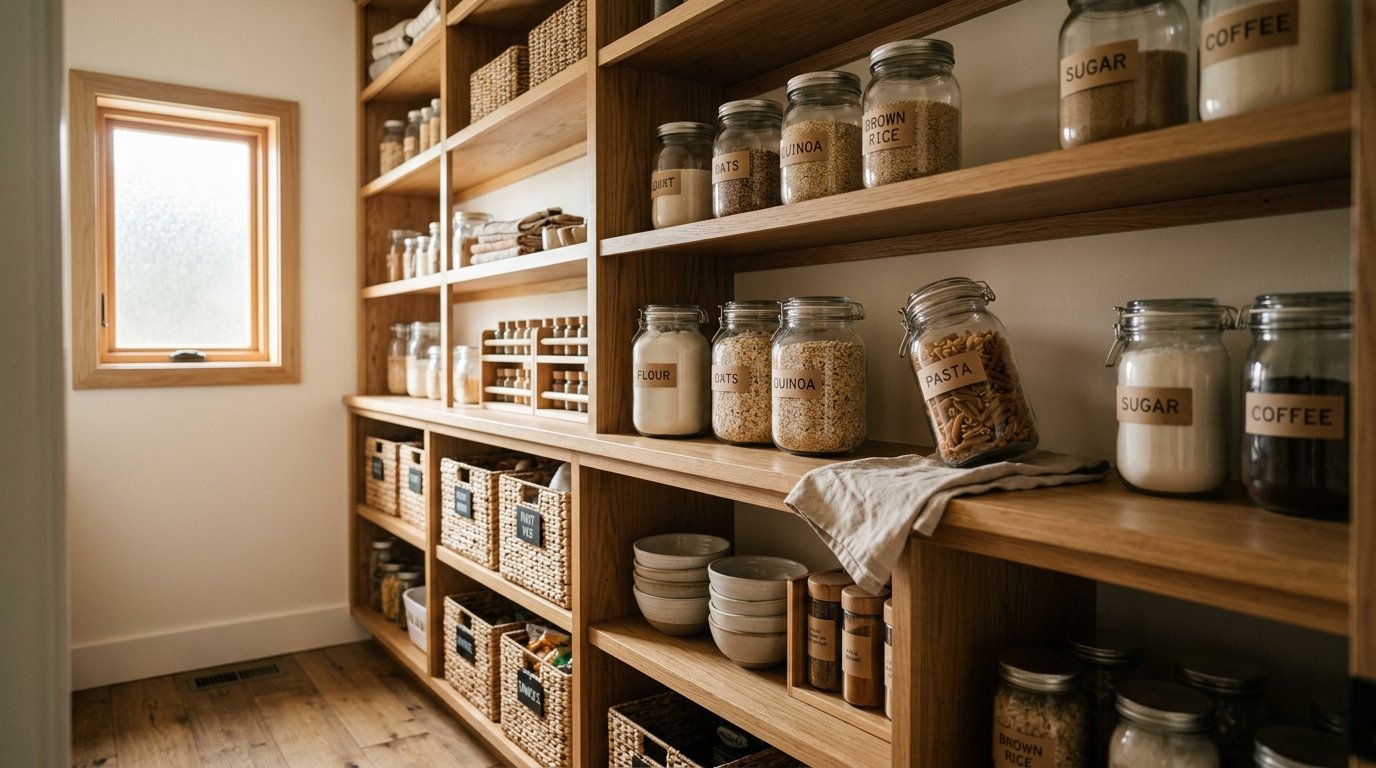
Decanting dry goods into uniform airtight containers and labeling them creates the most organized pantry shelf appearance at any budget level. More importantly, it extends the shelf life of dry goods by 30 to 50 percent compared to leaving them in their original packaging, according to food storage research from the National Center for Home Food Preservation.
OXO Good Grips Pop containers in a set of 20 cost $130 on Amazon and cover the most common pantry staples. Oxo’s square format stacks efficiently and maximizes shelf depth. Use a Dymo LabelManager at $25 or a Brother P-Touch at $30 to print uniform labels, and the shelves read as organized regardless of what goes inside the containers.
8. Freestanding Pantry Armoire or Cabinet
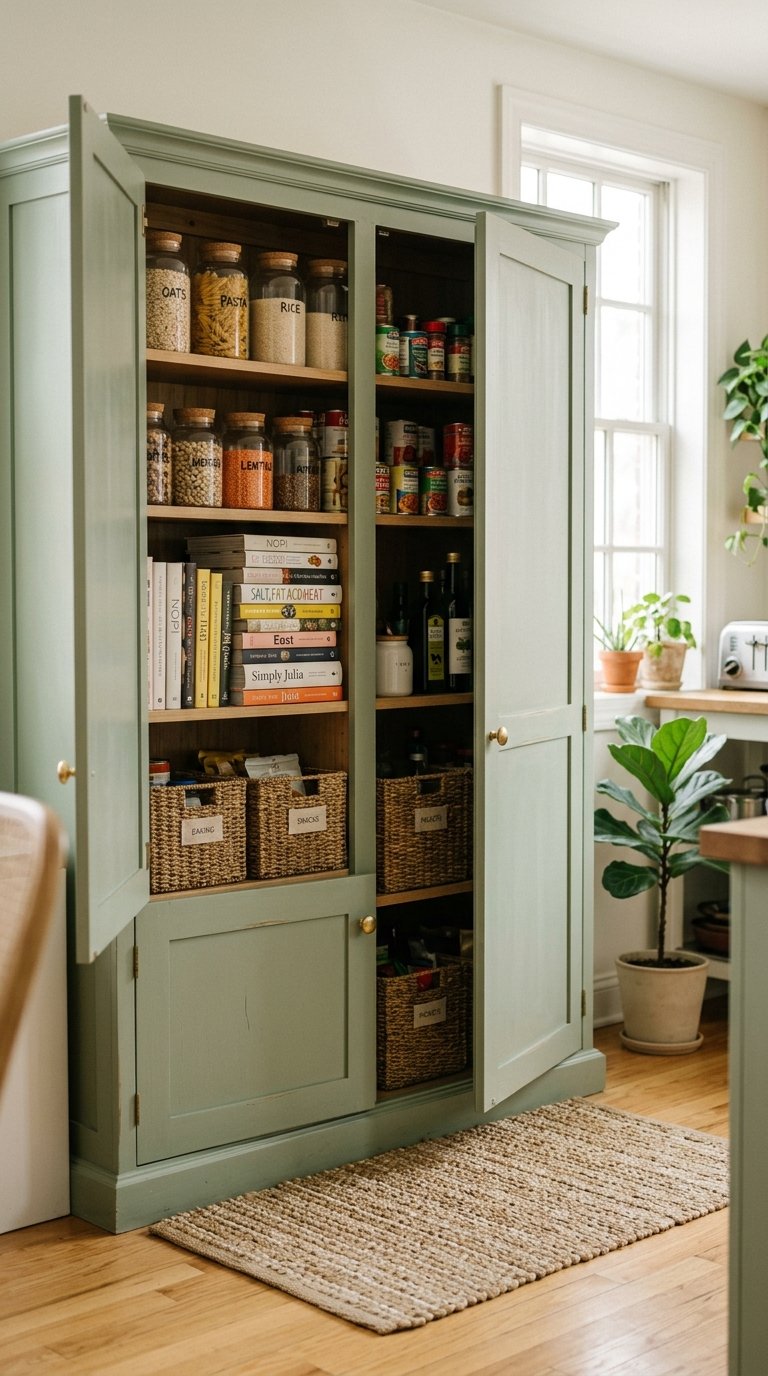
A freestanding pantry armour solves the rental kitchen problem completely. You bring it in, fill it with your pantry system, and take it with you when you leave. No drilling, no permanent modification, no landlord conversation required.
IKEA’s PAX wardrobe system configured with interior shelves costs $250 to $500 depending on size and interior fittings. Pottery Barn’s Aubrey Extra-Wide Cabinet at $1,400 delivers a more furniture-quality option with adjustable interior shelves and a closed-door finish. Both options add significant pantry storage to a kitchen with no built-in pantry space whatsoever.
9. Under-Stair Pantry Conversion
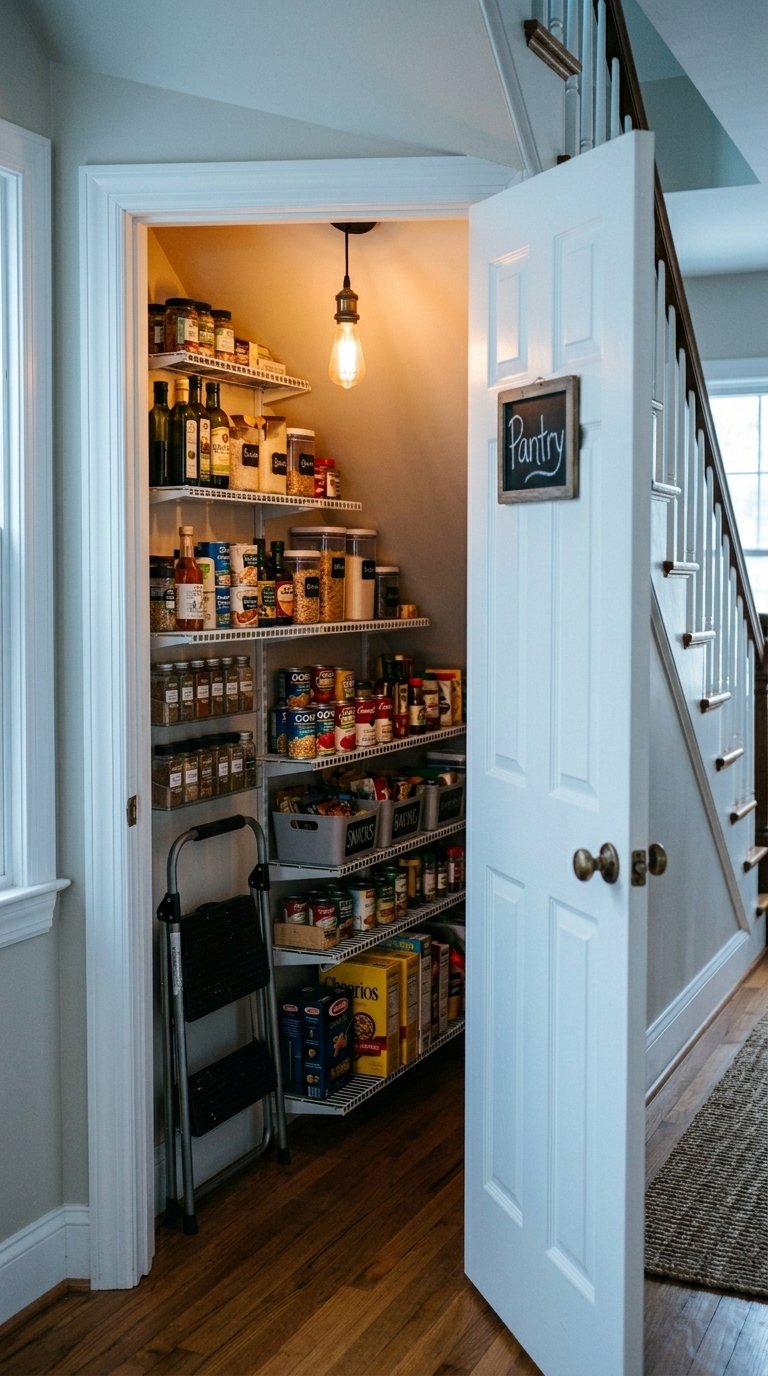
The space under a staircase converts into a pantry with more square footage than most dedicated pantry closets in standard home layouts. A standard staircase with a 10-foot run and 9-foot ceiling height generates 45 to 60 cubic feet of usable storage space beneath it.
Frame the opening with a standard door rough opening and install a pre-hung door from Masonite at $150 to $250. Line the interior with adjustable wire shelving from ClosetMaid at $2 to $4 per linear foot. The total conversion cost including framing, door, and shelving runs $500 to $1,200 depending on whether the space requires new framing or already has an accessible opening.
10. Tall Pantry Cabinet With Interior Pull-Out Baskets
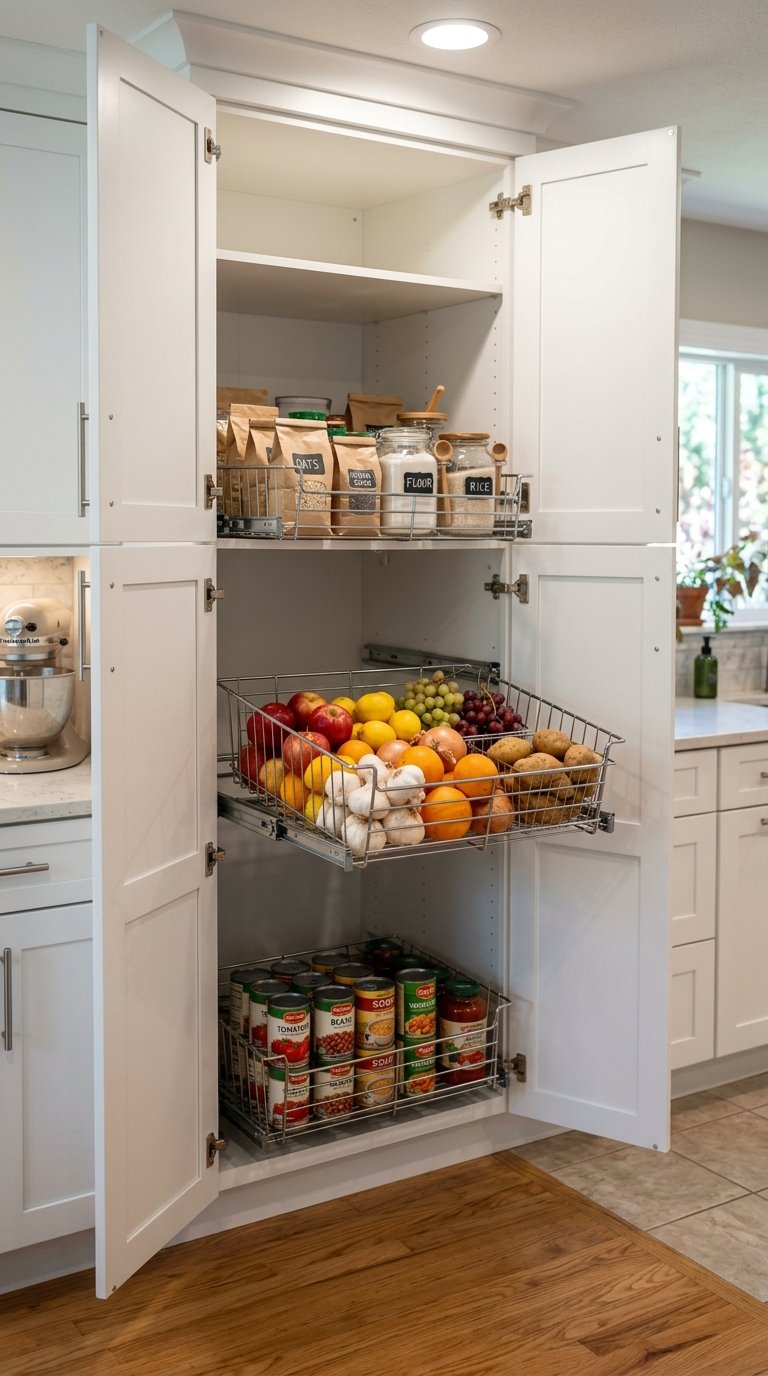
A tall pantry cabinet with interior pull-out baskets gives you the visual simplicity of a closed cabinet with the full accessibility of an open drawer system. The baskets slide forward on runners and tilt slightly, giving you a clear view of every item inside without full extension.
IKEA’s SEKTION tall pantry cabinet at 90 inches high costs $340 to $480 for the carcass. Add Häfele’s pull-out wire basket inserts at $45 to $75 per basket for three to four basket levels inside the cabinet. The total system costs $500 to $700 installed and holds the equivalent of eight standard base cabinet shelves worth of pantry goods in a single 24-inch wide footprint.
11. Magnetic Spice Jars on a Metal Pantry Wall Strip
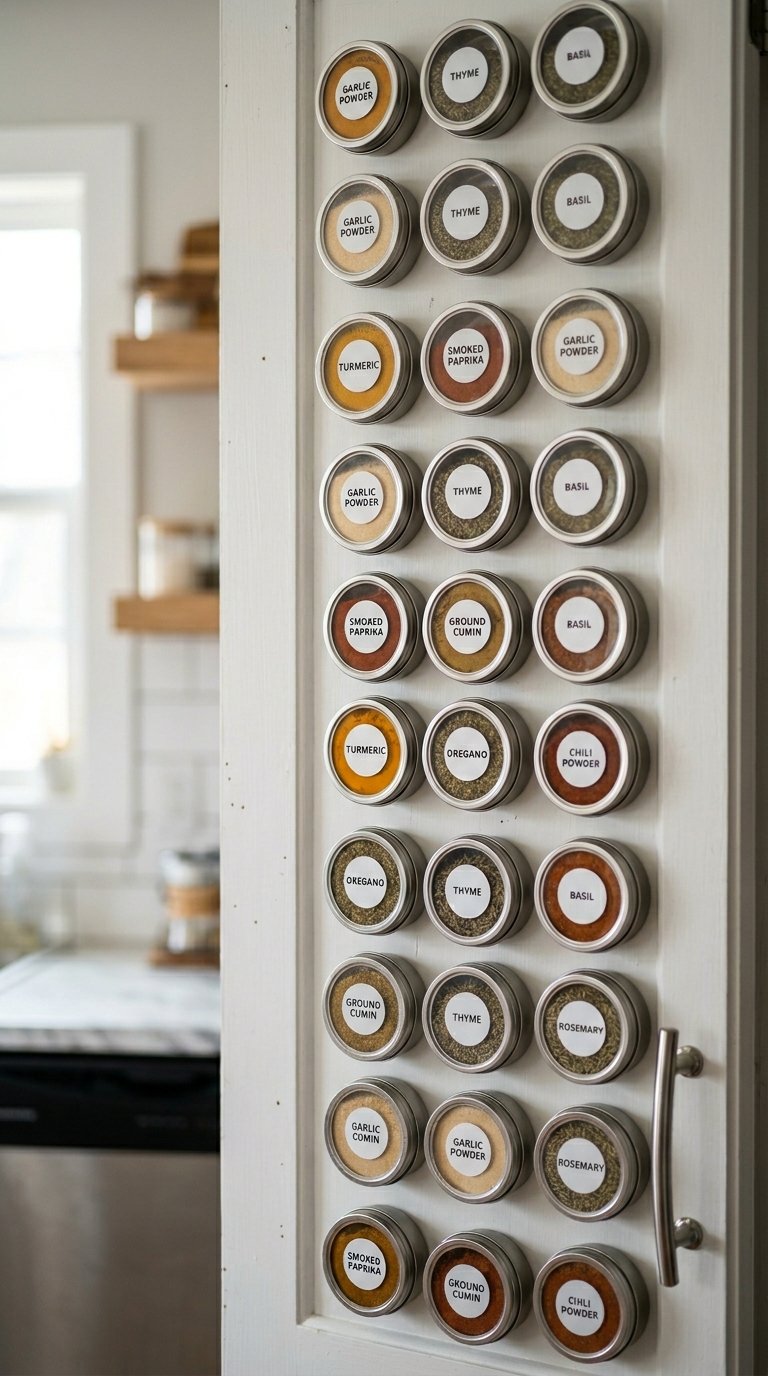
Magnetic spice jars mounted on a metal strip inside a pantry door or on a pantry wall face frees up an entire shelf for other storage. A standard spice collection of 30 jars takes up two full shelves in a conventional cabinet. The same collection mounted magnetically takes up zero shelf space.
Kamenstein’s magnetic spice tin set of 20 costs $35 on Amazon and mounts on any magnetic surface. A steel backsplash panel from Amazon at $18 for a 12×30-inch sheet provides the mounting surface on any wall or door face. The full setup costs under $60 and recovers two shelves of pantry space immediately.
12. Pantry With a Chalkboard or Whiteboard Inventory Wall
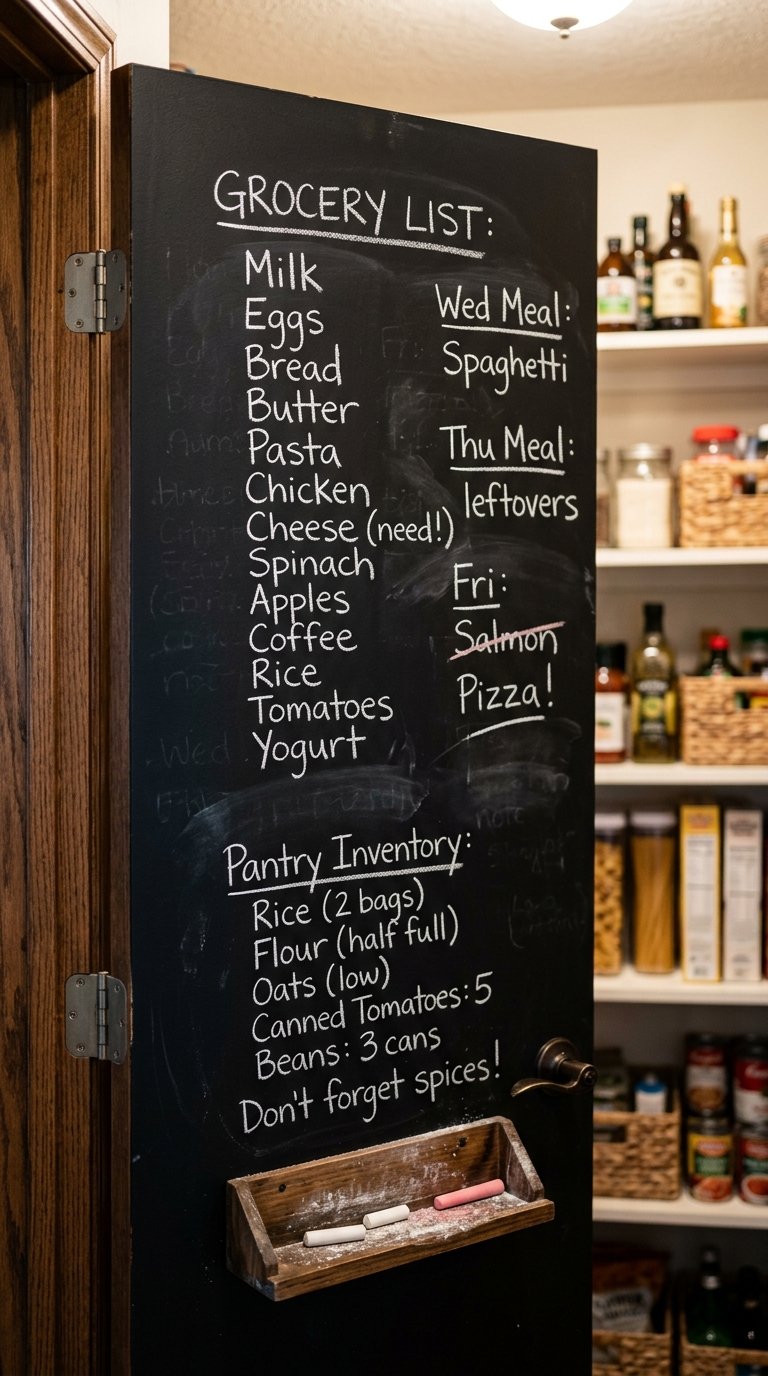
A chalkboard or whiteboard panel on the inside face of a pantry door serves as a running grocery list, meal plan, and inventory tracker in one surface. Families who track pantry inventory reduce food waste by an average of 25 percent, according to a 2021 WRAP food waste study.
Rust-Oleum’s Chalkboard Spray Paint costs $9 per can and covers a standard 24×80-inch door in two coats. For a whiteboard surface, use IdeaPaint’s clear dry-erase wall paint at $60 per quart, which converts any smooth surface into a whiteboard without the frame or hardware. Either option transforms the door face into a functional tool without adding any thickness to the door swing clearance.
13. Corner Pantry With Lazy Susan Shelving
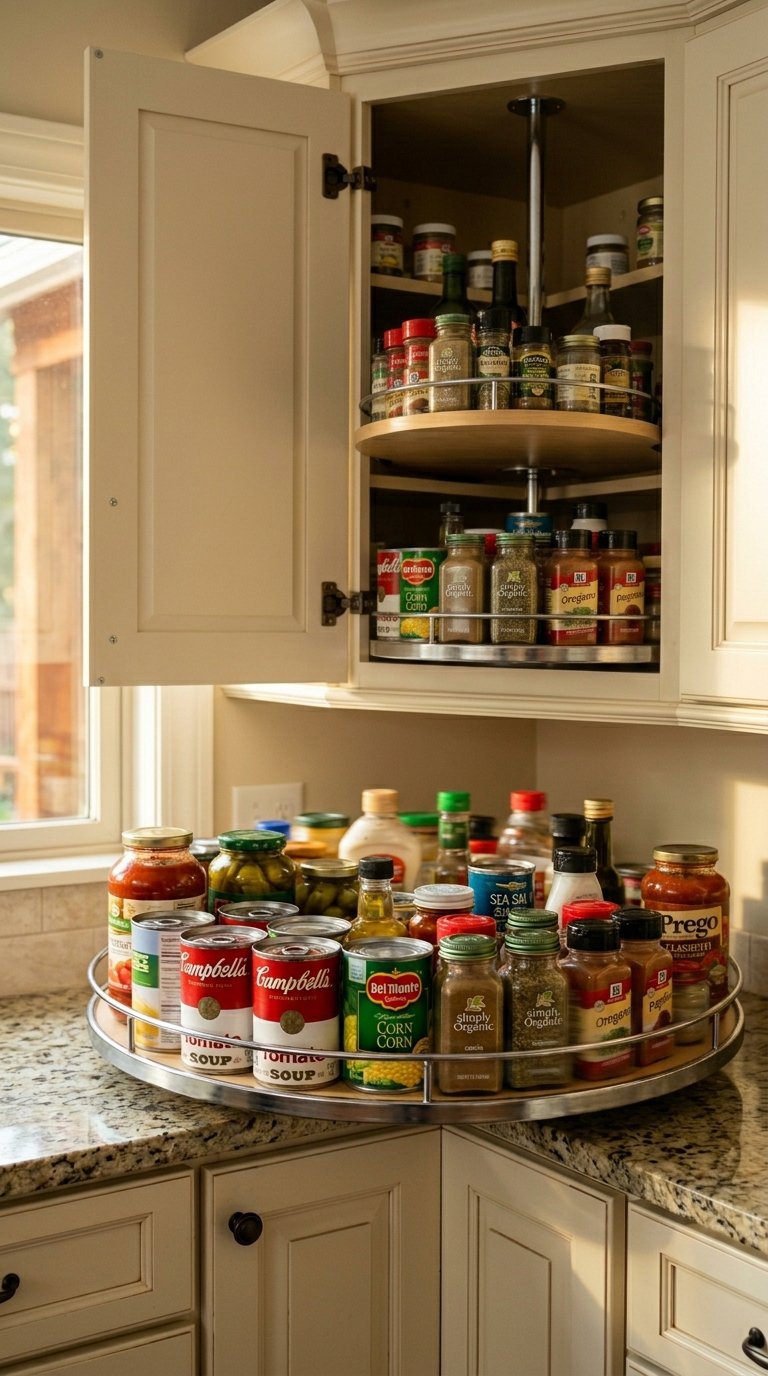
A corner pantry cabinet with full-circle lazy Susan shelving solves the dead corner storage problem that every kitchen with a corner layout faces. Standard corner cabinets waste 30 to 40 percent of their interior volume because items pushed to the back are inaccessible without removing everything in front.
Rev-A-Shelf’s full-circle kidney lazy Susan for a 36-inch corner cabinet costs $120 to $160 and replaces the fixed shelves with two rotating kidney-shaped tiers. Each tier holds 25 to 30 pounds and rotates 360 degrees for full access to every stored item. Install it in a standard 36-inch blind corner or diagonal corner cabinet without any structural modification.
14. Pantry Tower Built Between Two Refrigerators or Appliances
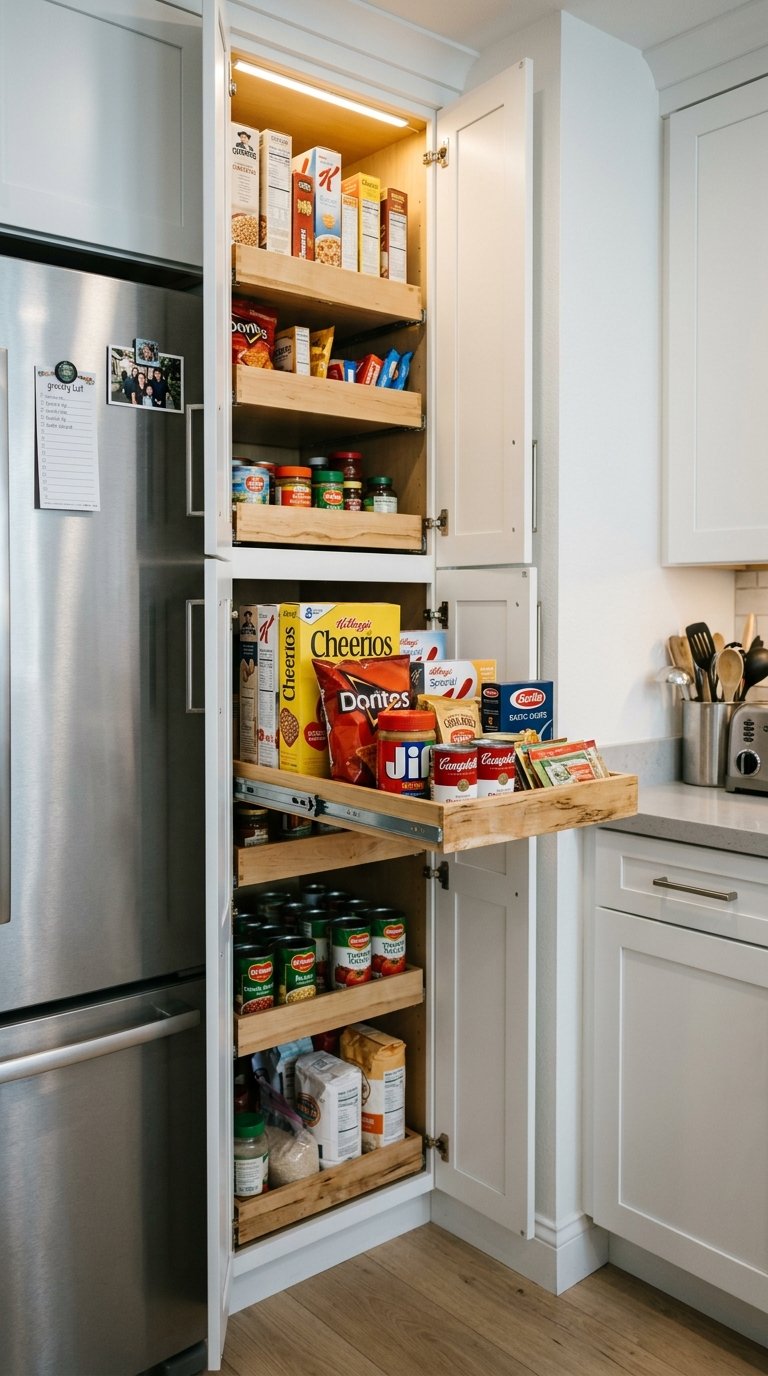
Building a narrow pantry tower between two appliances or between an appliance and a wall maximizes the vertical space that most kitchens ignore entirely. A 12-inch wide tower cabinet at 84 inches tall holds the equivalent volume of three standard base cabinets in a footprint smaller than a microwave.
Stock 12-inch wide pantry tower cabinets from Home Depot’s Hampton Bay line cost $180 to $280. Add interior pull-out organizers from Rev-A-Shelf for $80 to $120 to convert the fixed shelves into accessible pull-out trays. The total installed cost stays under $500 and adds a dedicated pantry column in a kitchen that had no pantry space at all.
15. Walk-In Pantry With Zone Organization
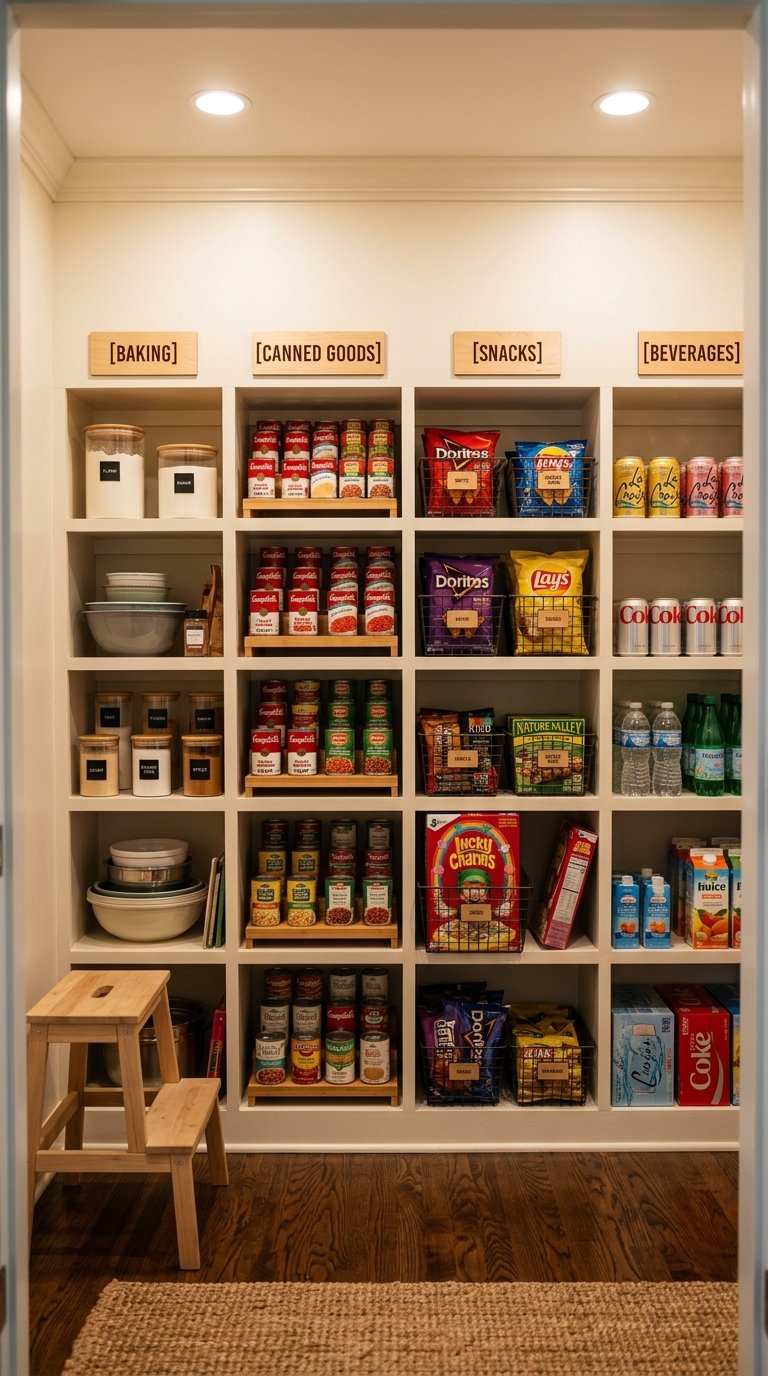
A walk-in pantry organized into dedicated zones, baking, canned goods, snacks, beverages, small appliances, performs at a higher functional level than the same space filled with random shelving. Zone organization reduces the time spent searching for items by an estimated 40 percent compared to unzoned storage, according to organization research from the National Association of Productivity and Organizing Professionals.
Assign the lowest shelves to heavy items such as canned goods and appliances, mid shelves to daily use items, and upper shelves to bulk overflow and rarely used items. Use uniform bin labels from a Brother P-Touch printer at $30 to mark each zone clearly. The physical materials cost nothing beyond the label maker, and the functional improvement is immediate.
16. Pantry Cabinet With Glass-Front Doors
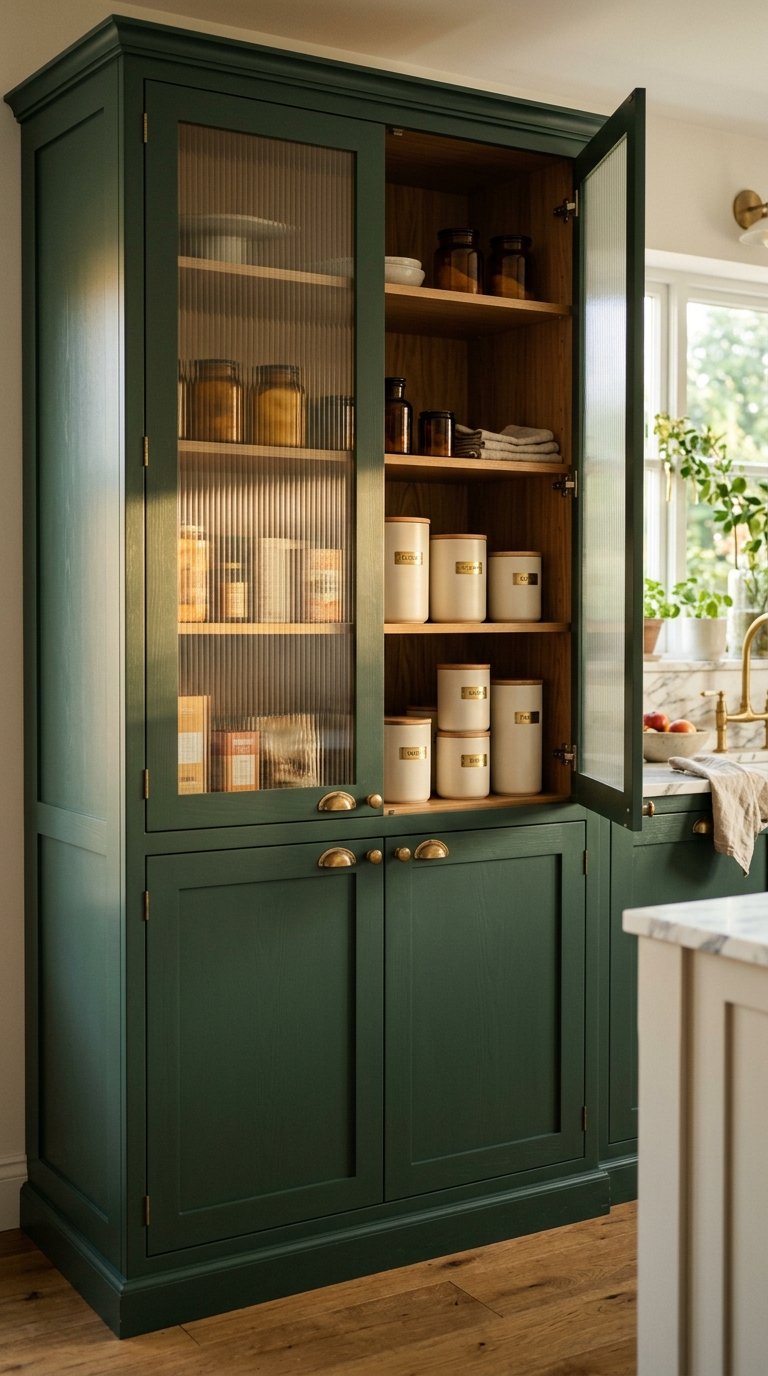
Glass-front pantry cabinet doors force you to keep the interior organized because the contents are always visible. That visual accountability produces a more consistently organized pantry than any closed-door system.
Replace solid cabinet doors with glass-insert doors from Semihandmade at $85 to $150 per door for IKEA SEKTION cabinets. Use seeded or reeded glass rather than clear glass if you want the visual warmth of glass without full transparency. The reeded glass diffuses the view slightly, softening any organizational imperfection while still letting light and color read through the door.
17. Pantry Drawers at Base Level for Heavy Items
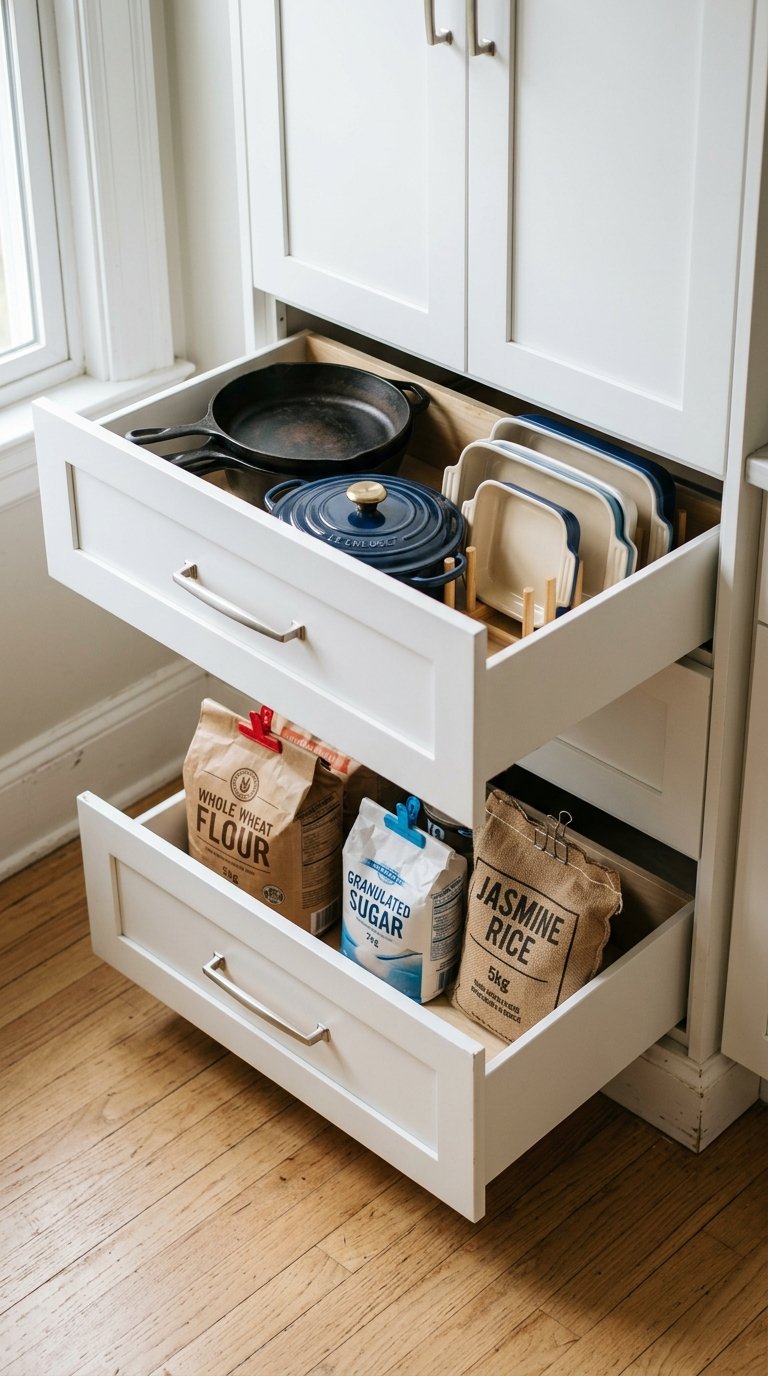
Base-level drawers in a pantry cabinet store heavy items such as cast iron, small appliances, and bulk bags more safely than shelves do. Pulling a drawer forward eliminates the need to lift heavy items from a low shelf, which reduces the risk of back strain and dropped items.
IKEA’s SEKTION base cabinet with two drawers costs $180 to $220 and supports up to 44 pounds per drawer on full-extension soft-close runners. Position the drawer pantry section at the base of a tall pantry column below three to four shelf levels. The drawer section handles weight where shelves create problems, and the shelves above handle lightweight items where drawers would be overkill.
18. Tiered Shelf Risers Inside a Pantry Cabinet
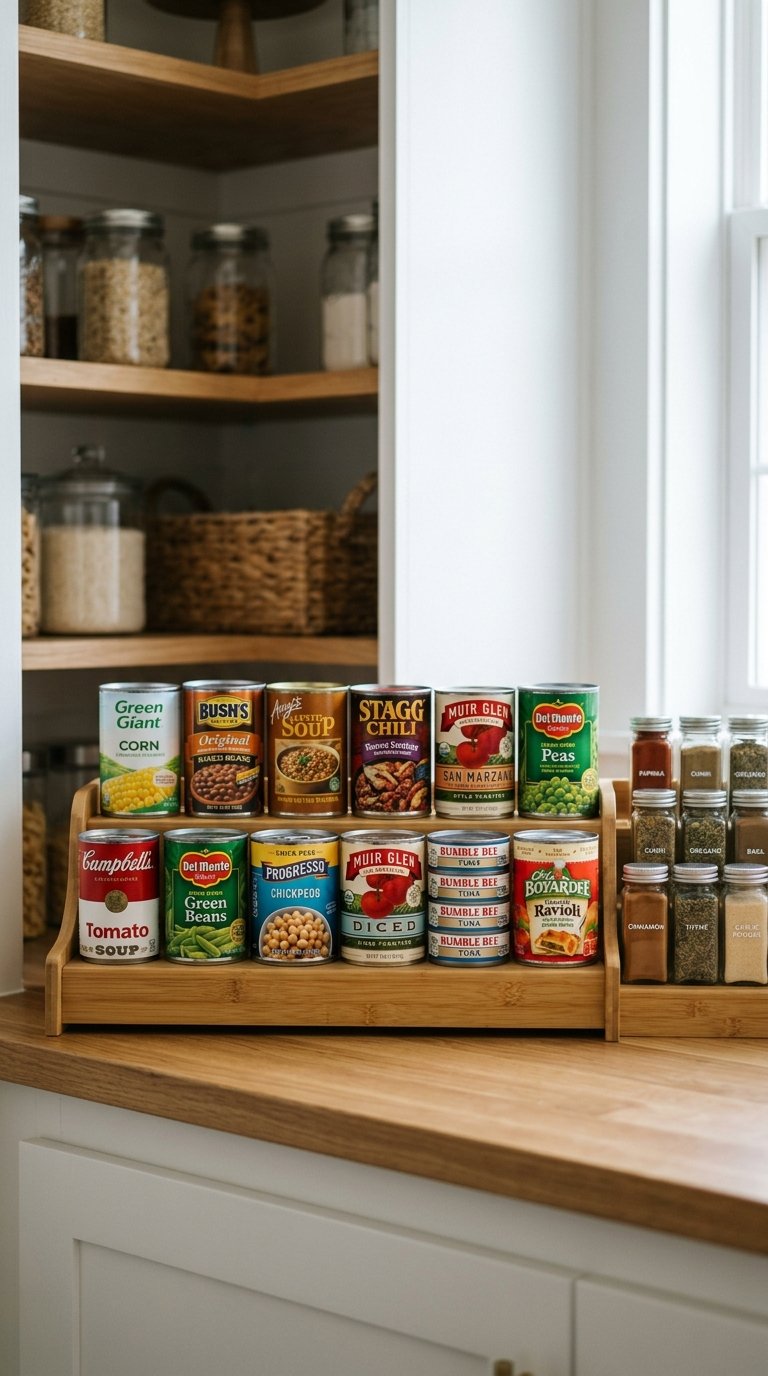
Tiered shelf risers inside a pantry cabinet double the usable depth of a single shelf by creating two visible rows of items on one shelf level. Without a riser, items at the back of a 14-inch deep shelf get hidden behind items at the front.
Bamboo shelf risers from SimpleHouseware at $18 to $25 for a two-tier set add a second row at the back of any pantry shelf. Use them specifically for canned goods, spice jars, and condiment bottles where the height difference between front and back rows is minimal. The $25 investment recovers the equivalent of one full additional shelf of visible storage space.
19. Pantry With a Built-In Charging and Small Appliance Station
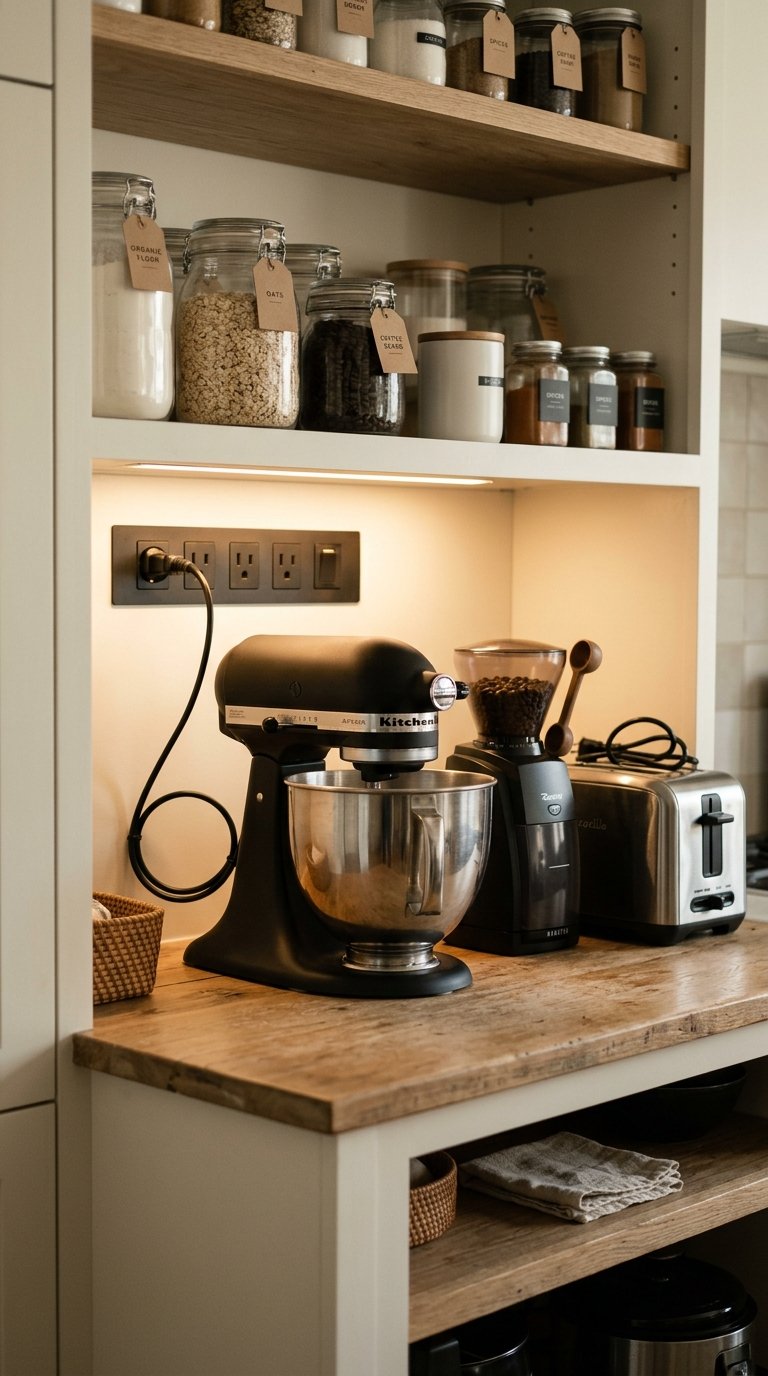
A built-in charging and small appliance station inside a deep pantry cabinet keeps countertop appliances off the main kitchen counter and plugged in at all times. Toasters, coffee grinders, stand mixers, and blenders all consume significant counter space when stored on the main kitchen surface.
Install a recessed electrical outlet strip from Legrand’s Wiremold line at $45 inside the pantry cabinet at the back of a 24-inch deep shelf. Set the shelf height to 18 to 20 inches to accommodate a stand mixer or blender. The appliance slides out for use and returns to the pantry without any cord management problem because the outlet lives inside the cabinet.
20. Floating Shelf Pantry Wall in an Alcove or Niche
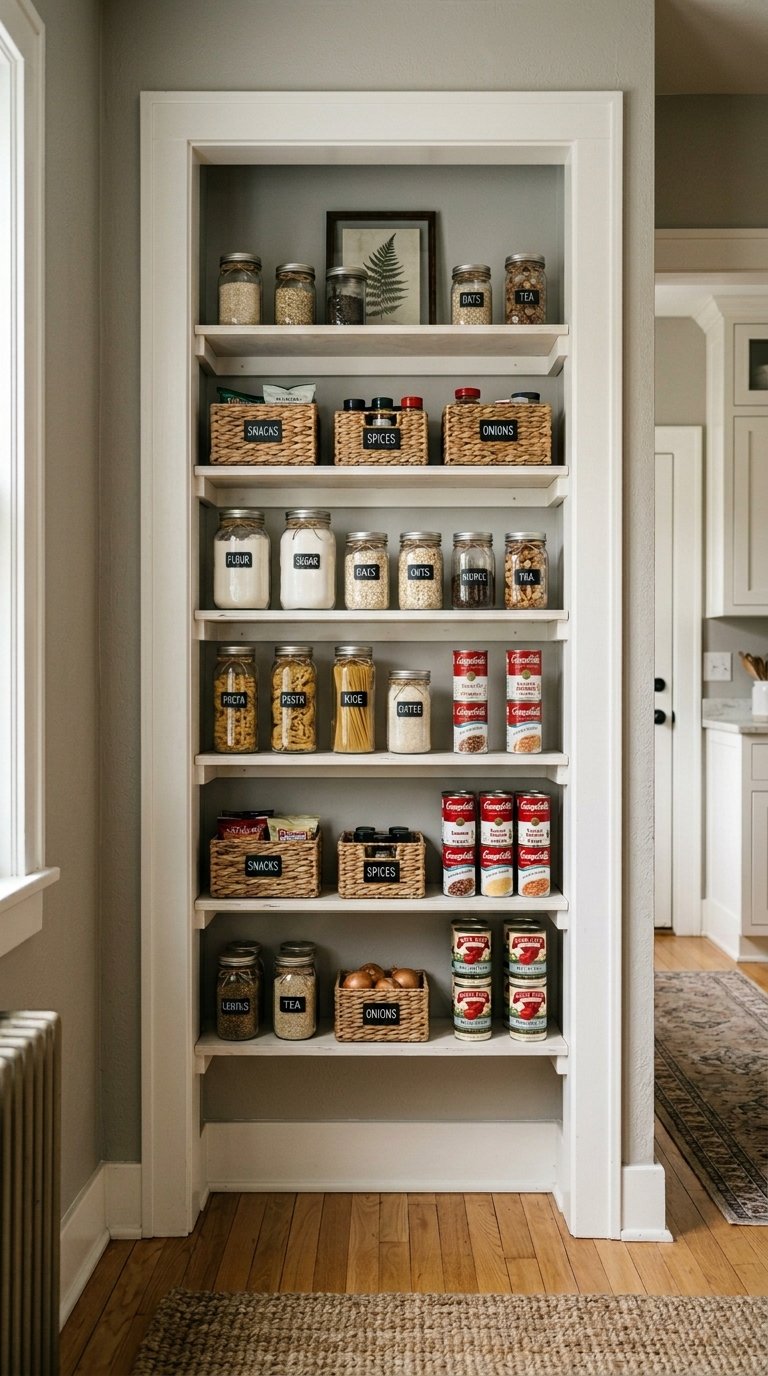
A floating shelf pantry wall built into an existing alcove or wall niche uses recessed space that no freestanding or surface-mounted shelving system reaches. Most homes have at least one wall with a 4 to 6-inch recess between studs, and a recessed pantry shelf built into that space adds storage without reducing floor area.
Build recessed pantry shelves between studs using 3/4-inch plywood cut to fit and painted with Benjamin Moore’s Advance paint in a satin finish for durability. A standard 16-inch stud bay at 8 feet tall holds four to six shelves at 12 to 15 inches of spacing. The total material cost for a single stud bay recessed pantry unit runs $60 to $120 in plywood and paint.
21. Pantry With Wire Basket Pull-Outs for Produce
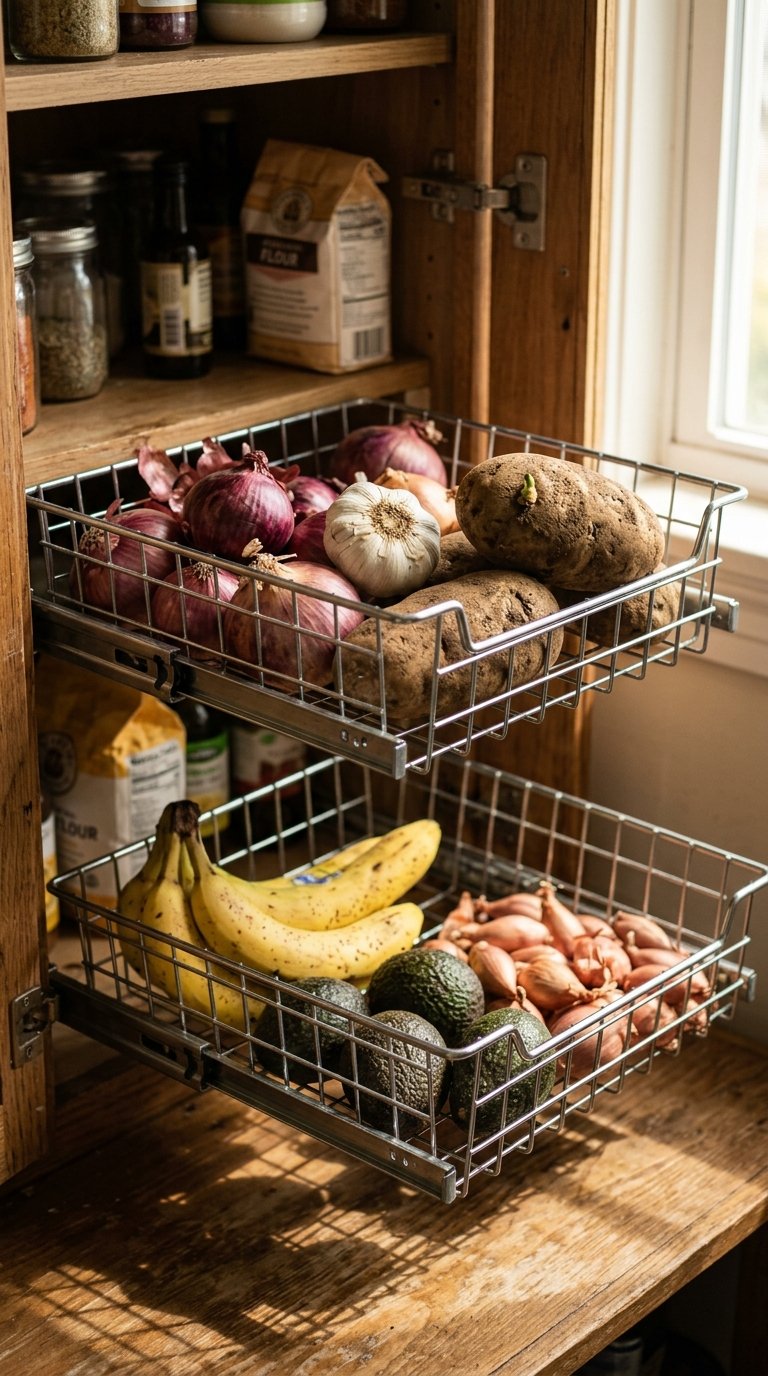
Wire basket pull-outs at mid-height in a pantry cabinet provide ventilated storage for produce, potatoes, onions, and garlic that keeps them cooler and better ventilated than a solid shelf or drawer. Proper airflow around root vegetables and alliums extends their usable life by one to two weeks compared to closed container storage.
Rev-A-Shelf’s ventilated pull-out wire baskets in a 14-inch or 18-inch width cost $55 to $90 per basket. Install two or three baskets at mid-shelf height in a pantry cabinet section dedicated to produce and bulk dry goods. The open wire construction also prevents the moisture buildup that leads to premature spoilage on solid shelves.
22. Modular Pantry System With Adjustable Components
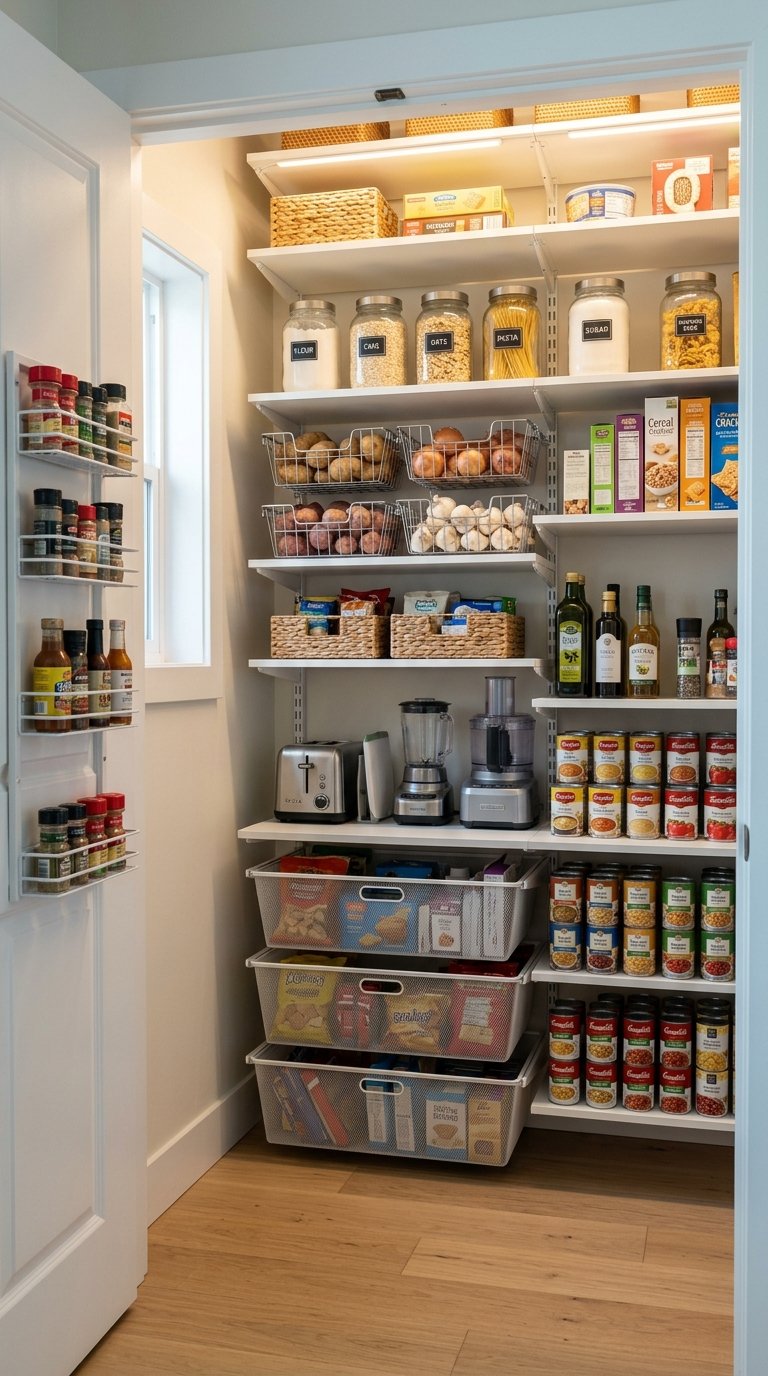
A modular pantry system with fully adjustable shelves, drawers, and inserts adapts to your changing storage needs without requiring a new cabinet installation every time your pantry requirements shift. A family with young children has completely different pantry storage needs than the same family five years later, and a fixed system never adjusts.
The Container Store’s ELFA modular system costs $4 to $12 per component and covers shelves, drawers, door racks, and specialty inserts in a single compatible system. A full pantry wall in ELFA runs $300 to $800 depending on configuration. Every component repositions in minutes with a screwdriver.
23. Pantry Cabinet Doors Replaced With Curtain Panels
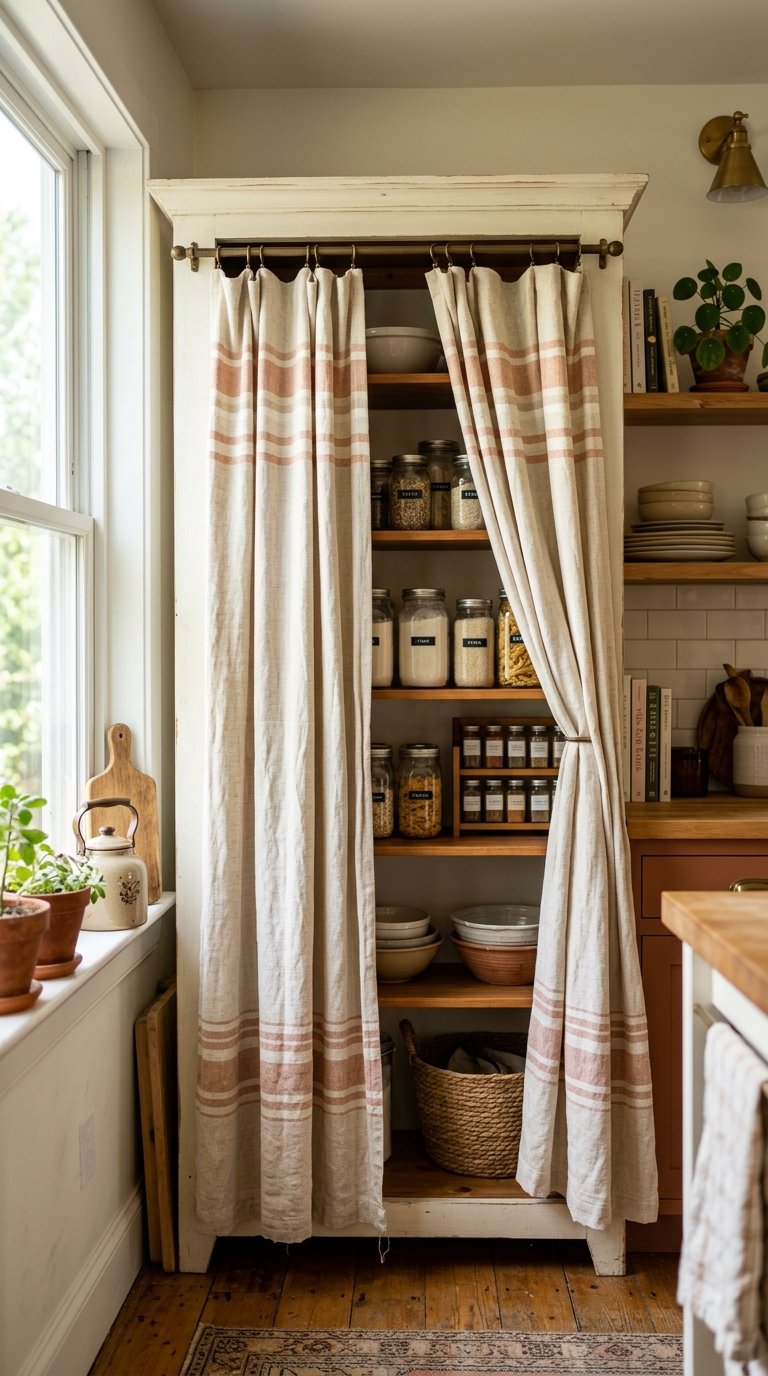
Replacing pantry cabinet doors with fabric curtain panels solves the rental restriction problem, reduces the door swing clearance requirement, and adds a soft texture to a kitchen that reads as too hard and cold. The curtain panels hang on a tension rod or a simple cafe rod inside the cabinet opening and pull aside rather than swinging out.
IKEA’s ANNO TULPAN curtain panels at $8 to $15 per pair fit standard cabinet openings when cut to length. Use a tension rod from Amazon at $8 to $12 per rod for a no-drill installation. The total cost per cabinet opening stays under $30, and the swap from hard cabinet doors to fabric panels takes under 15 minutes per opening.
Final Thoughts
Your pantry problem is always a space problem or an access problem. Either you do not have enough storage volume, or the storage you have does not give you clear sight and easy reach to everything inside it.
Every idea on this list addresses one or both of those problems with a specific product, a real price point, and a clear reason it works better than what you are doing now. You have options from $25 tiered risers to a $1,400 freestanding armoire, from a magnetic spice wall that costs $60 to a full walk-in pantry conversion for $800. Pick the idea that solves your specific problem first, and the rest of your pantry organization follows naturally from there.